 Add to Chrome
 Add to Firefox
 Add to Edge
On Scalability of Multi-Objective Evolutionary Algorithms on Combinatorial Optimisation Problems
Apr 20, 2026
Scalability of evolutionary algorithms refers to assessing how their performance changes as problem size increases. In the area of multi-objective optimisation, research on the scalability of multi-objective evolutionary algorithms (MOEAs) has predominantly focussed on continuous problems. However, multi-objective combinatorial optimisation problems (MOCOPs) differ from continuous ones. Their discrete and rigid structure often brings rugged landscape, numerous local optimal solutions and disjoint global optimal regions. This leads to different behaviour of MOEAs. For example, SEMO, a simple MOEA without mating selection and diversity maintenance mechanisms, has been shown to be highly competitive, and in many cases to outperform more sophisticated MOEAs on MOCOPs. Yet, it remains unclear whether such findings hold for large-scale cases. In this paper, we conduct an empirical investigation into the scalability of MOEAs on combinatorial problems, with problem size from 50 to 5,000. Our results show that SEMO experiences a decline in convergence speed as dimensionality increases, compared to other MOEAs such as NSGA-II, SMS-EMOA and MOEA/D. We further demonstrate that the absence of crossover is a major contributor to SEMO's underperformance in large-scale problems, and that incorporating crossover into SEMO can substantially accelerate convergence in general, despite being detrimental in spreading solutions over the Pareto front.

Variable Search Stepsize for Randomized Local Search in Multi-Objective Combinatorial Optimization
Feb 05, 2026Over the past two decades, research in evolutionary multi-objective optimization has predominantly focused on continuous domains, with comparatively limited attention given to multi-objective combinatorial optimization problems (MOCOPs). Combinatorial problems differ significantly from continuous ones in terms of problem structure and landscape. Recent studies have shown that on MOCOPs multi-objective evolutionary algorithms (MOEAs) can even be outperformed by simple randomised local search. Starting with a randomly sampled solution in search space, randomised local search iteratively draws a random solution (from an archive) to perform local variation within its neighbourhood. However, in most existing methods, the local variation relies on a fixed neighbourhood, which limits exploration and makes the search easy to get trapped in local optima. In this paper, we present a simple yet effective local search method, called variable stepsize randomized local search (VS-RLS), which adjusts the stepsize during the search. VS-RLS transitions gradually from a broad, exploratory search in the early phases to a more focused, fine-grained search as the search progresses. We demonstrate the effectiveness and generalizability of VS-RLS through extensive evaluations against local search and MOEAs methods on diverse MOCOPs.
Random is Faster than Systematic in Multi-Objective Local Search
Jan 09, 2026Local search is a fundamental method in operations research and combinatorial optimisation. It has been widely applied to a variety of challenging problems, including multi-objective optimisation where multiple, often conflicting, objectives need to be simultaneously considered. In multi-objective local search algorithms, a common practice is to maintain an archive of all non-dominated solutions found so far, from which the algorithm iteratively samples a solution to explore its neighbourhood. A central issue in this process is how to explore the neighbourhood of a selected solution. In general, there are two main approaches: 1) systematic exploration and 2) random sampling. The former systematically explores the solution's neighbours until a stopping condition is met -- for example, when the neighbourhood is exhausted (i.e., the best improvement strategy) or once a better solution is found (i.e., first improvement). In contrast, the latter randomly selects and evaluates only one neighbour of the solution. One may think systematic exploration may be more efficient, as it prevents from revisiting the same neighbours multiple times. In this paper, however, we show that this may not be the case. We first empirically demonstrate that the random sampling method is consistently faster than the systematic exploration method across a range of multi-objective problems. We then give an intuitive explanation for this phenomenon using toy examples, showing that the superior performance of the random sampling method relies on the distribution of ``good neighbours''. Next, we show that the number of such neighbours follows a certain probability distribution during the search. Lastly, building on this distribution, we provide a theoretical insight for why random sampling is more efficient than systematic exploration, regardless of whether the best improvement or first improvement strategy is used.
Not Just for Archiving: Provable Benefits of Reusing the Archive in Evolutionary Multi-objective Optimization
Aug 23, 2025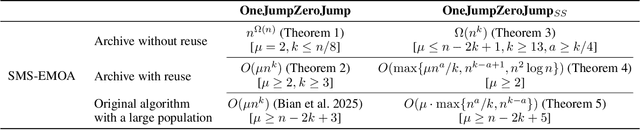
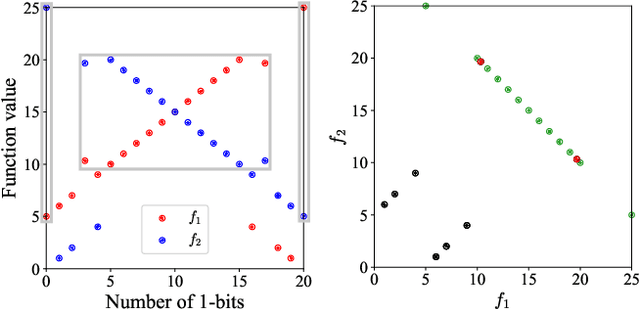
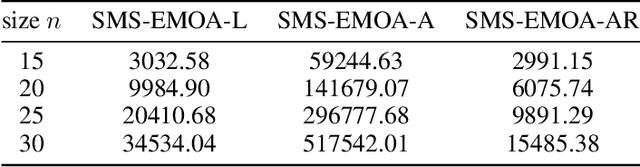
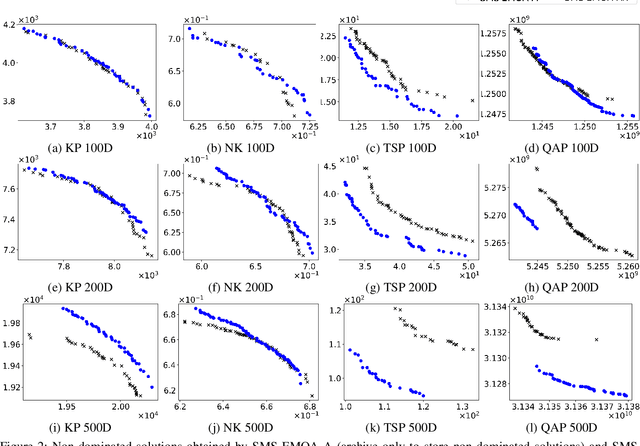
Evolutionary Algorithms (EAs) have become the most popular tool for solving widely-existed multi-objective optimization problems. In Multi-Objective EAs (MOEAs), there is increasing interest in using an archive to store non-dominated solutions generated during the search. This approach can 1) mitigate the effects of population oscillation, a common issue in many MOEAs, and 2) allow for the use of smaller, more practical population sizes. In this paper, we analytically show that the archive can even further help MOEAs through reusing its solutions during the process of new solution generation. We first prove that using a small population size alongside an archive (without incorporating archived solutions in the generation process) may fail on certain problems, as the population may remove previously discovered but promising solutions. We then prove that reusing archive solutions can overcome this limitation, resulting in at least a polynomial speedup on the expected running time. Our analysis focuses on the well-established SMS-EMOA algorithm applied to the commonly studied OneJumpZeroJump problem as well as one of its variants. We also show that reusing archive solutions can be better than using a large population size directly. Finally, we show that our theoretical findings can generally hold in practice by experiments on four well-known practical optimization problems -- multi-objective 0-1 Knapsack, TSP, QAP and NK-landscape problems -- with realistic settings.
When to Truncate the Archive? On the Effect of the Truncation Frequency in Multi-Objective Optimisation
Apr 02, 2025Using an archive to store nondominated solutions found during the search of a multi-objective evolutionary algorithm (MOEA) is a useful practice. However, as nondominated solutions of a multi-objective optimisation problem can be enormous or infinitely many, it is desirable to provide the decision-maker with only a small, representative portion of all the nondominated solutions in the archive, thus entailing a truncation operation. Then, an important issue is when to truncate the archive. This can be done once a new solution generated, a batch of new solutions generated, or even using an unbounded archive to keep all nondominated solutions generated and truncate it later. Intuitively, the last approach may lead to a better result since we have all the information in hand before performing the truncation. In this paper, we study this issue and investigate the effect of the timing of truncating the archive. We apply well-established truncation criteria that are commonly used in the population maintenance procedure of MOEAs (e.g., crowding distance, hypervolume indicator, and decomposition). We show that, interestingly, truncating the archive once a new solution generated tends to be the best, whereas considering an unbounded archive is often the worst. We analyse and discuss this phenomenon. Our results highlight the importance of developing effective subset selection techniques (rather than employing the population maintenance methods in MOEAs) when using a large archive.
Multi-objective Pseudo Boolean Functions in Runtime Analysis: A Review
Mar 24, 2025Recently, there has been growing interest within the theoretical community in analytically studying multi-objective evolutionary algorithms. This runtime analysis-focused research can help formally understand algorithm behaviour, explain empirical observations, and provide theoretical insights to support algorithm development and exploration. However, the test problems commonly used in the theoretical analysis are predominantly limited to problems with heavy ``artificial'' characteristics (e.g., symmetric objectives and linear Pareto fronts), which may not be able to well represent realistic scenarios. In this paper, we survey commonly used multi-objective functions in the theory domain and systematically review their features, limitations and implications to practical use. Moreover, we present several new functions with more realistic features, such as local optimality and nonlinearity of the Pareto front, through simply mixing and matching classical single-objective functions in the area (e.g., LeadingOnes, Jump and RoyalRoad). We hope these functions can enrich the existing test problem suites, and strengthen the connection between theoretic and practical research.
Stochastic Population Update Provably Needs An Archive in Evolutionary Multi-objective Optimization
Jan 28, 2025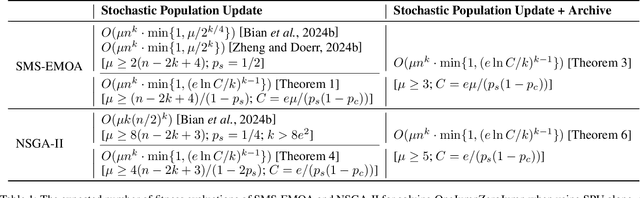


Evolutionary algorithms (EAs) have been widely applied to multi-objective optimization, due to their nature of population-based search. Population update, a key component in multi-objective EAs (MOEAs), is usually performed in a greedy, deterministic manner. However, recent studies have questioned this practice and shown that stochastic population update (SPU), which allows inferior solutions have a chance to be preserved, can help MOEAs jump out of local optima more easily. While introducing randomness in the population update process boosts the exploration of MOEAs, there is a drawback that the population may not always preserve the very best solutions found, thus entailing a large population. Intuitively, a possible solution to this issue is to introduce an archive that stores the best solutions ever found. In this paper, we theoretically show that using an archive can allow a small population and accelerate the search of SPU-based MOEAs substantially. Specifically, we analyze the expected running time of two well-established MOEAs, SMS-EMOA and NSGA-II, with SPU for solving a commonly studied bi-objective problem OneJumpZeroJump, and prove that using an archive can bring (even exponential) speedups. The comparison between SMS-EMOA and NSGA-II also suggests that the $(\mu+\mu)$ update mode may be more suitable for SPU than the $(\mu+1)$ update mode. Furthermore, our derived running time bounds for using SPU alone are significantly tighter than previously known ones. Our theoretical findings are also empirically validated on a well-known practical problem, the multi-objective traveling salesperson problem. We hope this work may provide theoretical support to explore different ideas of designing algorithms in evolutionary multi-objective optimization.
Non-Elitist Evolutionary Multi-Objective Optimisation: Proof-of-Principle Results
May 26, 2023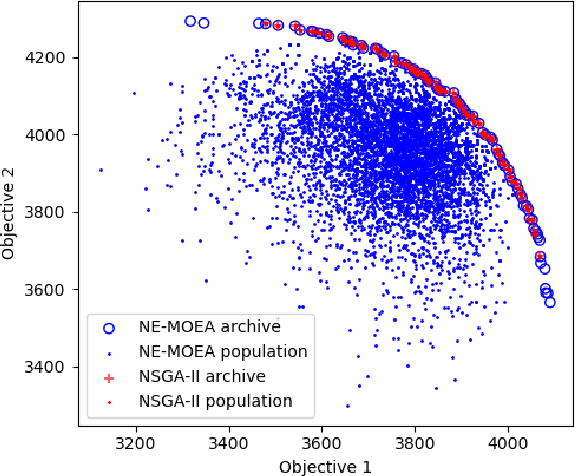
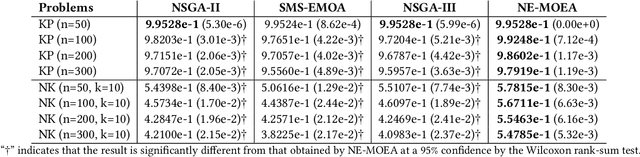
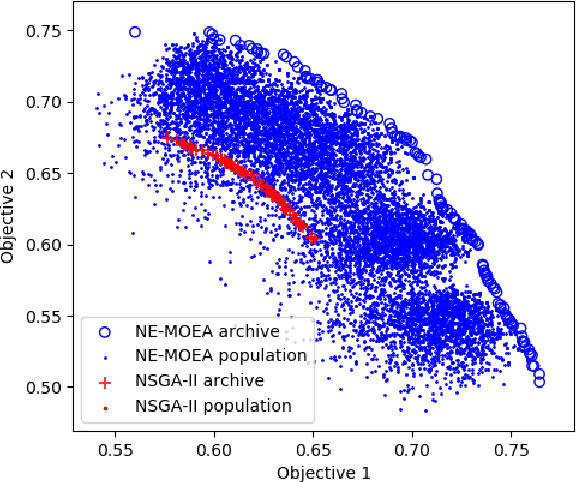
Elitism, which constructs the new population by preserving best solutions out of the old population and newly-generated solutions, has been a default way for population update since its introduction into multi-objective evolutionary algorithms (MOEAs) in the late 1990s. In this paper, we take an opposite perspective to conduct the population update in MOEAs by simply discarding elitism. That is, we treat the newly-generated solutions as the new population directly (so that all selection pressure comes from mating selection). We propose a simple non-elitist MOEA (called NE-MOEA) that only uses Pareto dominance sorting to compare solutions, without involving any diversity-related selection criterion. Preliminary experimental results show that NE-MOEA can compete with well-known elitist MOEAs (NSGA-II, SMS-EMOA and NSGA-III) on several combinatorial problems. Lastly, we discuss limitations of the proposed non-elitist algorithm and suggest possible future research directions.