 Add to Chrome
 Add to Firefox
 Add to Edge
DRGW: Learning Disentangled Representations for Robust Graph Watermarking
Jan 21, 2026
Graph-structured data is foundational to numerous web applications, and watermarking is crucial for protecting their intellectual property and ensuring data provenance. Existing watermarking methods primarily operate on graph structures or entangled graph representations, which compromise the transparency and robustness of watermarks due to the information coupling in representing graphs and uncontrollable discretization in transforming continuous numerical representations into graph structures. This motivates us to propose DRGW, the first graph watermarking framework that addresses these issues through disentangled representation learning. Specifically, we design an adversarially trained encoder that learns an invariant structural representation against diverse perturbations and derives a statistically independent watermark carrier, ensuring both robustness and transparency of watermarks. Meanwhile, we devise a graph-aware invertible neural network to provide a lossless channel for watermark embedding and extraction, guaranteeing high detectability and transparency of watermarks. Additionally, we develop a structure-aware editor that resolves the issue of latent modifications into discrete graph edits, ensuring robustness against structural perturbations. Experiments on diverse benchmark datasets demonstrate the superior effectiveness of DRGW.

Attesting Model Lineage by Consisted Knowledge Evolution with Fine-Tuning Trajectory
Jan 16, 2026The fine-tuning technique in deep learning gives rise to an emerging lineage relationship among models. This lineage provides a promising perspective for addressing security concerns such as unauthorized model redistribution and false claim of model provenance, which are particularly pressing in \textcolor{blue}{open-weight model} libraries where robust lineage verification mechanisms are often lacking. Existing approaches to model lineage detection primarily rely on static architectural similarities, which are insufficient to capture the dynamic evolution of knowledge that underlies true lineage relationships. Drawing inspiration from the genetic mechanism of human evolution, we tackle the problem of model lineage attestation by verifying the joint trajectory of knowledge evolution and parameter modification. To this end, we propose a novel model lineage attestation framework. In our framework, model editing is first leveraged to quantify parameter-level changes introduced by fine-tuning. Subsequently, we introduce a novel knowledge vectorization mechanism that refines the evolved knowledge within the edited models into compact representations by the assistance of probe samples. The probing strategies are adapted to different types of model families. These embeddings serve as the foundation for verifying the arithmetic consistency of knowledge relationships across models, thereby enabling robust attestation of model lineage. Extensive experimental evaluations demonstrate the effectiveness and resilience of our approach in a variety of adversarial scenarios in the real world. Our method consistently achieves reliable lineage verification across a broad spectrum of model types, including classifiers, diffusion models, and large language models.
Know2Vec: A Black-Box Proxy for Neural Network Retrieval
Dec 20, 2024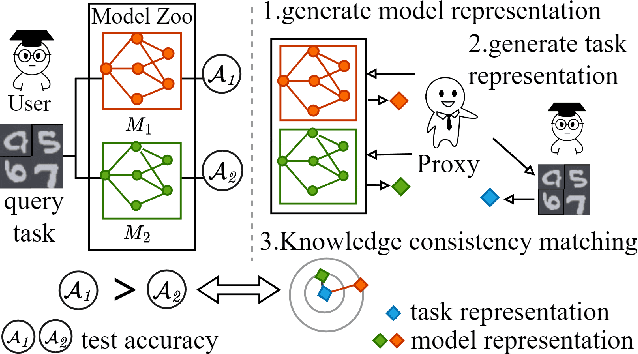
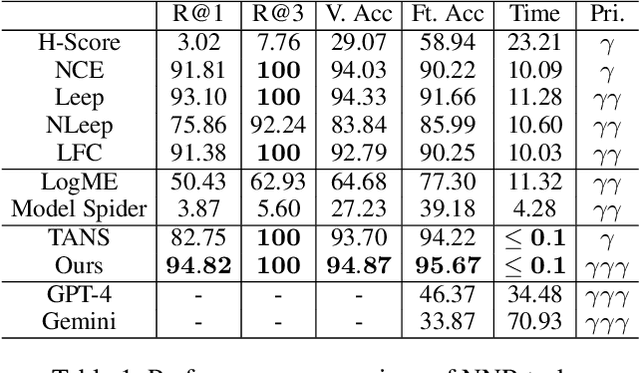
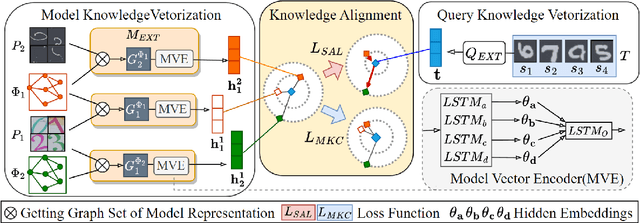
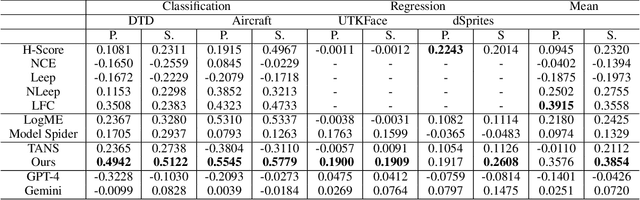
For general users, training a neural network from scratch is usually challenging and labor-intensive. Fortunately, neural network zoos enable them to find a well-performing model for directly use or fine-tuning it in their local environments. Although current model retrieval solutions attempt to convert neural network models into vectors to avoid complex multiple inference processes required for model selection, it is still difficult to choose a suitable model due to inaccurate vectorization and biased correlation alignment between the query dataset and models. From the perspective of knowledge consistency, i.e., whether the knowledge possessed by the model can meet the needs of query tasks, we propose a model retrieval scheme, named Know2Vec, that acts as a black-box retrieval proxy for model zoo. Know2Vec first accesses to models via a black-box interface in advance, capturing vital decision knowledge from models while ensuring their privacy. Next, it employs an effective encoding technique to transform the knowledge into precise model vectors. Secondly, it maps the user's query task to a knowledge vector by probing the semantic relationships within query samples. Furthermore, the proxy ensures the knowledge-consistency between query vector and model vectors within their alignment space, which is optimized through the supervised learning with diverse loss functions, and finally it can identify the most suitable model for a given task during the inference stage. Extensive experiments show that our Know2Vec achieves superior retrieval accuracy against the state-of-the-art methods in diverse neural network retrieval tasks.