 Add to Chrome
 Add to Firefox
 Add to Edge
Agentic Software Issue Resolution with Large Language Models: A Survey
Dec 24, 2025
Software issue resolution aims to address real-world issues in software repositories (e.g., bug fixing and efficiency optimization) based on natural language descriptions provided by users, representing a key aspect of software maintenance. With the rapid development of large language models (LLMs) in reasoning and generative capabilities, LLM-based approaches have made significant progress in automated software issue resolution. However, real-world software issue resolution is inherently complex and requires long-horizon reasoning, iterative exploration, and feedback-driven decision making, which demand agentic capabilities beyond conventional single-step approaches. Recently, LLM-based agentic systems have become mainstream for software issue resolution. Advancements in agentic software issue resolution not only greatly enhance software maintenance efficiency and quality but also provide a realistic environment for validating agentic systems' reasoning, planning, and execution capabilities, bridging artificial intelligence and software engineering. This work presents a systematic survey of 126 recent studies at the forefront of LLM-based agentic software issue resolution research. It outlines the general workflow of the task and establishes a taxonomy across three dimensions: benchmarks, techniques, and empirical studies. Furthermore, it highlights how the emergence of agentic reinforcement learning has brought a paradigm shift in the design and training of agentic systems for software engineering. Finally, it summarizes key challenges and outlines promising directions for future research.

CoSIL: Software Issue Localization via LLM-Driven Code Repository Graph Searching
Mar 28, 2025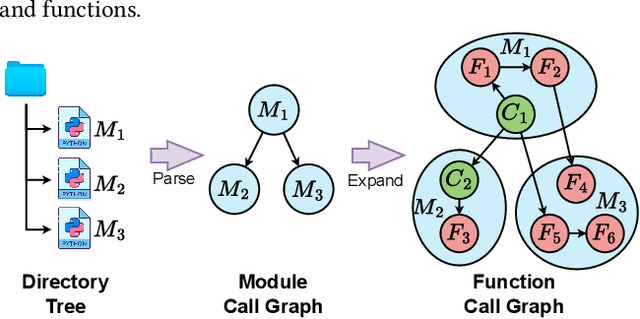

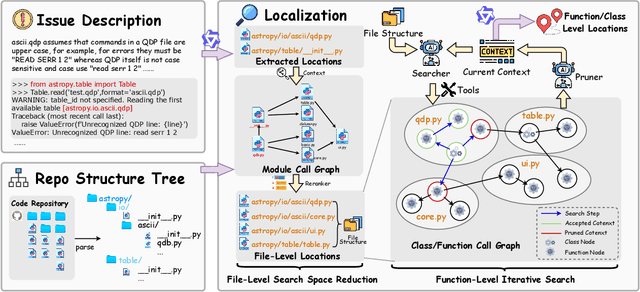
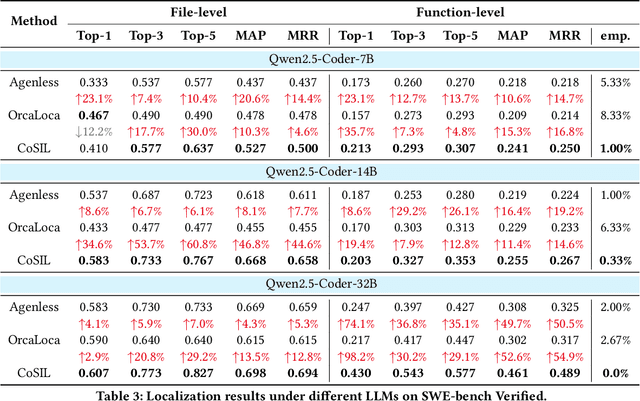
Large language models (LLMs) have significantly advanced autonomous software engineering, leading to a growing number of software engineering agents that assist developers in automatic program repair. Issue localization forms the basis for accurate patch generation. However, because of limitations caused by the context window length of LLMs, existing issue localization methods face challenges in balancing concise yet effective contexts and adequately comprehensive search spaces. In this paper, we introduce CoSIL, an LLM driven, simple yet powerful function level issue localization method without training or indexing. CoSIL reduces the search space through module call graphs, iteratively searches the function call graph to obtain relevant contexts, and uses context pruning to control the search direction and manage contexts effectively. Importantly, the call graph is dynamically constructed by the LLM during search, eliminating the need for pre-parsing. Experiment results demonstrate that CoSIL achieves a Top-1 localization success rate of 43 percent and 44.6 percent on SWE bench Lite and SWE bench Verified, respectively, using Qwen2.5 Coder 32B, outperforming existing methods by 8.6 to 98.2 percent. When CoSIL is applied to guide the patch generation stage, the resolved rate further improves by 9.3 to 31.5 percent.