 Add to Chrome
 Add to Firefox
 Add to Edge
ThermoSplat: Cross-Modal 3D Gaussian Splatting with Feature Modulation and Geometry Decoupling
Jan 22, 2026
Multi-modal scene reconstruction integrating RGB and thermal infrared data is essential for robust environmental perception across diverse lighting and weather conditions. However, extending 3D Gaussian Splatting (3DGS) to multi-spectral scenarios remains challenging. Current approaches often struggle to fully leverage the complementary information of multi-modal data, typically relying on mechanisms that either tend to neglect cross-modal correlations or leverage shared representations that fail to adaptively handle the complex structural correlations and physical discrepancies between spectrums. To address these limitations, we propose ThermoSplat, a novel framework that enables deep spectral-aware reconstruction through active feature modulation and adaptive geometry decoupling. First, we introduce a Cross-Modal FiLM Modulation mechanism that dynamically conditions shared latent features on thermal structural priors, effectively guiding visible texture synthesis with reliable cross-modal geometric cues. Second, to accommodate modality-specific geometric inconsistencies, we propose a Modality-Adaptive Geometric Decoupling scheme that learns independent opacity offsets and executes an independent rasterization pass for the thermal branch. Additionally, a hybrid rendering pipeline is employed to integrate explicit Spherical Harmonics with implicit neural decoding, ensuring both semantic consistency and high-frequency detail preservation. Extensive experiments on the RGBT-Scenes dataset demonstrate that ThermoSplat achieves state-of-the-art rendering quality across both visible and thermal spectrums.

Non-local Channel Aggregation Network for Single Image Rain Removal
Mar 03, 2021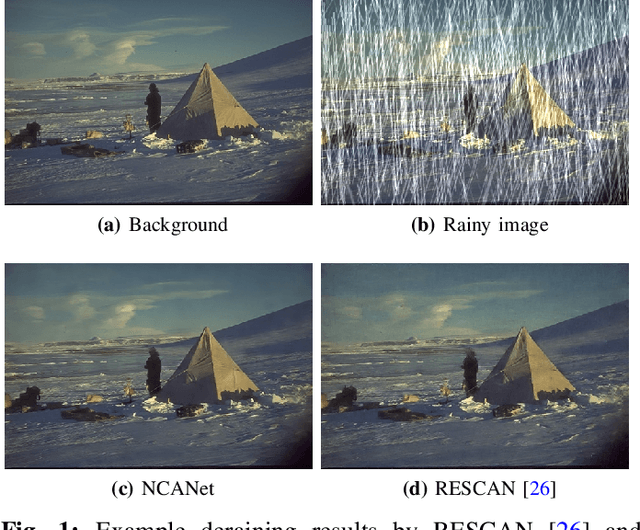
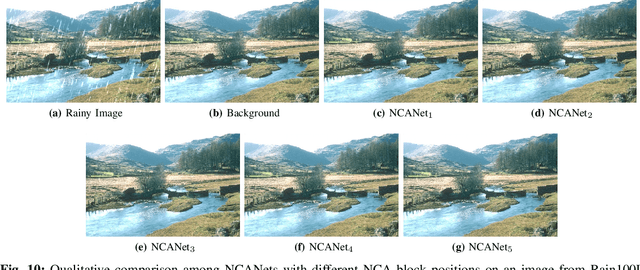
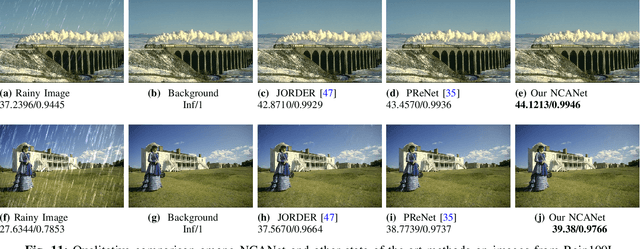
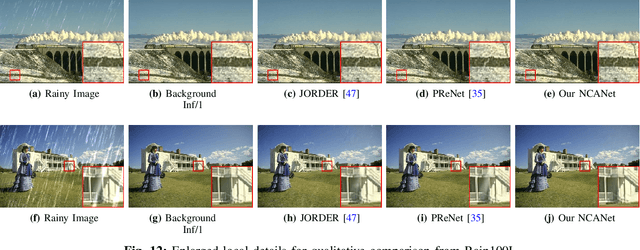
Rain streaks showing in images or videos would severely degrade the performance of computer vision applications. Thus, it is of vital importance to remove rain streaks and facilitate our vision systems. While recent convolutinal neural network based methods have shown promising results in single image rain removal (SIRR), they fail to effectively capture long-range location dependencies or aggregate convolutional channel information simultaneously. However, as SIRR is a highly illposed problem, these spatial and channel information are very important clues to solve SIRR. First, spatial information could help our model to understand the image context by gathering long-range dependency location information hidden in the image. Second, aggregating channels could help our model to concentrate on channels more related to image background instead of rain streaks. In this paper, we propose a non-local channel aggregation network (NCANet) to address the SIRR problem. NCANet models 2D rainy images as sequences of vectors in three directions, namely vertical direction, transverse direction and channel direction. Recurrently aggregating information from all three directions enables our model to capture the long-range dependencies in both channels and spaitials locations. Extensive experiments on both heavy and light rain image data sets demonstrate the effectiveness of the proposed NCANet model.