 Add to Chrome
 Add to Firefox
 Add to Edge
Real-Time 4D Radar Perception for Robust Human Detection in Harsh Enclosed Environments
Jan 19, 2026
This paper introduces a novel methodology for generating controlled, multi-level dust concentrations in a highly cluttered environment representative of harsh, enclosed environments, such as underground mines, road tunnels, or collapsed buildings, enabling repeatable mm-wave propagation studies under severe electromagnetic constraints. We also present a new 4D mmWave radar dataset, augmented by camera and LiDAR, illustrating how dust particles and reflective surfaces jointly impact the sensing functionality. To address these challenges, we develop a threshold-based noise filtering framework leveraging key radar parameters (RCS, velocity, azimuth, elevation) to suppress ghost targets and mitigate strong multipath reflections at the raw data level. Building on the filtered point clouds, a cluster-level, rule-based classification pipeline exploits radar semantics-velocity, RCS, and volumetric spread-to achieve reliable, real-time pedestrian detection without extensive domainspecific training. Experimental results confirm that this integrated approach significantly enhances clutter mitigation, detection robustness, and overall system resilience in dust-laden mining environments.

A Lightweight Model-Driven 4D Radar Framework for Pervasive Human Detection in Harsh Conditions
Jan 19, 2026Pervasive sensing in industrial and underground environments is severely constrained by airborne dust, smoke, confined geometry, and metallic structures, which rapidly degrade optical and LiDAR based perception. Elevation resolved 4D mmWave radar offers strong resilience to such conditions, yet there remains a limited understanding of how to process its sparse and anisotropic point clouds for reliable human detection in enclosed, visibility degraded spaces. This paper presents a fully model-driven 4D radar perception framework designed for real-time execution on embedded edge hardware. The system uses radar as its sole perception modality and integrates domain aware multi threshold filtering, ego motion compensated temporal accumulation, KD tree Euclidean clustering with Doppler aware refinement, and a rule based 3D classifier. The framework is evaluated in a dust filled enclosed trailer and in real underground mining tunnels, and in the tested scenarios the radar based detector maintains stable pedestrian identification as camera and LiDAR modalities fail under severe visibility degradation. These results suggest that the proposed model-driven approach provides robust, interpretable, and computationally efficient perception for safety-critical applications in harsh industrial and subterranean environments.
Enhancing Indoor Mobility with Connected Sensor Nodes: A Real-Time, Delay-Aware Cooperative Perception Approach
Nov 04, 2024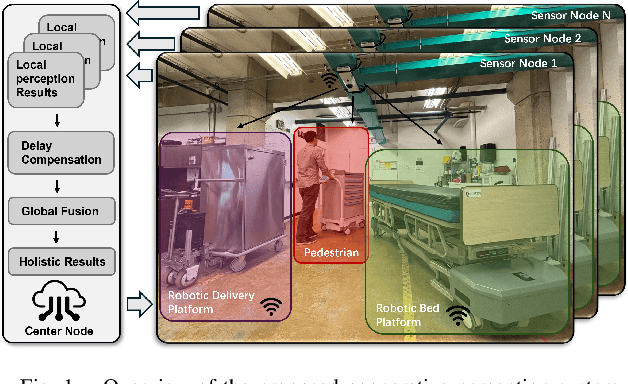
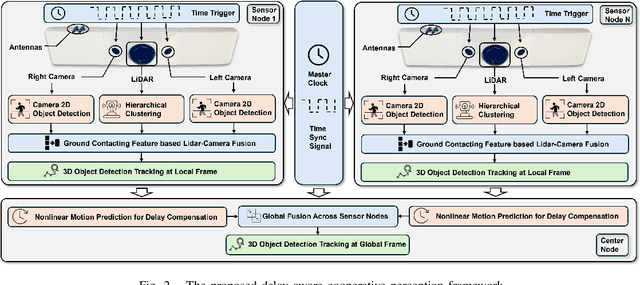
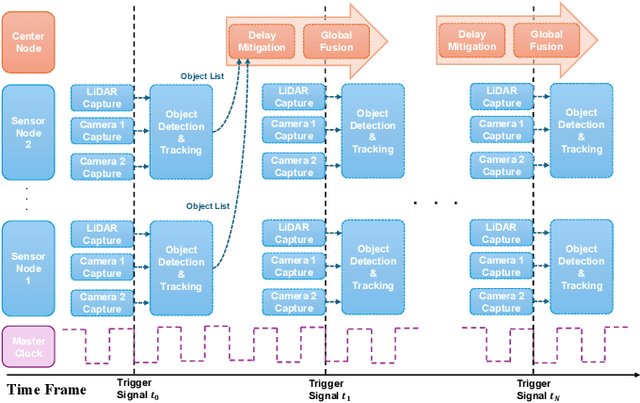
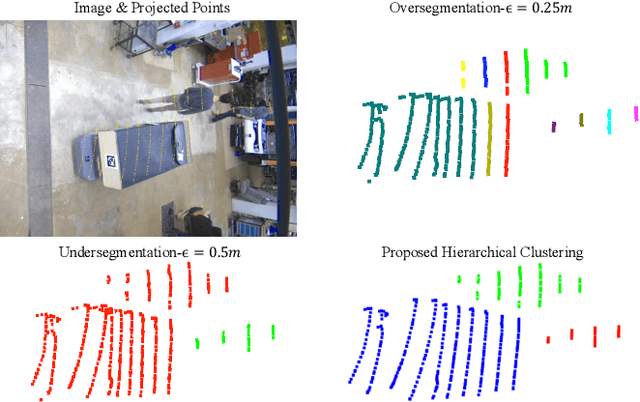
This paper presents a novel real-time, delay-aware cooperative perception system designed for intelligent mobility platforms operating in dynamic indoor environments. The system contains a network of multi-modal sensor nodes and a central node that collectively provide perception services to mobility platforms. The proposed Hierarchical Clustering Considering the Scanning Pattern and Ground Contacting Feature based Lidar Camera Fusion improve intra-node perception for crowded environment. The system also features delay-aware global perception to synchronize and aggregate data across nodes. To validate our approach, we introduced the Indoor Pedestrian Tracking dataset, compiled from data captured by two indoor sensor nodes. Our experiments, compared to baselines, demonstrate significant improvements in detection accuracy and robustness against delays. The dataset is available in the repository: https://github.com/NingMingHao/MVSLab-IndoorCooperativePerception