 Add to Chrome
 Add to Firefox
 Add to Edge
FrontierCS: Evolving Challenges for Evolving Intelligence
Dec 17, 2025


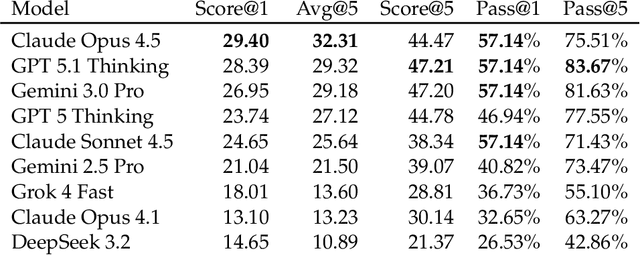
We introduce FrontierCS, a benchmark of 156 open-ended problems across diverse areas of computer science, designed and reviewed by experts, including CS PhDs and top-tier competitive programming participants and problem setters. Unlike existing benchmarks that focus on tasks with known optimal solutions, FrontierCS targets problems where the optimal solution is unknown, but the quality of a solution can be objectively evaluated. Models solve these tasks by implementing executable programs rather than outputting a direct answer. FrontierCS includes algorithmic problems, which are often NP-hard variants of competitive programming problems with objective partial scoring, and research problems with the same property. For each problem we provide an expert reference solution and an automatic evaluator. Combining open-ended design, measurable progress, and expert curation, FrontierCS provides a benchmark at the frontier of computer-science difficulty. Empirically, we find that frontier reasoning models still lag far behind human experts on both the algorithmic and research tracks, that increasing reasoning budgets alone does not close this gap, and that models often over-optimize for generating merely workable code instead of discovering high-quality algorithms and system designs.

Information Filter upon Diversity-Improved Decoding for Diversity-Faithfulness Tradeoff in NLG
Oct 25, 2022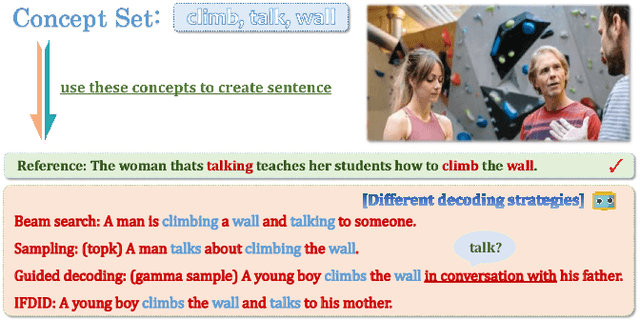
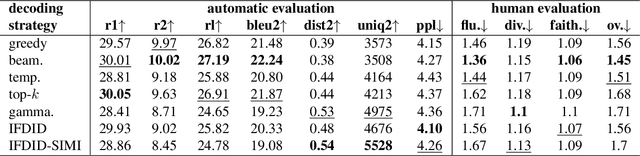
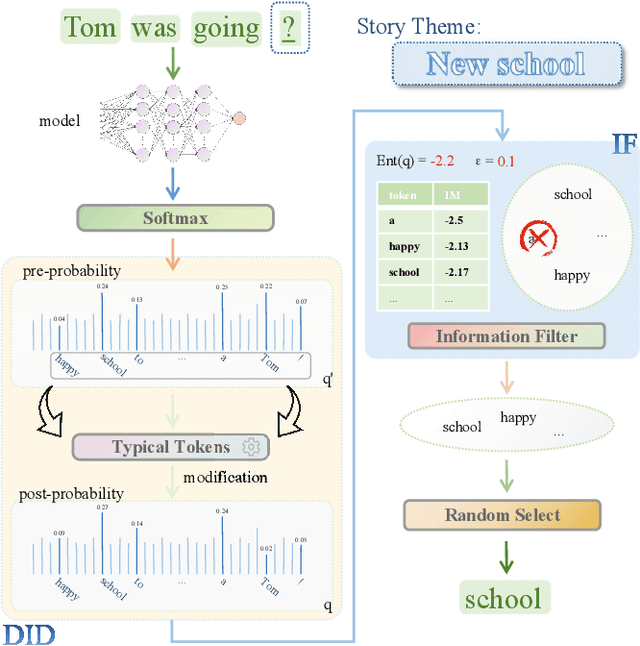
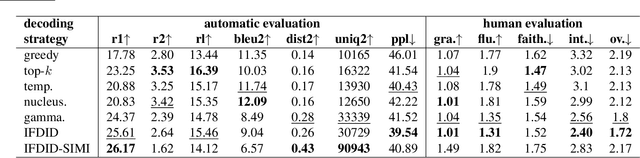
Some Natural Language Generation (NLG) tasks require both faithfulness and diversity. The decoding strategy is intensively related to the quality of the generated text. Strategies such as beam search, greedy search, etc., perform with low diversity and high repetition. On the other hand, guided decoding, the solution towards diversity, may generate unfaithful expressions. To this end, this paper presents Information Filter upon Diversity-Improved Decoding (IFDID) to obtain the tradeoff between diversity and faithfulness. IFDID is a two-stage decoding strategy leveraging the proposed Enhance-Filter framework, which achieves the tradeoff by increasing the probabilities of some typical tokens being selected and subsequently filtering them by their information amount. To verify the effectiveness, we compare our method with other baselines on related CommonGEN, RocStories and AdGen benchmarks, which cover Chinese and English datasets. Our numerical experimental results and human evaluation outcomes verify the effectiveness of the proposed approach, as our approach achieves a 1.24 higher ROUGE score describing faithfulness as well as higher diversity represented by 62.5% higher upon Dist-2 than traditional approaches, demonstrating that IFDID is a novel SOTA decoding strategy for the tradeoff between diversity and faithfulness.