 Add to Chrome
 Add to Firefox
 Add to Edge
Hyperspectral Image Fusion with Spectral-Band and Fusion-Scale Agnosticism
Feb 02, 2026
Current deep learning models for Multispectral and Hyperspectral Image Fusion (MS/HS fusion) are typically designed for fixed spectral bands and spatial scales, which limits their transferability across diverse sensors. To address this, we propose SSA, a universal framework for MS/HS fusion with spectral-band and fusion-scale agnosticism. Specifically, we introduce Matryoshka Kernel (MK), a novel operator that enables a single model to adapt to arbitrary numbers of spectral channels. Meanwhile, we build SSA upon an Implicit Neural Representation (INR) backbone that models the HS signal as a continuous function, enabling reconstruction at arbitrary spatial resolutions. Together, these two forms of agnosticism enable a single MS/HS fusion model that generalizes effectively to unseen sensors and spatial scales. Extensive experiments demonstrate that our single model achieves state-of-the-art performance while generalizing well to unseen sensors and scales, paving the way toward future HS foundation models.

Fourier-enhanced Implicit Neural Fusion Network for Multispectral and Hyperspectral Image Fusion
Apr 23, 2024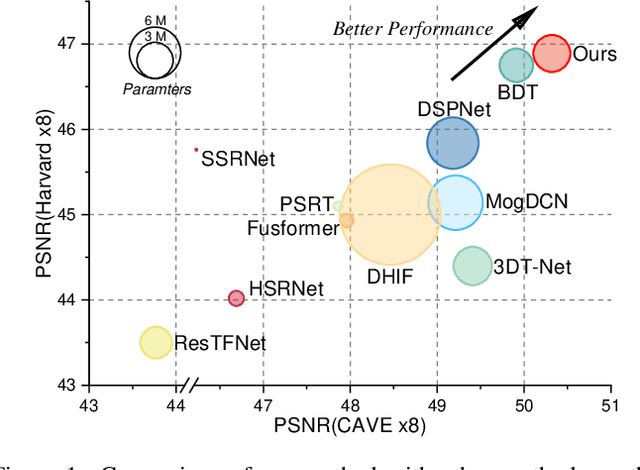
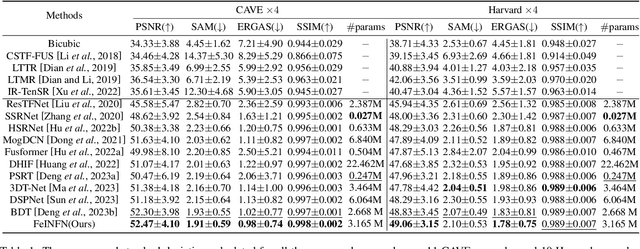
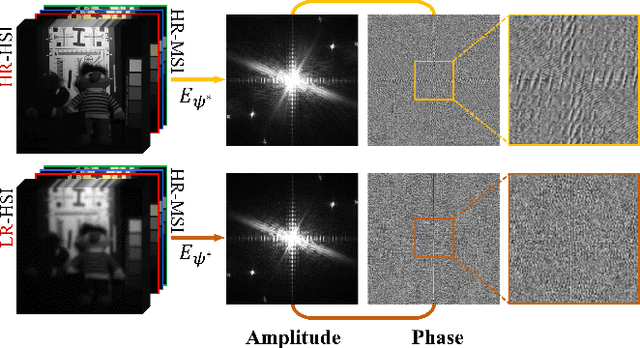
Recently, implicit neural representations (INR) have made significant strides in various vision-related domains, providing a novel solution for Multispectral and Hyperspectral Image Fusion (MHIF) tasks. However, INR is prone to losing high-frequency information and is confined to the lack of global perceptual capabilities. To address these issues, this paper introduces a Fourier-enhanced Implicit Neural Fusion Network (FeINFN) specifically designed for MHIF task, targeting the following phenomena: The Fourier amplitudes of the HR-HSI latent code and LR-HSI are remarkably similar; however, their phases exhibit different patterns. In FeINFN, we innovatively propose a spatial and frequency implicit fusion function (Spa-Fre IFF), helping INR capture high-frequency information and expanding the receptive field. Besides, a new decoder employing a complex Gabor wavelet activation function, called Spatial-Frequency Interactive Decoder (SFID), is invented to enhance the interaction of INR features. Especially, we further theoretically prove that the Gabor wavelet activation possesses a time-frequency tightness property that favors learning the optimal bandwidths in the decoder. Experiments on two benchmark MHIF datasets verify the state-of-the-art (SOTA) performance of the proposed method, both visually and quantitatively. Also, ablation studies demonstrate the mentioned contributions. The code will be available on Anonymous GitHub (https://anonymous.4open.science/r/FeINFN-15C9/) after possible acceptance.