 Add to Chrome
 Add to Firefox
 Add to Edge
Sound Event Detection with Boundary-Aware Optimization and Inference
Jan 07, 2026
Temporal detection problems appear in many fields including time-series estimation, activity recognition and sound event detection (SED). In this work, we propose a new approach to temporal event modeling by explicitly modeling event onsets and offsets, and by introducing boundary-aware optimization and inference strategies that substantially enhance temporal event detection. The presented methodology incorporates new temporal modeling layers - Recurrent Event Detection (RED) and Event Proposal Network (EPN) - which, together with tailored loss functions, enable more effective and precise temporal event detection. We evaluate the proposed method in the SED domain using a subset of the temporally-strongly annotated portion of AudioSet. Experimental results show that our approach not only outperforms traditional frame-wise SED models with state-of-the-art post-processing, but also removes the need for post-processing hyperparameter tuning, and scales to achieve new state-of-the-art performance across all AudioSet Strong classes.

Argus++: Robust Real-time Activity Detection for Unconstrained Video Streams with Overlapping Cube Proposals
Jan 14, 2022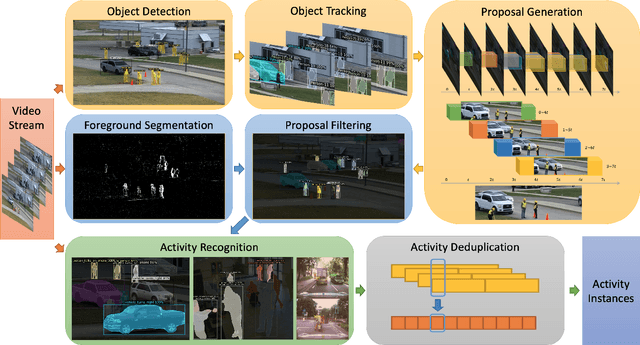
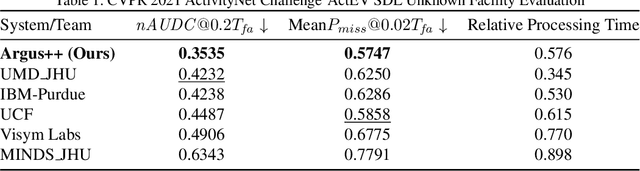
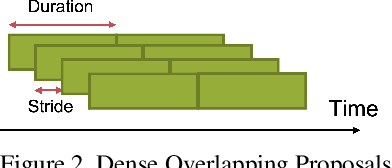
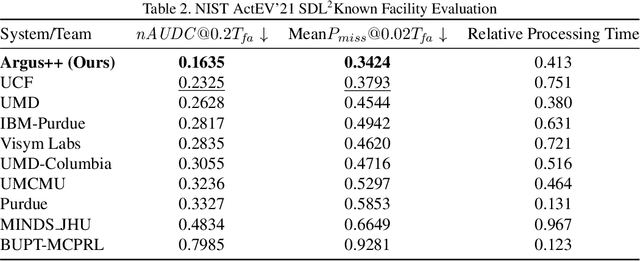
Activity detection is one of the attractive computer vision tasks to exploit the video streams captured by widely installed cameras. Although achieving impressive performance, conventional activity detection algorithms are usually designed under certain constraints, such as using trimmed and/or object-centered video clips as inputs. Therefore, they failed to deal with the multi-scale multi-instance cases in real-world unconstrained video streams, which are untrimmed and have large field-of-views. Real-time requirements for streaming analysis also mark brute force expansion of them unfeasible. To overcome these issues, we propose Argus++, a robust real-time activity detection system for analyzing unconstrained video streams. The design of Argus++ introduces overlapping spatio-temporal cubes as an intermediate concept of activity proposals to ensure coverage and completeness of activity detection through over-sampling. The overall system is optimized for real-time processing on standalone consumer-level hardware. Extensive experiments on different surveillance and driving scenarios demonstrated its superior performance in a series of activity detection benchmarks, including CVPR ActivityNet ActEV 2021, NIST ActEV SDL UF/KF, TRECVID ActEV 2020/2021, and ICCV ROAD 2021.