 Add to Chrome
 Add to Firefox
 Add to Edge
Co-Channel Interference Mitigation Using Deep Learning for Drone-Based Large-Scale Antenna Measurements
Jan 19, 2026
Unmanned aerial vehicles (UAVs) enable efficient in-situ radiation characterization of large-aperture antennas directly in their deployment environments. In such measurements, a continuous-wave (CW) probe tone is commonly transmitted to characterize the antenna response. However, active co-channel emissions from neighboring antennas often introduce severe in-band interference, where classical FFT-based estimators fail to accurately estimate the CW tone amplitude when the signal-to-interference ratios (SIR) falls below -10 dB. This paper proposes a lightweight deep convolutional neural network (DC-CNN) that estimates the amplitude of the CW tone. The model is trained and evaluated on real 5~GHz measurement bursts spanning an effective SIR range of --33.3 dB to +46.7 dB. Despite its compact size (<20k parameters), the proposed DC-CNN achieves a mean absolute error (MAE) of 7% over the full range, with <1 dB error for SIR >= -30 dB. This robustness and efficiency make DC-CNN suitable for deployment on embedded UAV platforms for interference-resilient antenna pattern characterization.

Multiple-Frequency-Bands Channel Characterization for In-vehicle Wireless Networks
Oct 03, 2024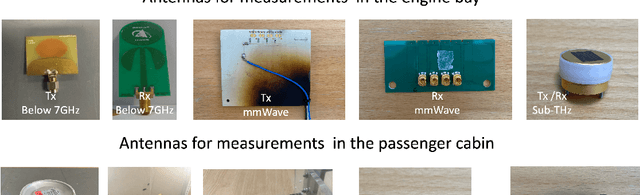
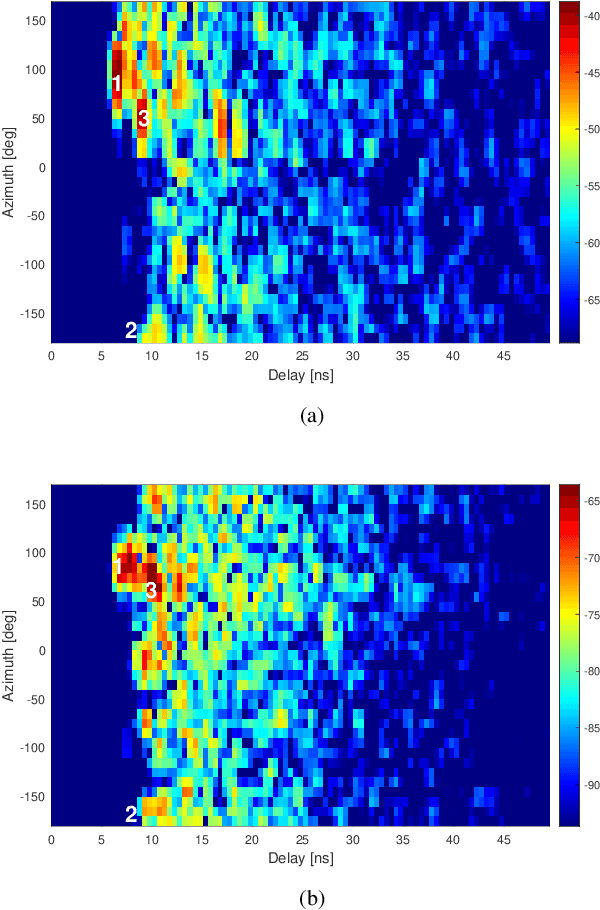
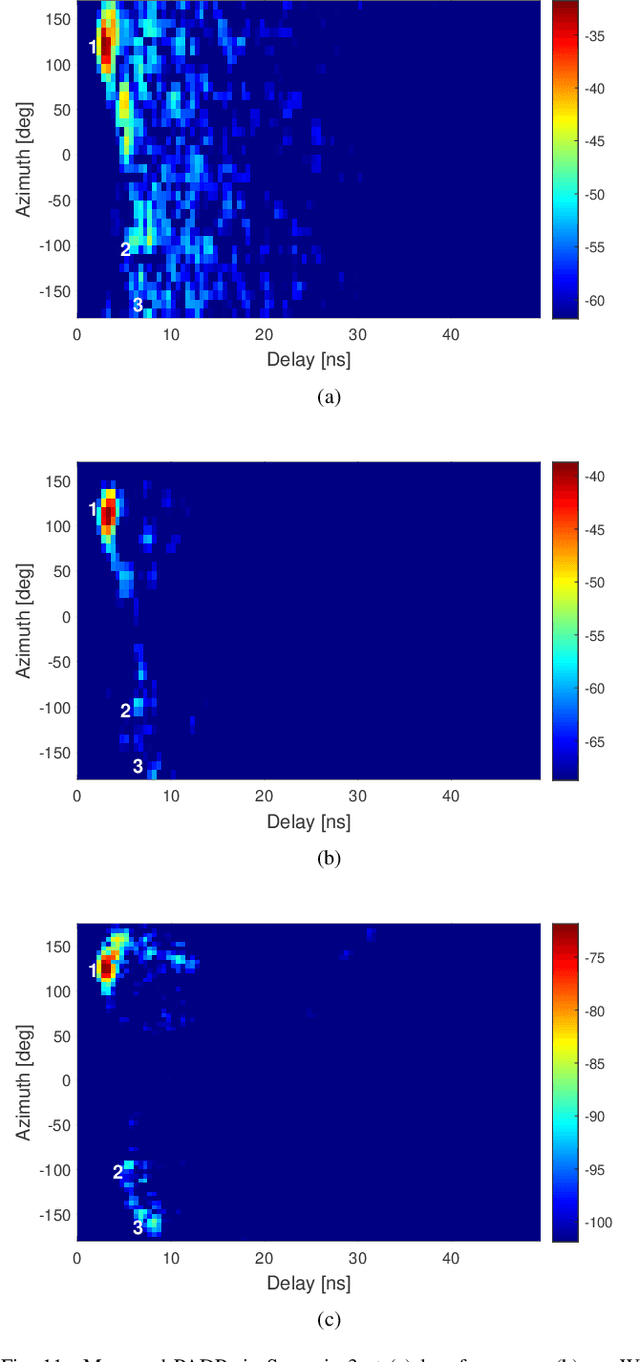
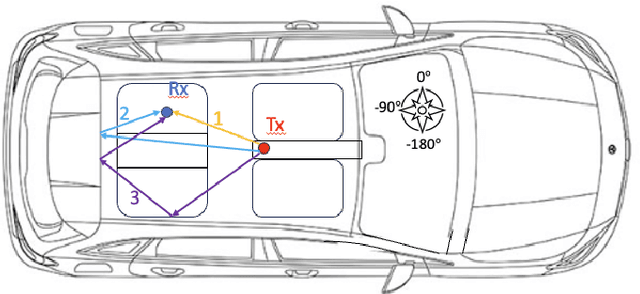
In-vehicle wireless networks are crucial for advancing smart transportation systems and enhancing interaction among vehicles and their occupants. However, there are limited studies in the current state of the art that investigate the in-vehicle channel characteristics in multiple frequency bands. In this paper, we present measurement campaigns conducted in a van and a car across below 7 GHz, millimeter-wave (mmWave), and sub-Terahertz (Sub-THz) bands. These campaigns aim to compare the channel characteristics for in-vehicle scenarios across various frequency bands. Channel impulse responses (CIRs) were measured at various locations distributed across the engine compartment of both the van and car. The CIR results reveal a high similarity in the delay properties between frequency bands below 7GHz and mmWave bands for the measurements in the engine bay. Sparse channels can be observed at Sub-THz bands in the engine bay scenarios. Channel spatial profiles in the passenger cabin of both the van and car are obtained by the directional scan sounding scheme for three bands. We compare the power angle delay profiles (PADPs) measured at different frequency bands in two line of sight (LOS) scenarios and one non-LOS (NLOS) scenario. Some major \added{multipath components (MPCs)} can be identified in all frequency bands and their trajectories are traced based on the geometry of the vehicles. The angular spread of arrival is also calculated for three scenarios. The analysis of channel characteristics in this paper can enhance our understanding of in-vehicle channels and foster the evolution of in-vehicle wireless networks.