 Add to Chrome
 Add to Firefox
 Add to Edge
Enhancing Multi-Image Understanding through Delimiter Token Scaling
Feb 02, 2026
Large Vision-Language Models (LVLMs) achieve strong performance on single-image tasks, but their performance declines when multiple images are provided as input. One major reason is the cross-image information leakage, where the model struggles to distinguish information across different images. Existing LVLMs already employ delimiter tokens to mark the start and end of each image, yet our analysis reveals that these tokens fail to effectively block cross-image information leakage. To enhance their effectiveness, we propose a method that scales the hidden states of delimiter tokens. This enhances the model's ability to preserve image-specific information by reinforcing intra-image interaction and limiting undesired cross-image interactions. Consequently, the model is better able to distinguish between images and reason over them more accurately. Experiments show performance gains on multi-image benchmarks such as Mantis, MuirBench, MIRB, and QBench2. We further evaluate our method on text-only tasks that require clear distinction. The method improves performance on multi-document and multi-table understanding benchmarks, including TQABench, MultiNews, and WCEP-10. Notably, our method requires no additional training or inference cost.

ConVis: Contrastive Decoding with Hallucination Visualization for Mitigating Hallucinations in Multimodal Large Language Models
Aug 25, 2024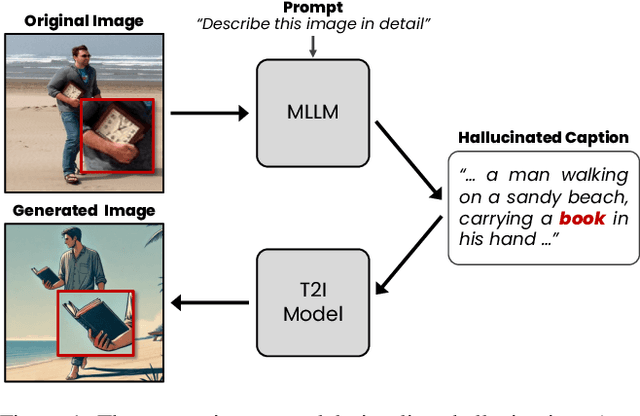
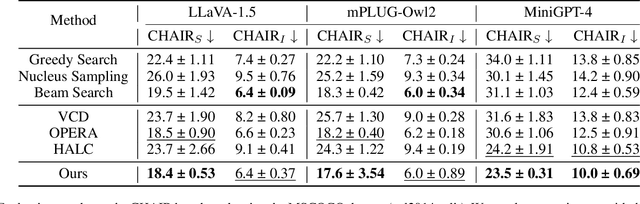
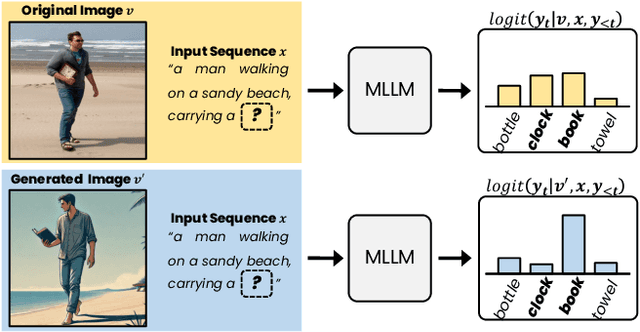
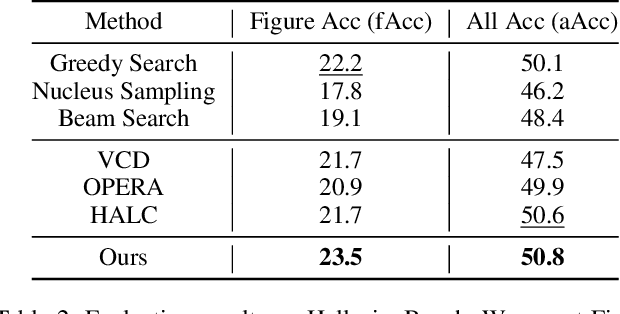
Hallucinations in Multimodal Large Language Models (MLLMs) where generated responses fail to accurately reflect the given image pose a significant challenge to their reliability. To address this, we introduce ConVis, a novel training-free contrastive decoding method. ConVis leverages a text-to-image (T2I) generation model to semantically reconstruct the given image from hallucinated captions. By comparing the contrasting probability distributions produced by the original and reconstructed images, ConVis enables MLLMs to capture visual contrastive signals that penalize hallucination generation. Notably, this method operates purely within the decoding process, eliminating the need for additional data or model updates. Our extensive experiments on five popular benchmarks demonstrate that ConVis effectively reduces hallucinations across various MLLMs, highlighting its potential to enhance model reliability.