 Add to Chrome
 Add to Firefox
 Add to Edge
RainFusion2.0: Temporal-Spatial Awareness and Hardware-Efficient Block-wise Sparse Attention
Dec 30, 2025
In video and image generation tasks, Diffusion Transformer (DiT) models incur extremely high computational costs due to attention mechanisms, which limits their practical applications. Furthermore, with hardware advancements, a wide range of devices besides graphics processing unit (GPU), such as application-specific integrated circuit (ASIC), have been increasingly adopted for model inference. Sparse attention, which leverages the inherent sparsity of attention by skipping computations for insignificant tokens, is an effective approach to mitigate computational costs. However, existing sparse attention methods have two critical limitations: the overhead of sparse pattern prediction and the lack of hardware generality, as most of these methods are designed for GPU. To address these challenges, this study proposes RainFusion2.0, which aims to develop an online adaptive, hardware-efficient, and low-overhead sparse attention mechanism to accelerate both video and image generative models, with robust performance across diverse hardware platforms. Key technical insights include: (1) leveraging block-wise mean values as representative tokens for sparse mask prediction; (2) implementing spatiotemporal-aware token permutation; and (3) introducing a first-frame sink mechanism specifically designed for video generation scenarios. Experimental results demonstrate that RainFusion2.0 can achieve 80% sparsity while achieving an end-to-end speedup of 1.5~1.8x without compromising video quality. Moreover, RainFusion2.0 demonstrates effectiveness across various generative models and validates its generalization across diverse hardware platforms.

Model Reveals What to Cache: Profiling-Based Feature Reuse for Video Diffusion Models
Apr 04, 2025
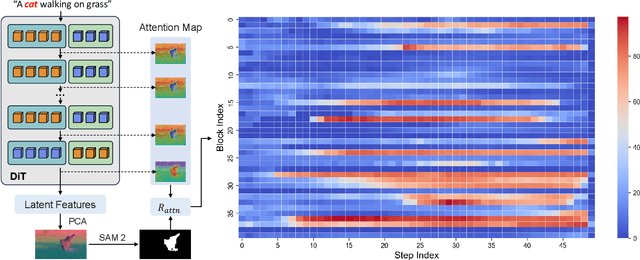

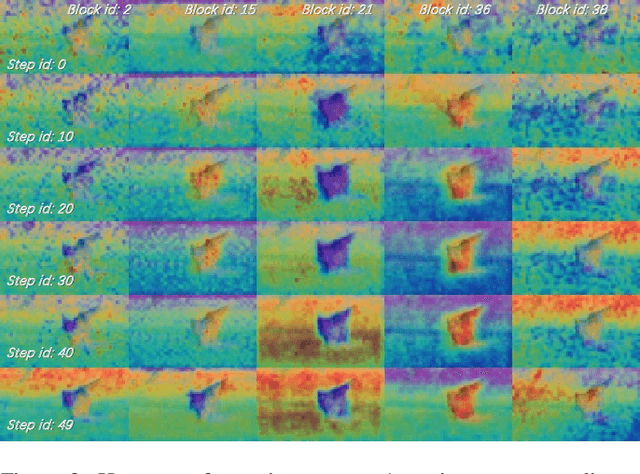
Recent advances in diffusion models have demonstrated remarkable capabilities in video generation. However, the computational intensity remains a significant challenge for practical applications. While feature caching has been proposed to reduce the computational burden of diffusion models, existing methods typically overlook the heterogeneous significance of individual blocks, resulting in suboptimal reuse and degraded output quality. To this end, we address this gap by introducing ProfilingDiT, a novel adaptive caching strategy that explicitly disentangles foreground and background-focused blocks. Through a systematic analysis of attention distributions in diffusion models, we reveal a key observation: 1) Most layers exhibit a consistent preference for either foreground or background regions. 2) Predicted noise shows low inter-step similarity initially, which stabilizes as denoising progresses. This finding inspires us to formulate a selective caching strategy that preserves full computation for dynamic foreground elements while efficiently caching static background features. Our approach substantially reduces computational overhead while preserving visual fidelity. Extensive experiments demonstrate that our framework achieves significant acceleration (e.g., 2.01 times speedup for Wan2.1) while maintaining visual fidelity across comprehensive quality metrics, establishing a viable method for efficient video generation.