 Add to Chrome
 Add to Firefox
 Add to Edge
Decision-oriented benchmarking to transform AI weather forecast access: Application to the Indian monsoon
Feb 03, 2026
Artificial intelligence weather prediction (AIWP) models now often outperform traditional physics-based models on common metrics while requiring orders-of-magnitude less computing resources and time. Open-access AIWP models thus hold promise as transformational tools for helping low- and middle-income populations make decisions in the face of high-impact weather shocks. Yet, current approaches to evaluating AIWP models focus mainly on aggregated meteorological metrics without considering local stakeholders' needs in decision-oriented, operational frameworks. Here, we introduce such a framework that connects meteorology, AI, and social sciences. As an example, we apply it to the 150-year-old problem of Indian monsoon forecasting, focusing on benefits to rain-fed agriculture, which is highly susceptible to climate change. AIWP models skillfully predict an agriculturally relevant onset index at regional scales weeks in advance when evaluated out-of-sample using deterministic and probabilistic metrics. This framework informed a government-led effort in 2025 to send 38 million Indian farmers AI-based monsoon onset forecasts, which captured an unusual weeks-long pause in monsoon progression. This decision-oriented benchmarking framework provides a key component of a blueprint for harnessing the power of AIWP models to help large vulnerable populations adapt to weather shocks in the face of climate variability and change.

Can AI weather models predict out-of-distribution gray swan tropical cyclones?
Oct 19, 2024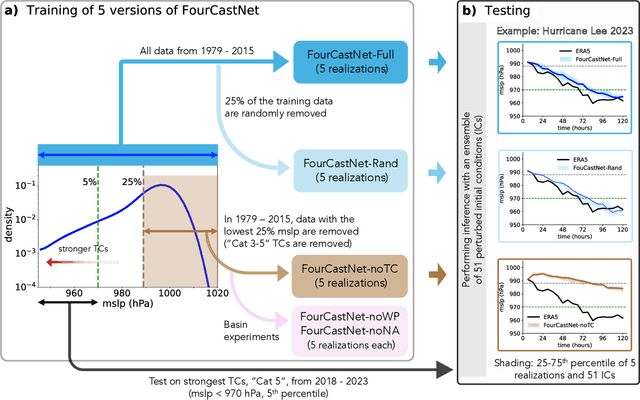
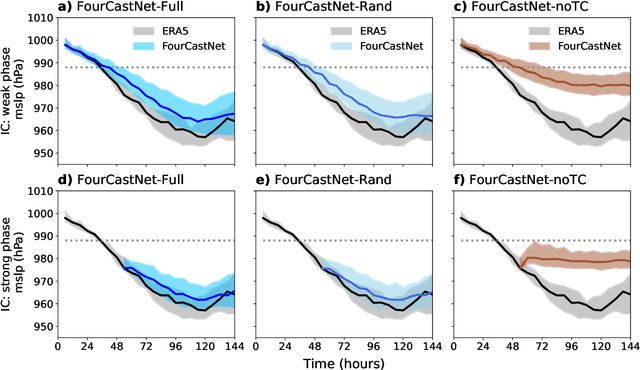
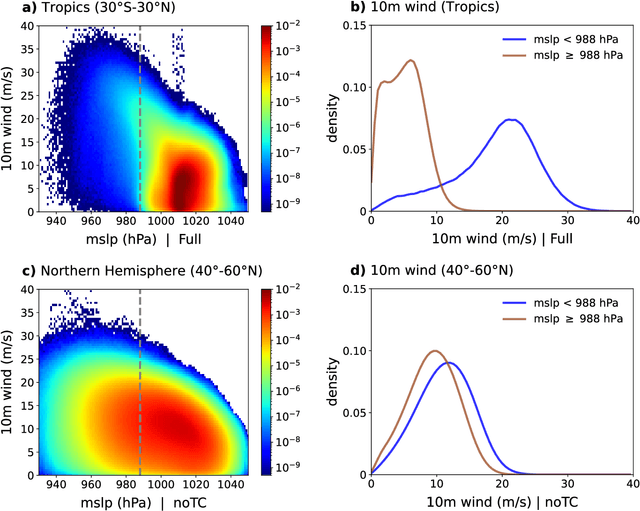
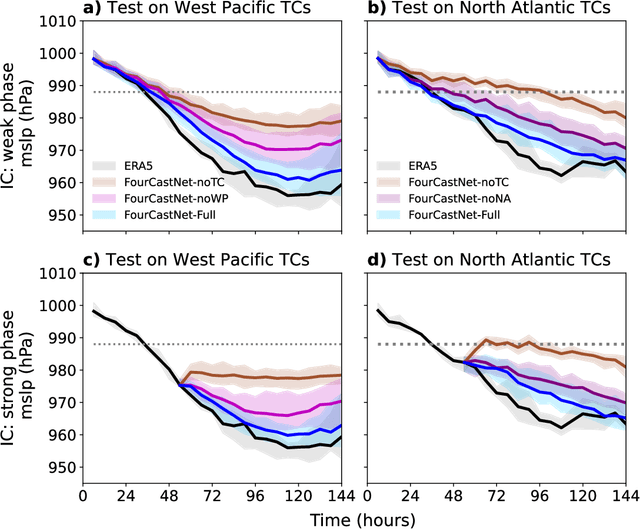
Predicting gray swan weather extremes, which are possible but so rare that they are absent from the training dataset, is a major concern for AI weather/climate models. An important open question is whether AI models can extrapolate from weaker weather events present in the training set to stronger, unseen weather extremes. To test this, we train independent versions of the AI model FourCastNet on the 1979-2015 ERA5 dataset with all data, or with Category 3-5 tropical cyclones (TCs) removed, either globally or only over the North Atlantic or Western Pacific basin. We then test these versions of FourCastNet on 2018-2023 Category 5 TCs (gray swans). All versions yield similar accuracy for global weather, but the one trained without Category 3-5 TCs cannot accurately forecast Category 5 TCs, indicating that these models cannot extrapolate from weaker storms. The versions trained without Category 3-5 TCs in one basin show some skill forecasting Category 5 TCs in that basin, suggesting that FourCastNet can generalize across tropical basins. This is encouraging and surprising because regional information is implicitly encoded in inputs. No version satisfies gradient-wind balance, implying that enforcing such physical constraints may not improve generalizability to gray swans. Given that current state-of-the-art AI weather/climate models have similar learning strategies, we expect our findings to apply to other models and extreme events. Our work demonstrates that novel learning strategies are needed for AI weather/climate models to provide early warning or estimated statistics for the rarest, most impactful weather extremes.