 Add to Chrome
 Add to Firefox
 Add to Edge
How Do Decoder-Only LLMs Perceive Users? Rethinking Attention Masking for User Representation Learning
Feb 11, 2026
Decoder-only large language models are increasingly used as behavioral encoders for user representation learning, yet the impact of attention masking on the quality of user embeddings remains underexplored. In this work, we conduct a systematic study of causal, hybrid, and bidirectional attention masks within a unified contrastive learning framework trained on large-scale real-world Alipay data that integrates long-horizon heterogeneous user behaviors. To improve training dynamics when transitioning from causal to bidirectional attention, we propose Gradient-Guided Soft Masking, a gradient-based pre-warmup applied before a linear scheduler that gradually opens future attention during optimization. Evaluated on 9 industrial user cognition benchmarks covering prediction, preference, and marketing sensitivity tasks, our approach consistently yields more stable training and higher-quality bidirectional representations compared with causal, hybrid, and scheduler-only baselines, while remaining compatible with decoder pretraining. Overall, our findings highlight the importance of masking design and training transition in adapting decoder-only LLMs for effective user representation learning. Our code is available at https://github.com/JhCircle/Deepfind-GGSM.

Differentially Private Pre-Trained Model Fusion using Decentralized Federated Graph Matching
Nov 05, 2023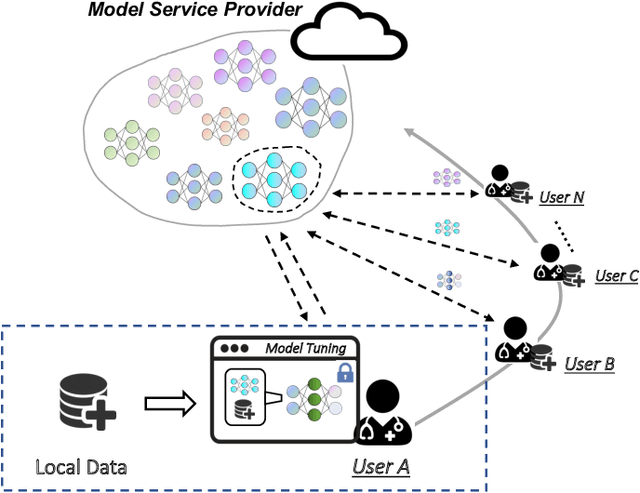
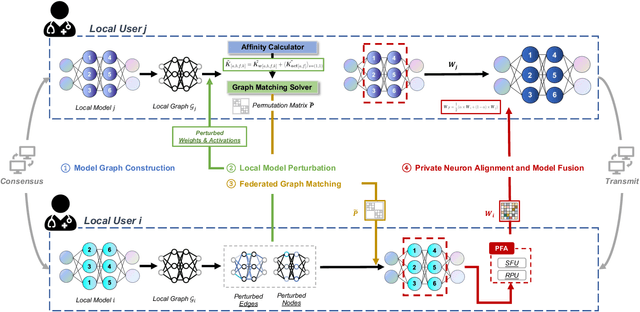
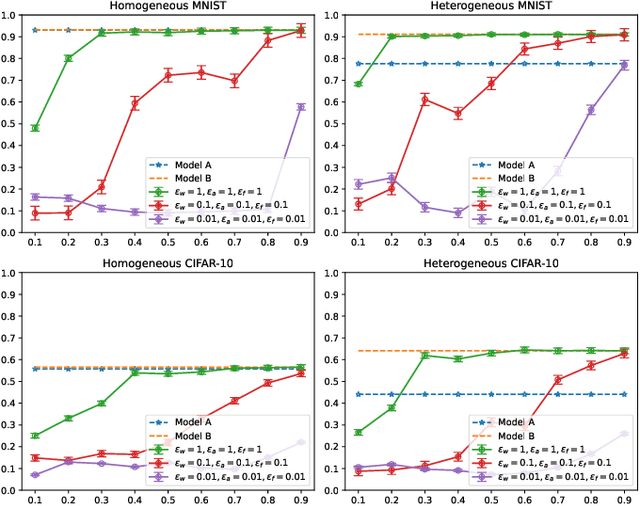
Model fusion is becoming a crucial component in the context of model-as-a-service scenarios, enabling the delivery of high-quality model services to local users. However, this approach introduces privacy risks and imposes certain limitations on its applications. Ensuring secure model exchange and knowledge fusion among users becomes a significant challenge in this setting. To tackle this issue, we propose PrivFusion, a novel architecture that preserves privacy while facilitating model fusion under the constraints of local differential privacy. PrivFusion leverages a graph-based structure, enabling the fusion of models from multiple parties without necessitating retraining. By employing randomized mechanisms, PrivFusion ensures privacy guarantees throughout the fusion process. To enhance model privacy, our approach incorporates a hybrid local differentially private mechanism and decentralized federated graph matching, effectively protecting both activation values and weights. Additionally, we introduce a perturbation filter adapter to alleviate the impact of randomized noise, thereby preserving the utility of the fused model. Through extensive experiments conducted on diverse image datasets and real-world healthcare applications, we provide empirical evidence showcasing the effectiveness of PrivFusion in maintaining model performance while preserving privacy. Our contributions offer valuable insights and practical solutions for secure and collaborative data analysis within the domain of privacy-preserving model fusion.
FedBone: Towards Large-Scale Federated Multi-Task Learning
Jun 30, 2023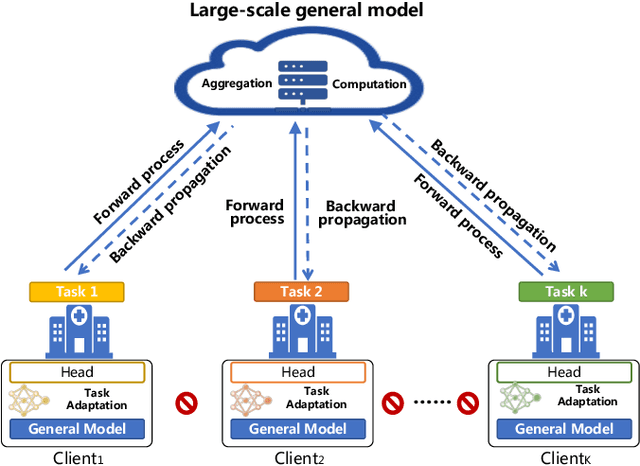

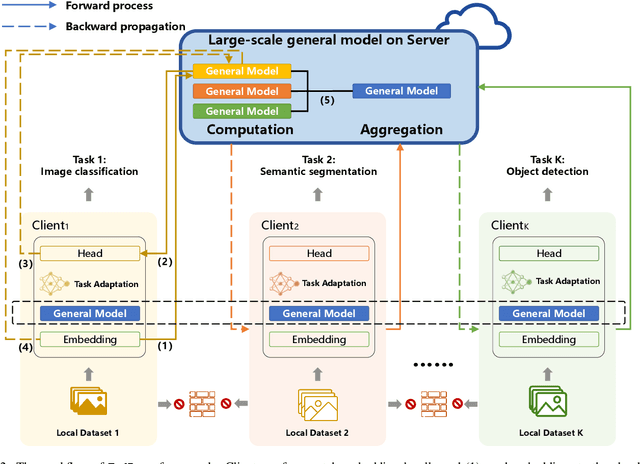
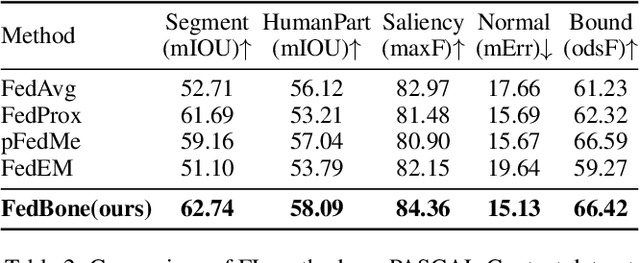
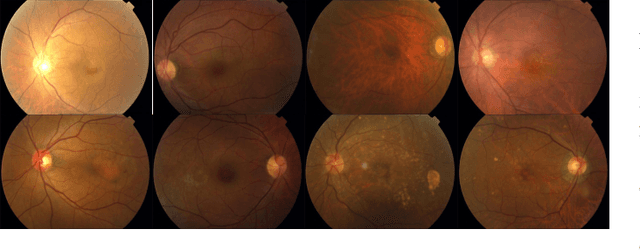
Heterogeneous federated multi-task learning (HFMTL) is a federated learning technique that combines heterogeneous tasks of different clients to achieve more accurate, comprehensive predictions. In real-world applications, visual and natural language tasks typically require large-scale models to extract high-level abstract features. However, large-scale models cannot be directly applied to existing federated multi-task learning methods. Existing HFML methods also disregard the impact of gradient conflicts on multi-task optimization during the federated aggregation process. In this work, we propose an innovative framework called FedBone, which enables the construction of large-scale models with better generalization from the perspective of server-client split learning and gradient projection. We split the entire model into two components: a large-scale general model (referred to as the general model) on the cloud server and multiple task-specific models (referred to as the client model) on edge clients, solving the problem of insufficient computing power on edge clients. The conflicting gradient projection technique is used to enhance the generalization of the large-scale general model between different tasks. The proposed framework is evaluated on two benchmark datasets and a real ophthalmic dataset. Comprehensive results demonstrate that FedBone efficiently adapts to heterogeneous local tasks of each client and outperforms existing federated learning algorithms in most dense prediction and classification tasks with off-the-shelf computational resources on the client side.