 Add to Chrome
 Add to Firefox
 Add to Edge
Seq103: A Unified Neuroevolution Framework for Compact Sequence Architecture Discovery
Jun 03, 2026
Neuroevolution is a representative neural architecture search paradigm that evolves both network topology and weights through evolutionary algorithms. In this paper, we propose Seq103, a unified NEAT-style neuroevolution framework for compact sequence architecture discovery. Seq103 consists of a shared evolutionary backbone and an optional recurrent extension. The shared backbone includes an elementary node-and-connection representation, per-class RMSE-based evaluation, mutation-based evolution with class-wise recombination, and elitism. The optional hidden-state mechanism extends the search space with hidden-state nodes and hidden connections, enabling temporal memory when step-wise recurrent inference is required. With this design, Seq103 applies the same core search pipeline to both step-wise recurrent and sample-wise feedforward sequence classification. In recurrent tasks, the hidden-state extension is enabled to provide temporal memory; in feedforward tasks, it is disabled while the shared evolutionary backbone remains unchanged. We evaluate Seq103 on 8 text classification datasets and the full UCRArchive2018 benchmark with 128 univariate time-series datasets. On step-wise tasks, Seq103 retains 86.96% of the best-baseline accuracy on average while using 34.6x to 3218.0x fewer parameters. On sample-wise tasks over the full UCRArchive2018 benchmark, Seq103 retains 81.95% of the best-baseline accuracy on average while using 11.8x to 160,601.0x fewer parameters.

Topology-Guaranteed Image Segmentation: Enforcing Connectivity, Genus, and Width Constraints
Jan 16, 2026Existing research highlights the crucial role of topological priors in image segmentation, particularly in preserving essential structures such as connectivity and genus. Accurately capturing these topological features often requires incorporating width-related information, including the thickness and length inherent to the image structures. However, traditional mathematical definitions of topological structures lack this dimensional width information, limiting methods like persistent homology from fully addressing practical segmentation needs. To overcome this limitation, we propose a novel mathematical framework that explicitly integrates width information into the characterization of topological structures. This method leverages persistent homology, complemented by smoothing concepts from partial differential equations (PDEs), to modify local extrema of upper-level sets. This approach enables the resulting topological structures to inherently capture width properties. We incorporate this enhanced topological description into variational image segmentation models. Using some proper loss functions, we are also able to design neural networks that can segment images with the required topological and width properties. Through variational constraints on the relevant topological energies, our approach successfully preserves essential topological invariants such as connectivity and genus counts, simultaneously ensuring that segmented structures retain critical width attributes, including line thickness and length. Numerical experiments demonstrate the effectiveness of our method, showcasing its capability to maintain topological fidelity while explicitly embedding width characteristics into segmented image structures.
Slender Object Scene Segmentation in Remote Sensing Image Based on Learnable Morphological Skeleton with Segment Anything Model
Nov 13, 2024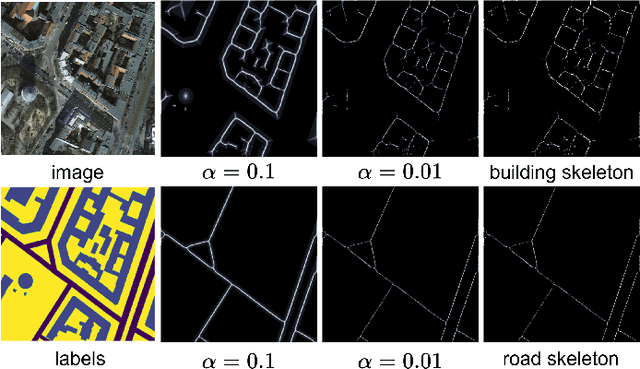
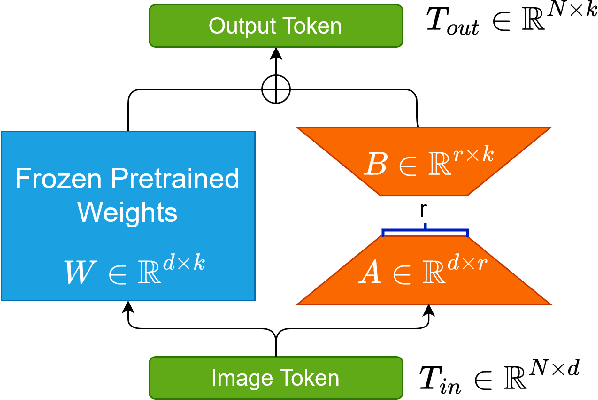
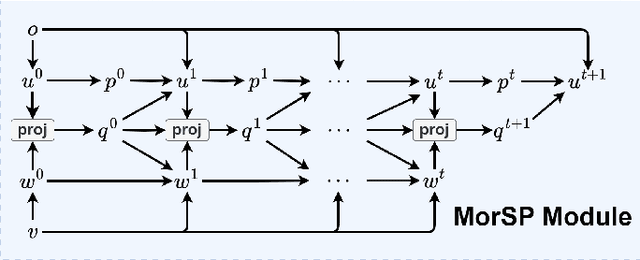
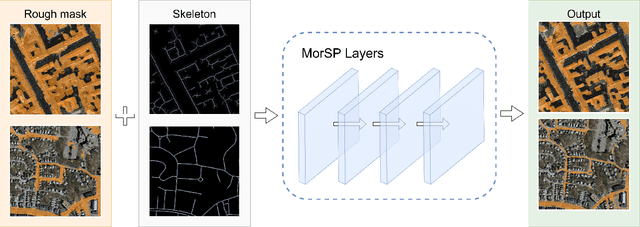
Morphological methods play a crucial role in remote sensing image processing, due to their ability to capture and preserve small structural details. However, most of the existing deep learning models for semantic segmentation are based on the encoder-decoder architecture including U-net and Segment Anything Model (SAM), where the downsampling process tends to discard fine details. In this paper, we propose a new approach that integrates learnable morphological skeleton prior into deep neural networks using the variational method. To address the difficulty in backpropagation in neural networks caused by the non-differentiability presented in classical morphological operations, we provide a smooth representation of the morphological skeleton and design a variational segmentation model integrating morphological skeleton prior by employing operator splitting and dual methods. Then, we integrate this model into the network architecture of SAM, which is achieved by adding a token to mask decoder and modifying the final sigmoid layer, ensuring the final segmentation results preserve the skeleton structure as much as possible. Experimental results on remote sensing datasets, including buildings and roads, demonstrate that our method outperforms the original SAM on slender object segmentation and exhibits better generalization capability.