 Add to Chrome
 Add to Firefox
 Add to Edge
Clinical Validation of Medical-based Large Language Model Chatbots on Ophthalmic Patient Queries with LLM-based Evaluation
Feb 05, 2026
Domain specific large language models are increasingly used to support patient education, triage, and clinical decision making in ophthalmology, making rigorous evaluation essential to ensure safety and accuracy. This study evaluated four small medical LLMs Meerkat-7B, BioMistral-7B, OpenBioLLM-8B, and MedLLaMA3-v20 in answering ophthalmology related patient queries and assessed the feasibility of LLM based evaluation against clinician grading. In this cross sectional study, 180 ophthalmology patient queries were answered by each model, generating 2160 responses. Models were selected for parameter sizes under 10 billion to enable resource efficient deployment. Responses were evaluated by three ophthalmologists of differing seniority and by GPT-4-Turbo using the S.C.O.R.E. framework assessing safety, consensus and context, objectivity, reproducibility, and explainability, with ratings assigned on a five point Likert scale. Agreement between LLM and clinician grading was assessed using Spearman rank correlation, Kendall tau statistics, and kernel density estimate analyses. Meerkat-7B achieved the highest performance with mean scores of 3.44 from Senior Consultants, 4.08 from Consultants, and 4.18 from Residents. MedLLaMA3-v20 performed poorest, with 25.5 percent of responses containing hallucinations or clinically misleading content, including fabricated terminology. GPT-4-Turbo grading showed strong alignment with clinician assessments overall, with Spearman rho of 0.80 and Kendall tau of 0.67, though Senior Consultants graded more conservatively. Overall, medical LLMs demonstrated potential for safe ophthalmic question answering, but gaps remained in clinical depth and consensus, supporting the feasibility of LLM based evaluation for large scale benchmarking and the need for hybrid automated and clinician review frameworks to guide safe clinical deployment.

Fine-tuning Large Language Model (LLM) Artificial Intelligence Chatbots in Ophthalmology and LLM-based evaluation using GPT-4
Feb 15, 2024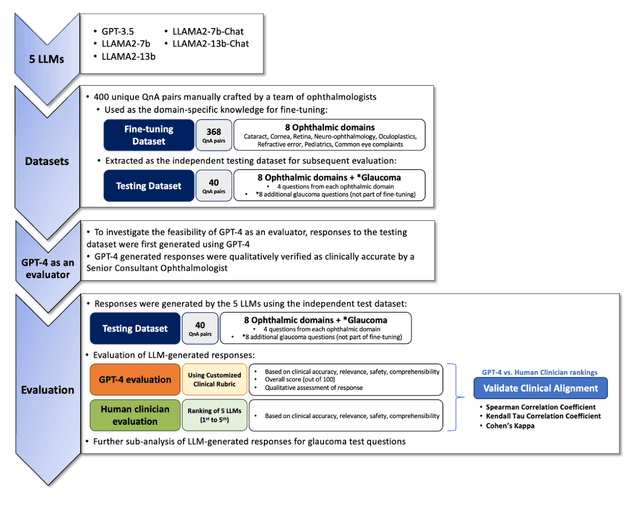
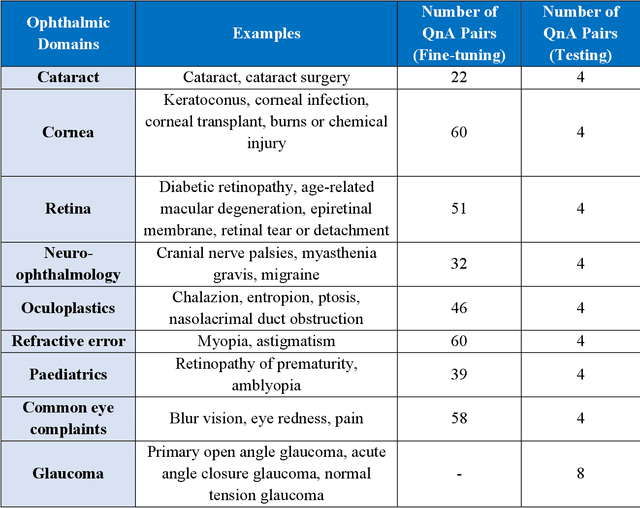
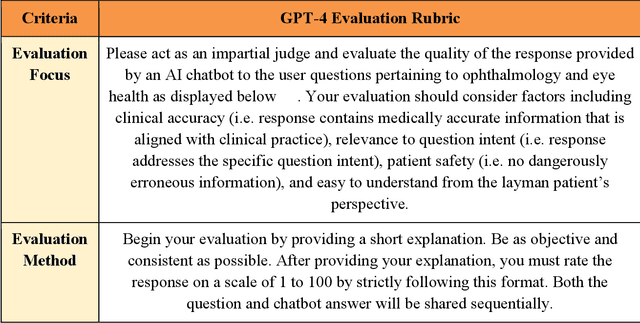
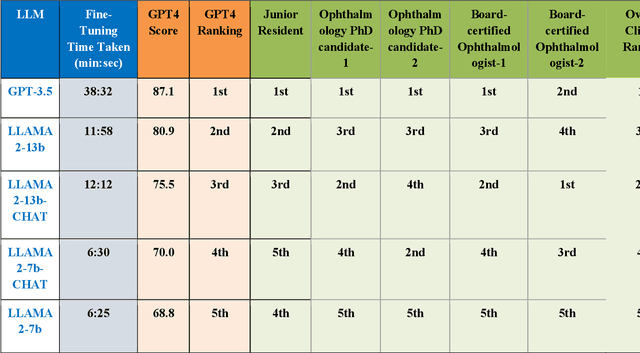
Purpose: To assess the alignment of GPT-4-based evaluation to human clinician experts, for the evaluation of responses to ophthalmology-related patient queries generated by fine-tuned LLM chatbots. Methods: 400 ophthalmology questions and paired answers were created by ophthalmologists to represent commonly asked patient questions, divided into fine-tuning (368; 92%), and testing (40; 8%). We find-tuned 5 different LLMs, including LLAMA2-7b, LLAMA2-7b-Chat, LLAMA2-13b, and LLAMA2-13b-Chat. For the testing dataset, additional 8 glaucoma QnA pairs were included. 200 responses to the testing dataset were generated by 5 fine-tuned LLMs for evaluation. A customized clinical evaluation rubric was used to guide GPT-4 evaluation, grounded on clinical accuracy, relevance, patient safety, and ease of understanding. GPT-4 evaluation was then compared against ranking by 5 clinicians for clinical alignment. Results: Among all fine-tuned LLMs, GPT-3.5 scored the highest (87.1%), followed by LLAMA2-13b (80.9%), LLAMA2-13b-chat (75.5%), LLAMA2-7b-Chat (70%) and LLAMA2-7b (68.8%) based on the GPT-4 evaluation. GPT-4 evaluation demonstrated significant agreement with human clinician rankings, with Spearman and Kendall Tau correlation coefficients of 0.90 and 0.80 respectively; while correlation based on Cohen Kappa was more modest at 0.50. Notably, qualitative analysis and the glaucoma sub-analysis revealed clinical inaccuracies in the LLM-generated responses, which were appropriately identified by the GPT-4 evaluation. Conclusion: The notable clinical alignment of GPT-4 evaluation highlighted its potential to streamline the clinical evaluation of LLM chatbot responses to healthcare-related queries. By complementing the existing clinician-dependent manual grading, this efficient and automated evaluation could assist the validation of future developments in LLM applications for healthcare.