 Add to Chrome
 Add to Firefox
 Add to Edge
PackKV: Reducing KV Cache Memory Footprint through LLM-Aware Lossy Compression
Dec 30, 2025
Transformer-based large language models (LLMs) have demonstrated remarkable potential across a wide range of practical applications. However, long-context inference remains a significant challenge due to the substantial memory requirements of the key-value (KV) cache, which can scale to several gigabytes as sequence length and batch size increase. In this paper, we present \textbf{PackKV}, a generic and efficient KV cache management framework optimized for long-context generation. %, which synergistically supports both latency-critical and throughput-critical inference scenarios. PackKV introduces novel lossy compression techniques specifically tailored to the characteristics of KV cache data, featuring a careful co-design of compression algorithms and system architecture. Our approach is compatible with the dynamically growing nature of the KV cache while preserving high computational efficiency. Experimental results show that, under the same and minimum accuracy drop as state-of-the-art quantization methods, PackKV achieves, on average, \textbf{153.2}\% higher memory reduction rate for the K cache and \textbf{179.6}\% for the V cache. Furthermore, PackKV delivers extremely high execution throughput, effectively eliminating decompression overhead and accelerating the matrix-vector multiplication operation. Specifically, PackKV achieves an average throughput improvement of \textbf{75.7}\% for K and \textbf{171.7}\% for V across A100 and RTX Pro 6000 GPUs, compared to cuBLAS matrix-vector multiplication kernels, while demanding less GPU memory bandwidth. Code available on https://github.com/BoJiang03/PackKV

Enhancing Lossy Compression Through Cross-Field Information for Scientific Applications
Sep 26, 2024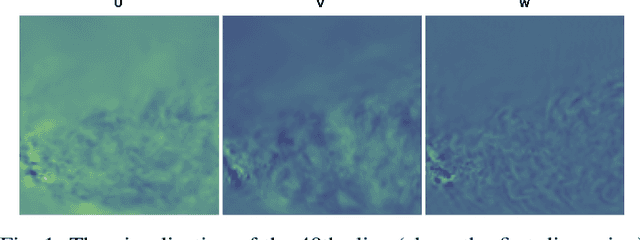
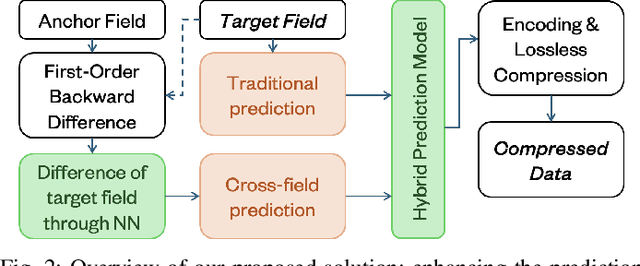
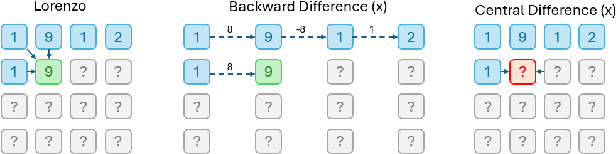
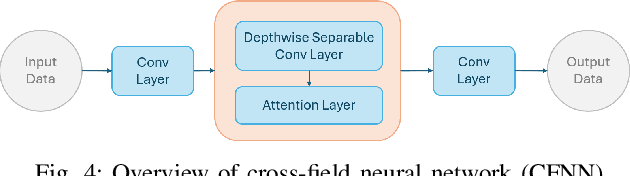
Lossy compression is one of the most effective methods for reducing the size of scientific data containing multiple data fields. It reduces information density through prediction or transformation techniques to compress the data. Previous approaches use local information from a single target field when predicting target data points, limiting their potential to achieve higher compression ratios. In this paper, we identified significant cross-field correlations within scientific datasets. We propose a novel hybrid prediction model that utilizes CNN to extract cross-field information and combine it with existing local field information. Our solution enhances the prediction accuracy of lossy compressors, leading to improved compression ratios without compromising data quality. We evaluate our solution on three scientific datasets, demonstrating its ability to improve compression ratios by up to 25% under specific error bounds. Additionally, our solution preserves more data details and reduces artifacts compared to baseline approaches.