 Add to Chrome
 Add to Firefox
 Add to Edge
Mi:dm 2.0 Korea-centric Bilingual Language Models
Jan 14, 2026
We introduce Mi:dm 2.0, a bilingual large language model (LLM) specifically engineered to advance Korea-centric AI. This model goes beyond Korean text processing by integrating the values, reasoning patterns, and commonsense knowledge inherent to Korean society, enabling nuanced understanding of cultural contexts, emotional subtleties, and real-world scenarios to generate reliable and culturally appropriate responses. To address limitations of existing LLMs, often caused by insufficient or low-quality Korean data and lack of cultural alignment, Mi:dm 2.0 emphasizes robust data quality through a comprehensive pipeline that includes proprietary data cleansing, high-quality synthetic data generation, strategic data mixing with curriculum learning, and a custom Korean-optimized tokenizer to improve efficiency and coverage. To realize this vision, we offer two complementary configurations: Mi:dm 2.0 Base (11.5B parameters), built with a depth-up scaling strategy for general-purpose use, and Mi:dm 2.0 Mini (2.3B parameters), optimized for resource-constrained environments and specialized tasks. Mi:dm 2.0 achieves state-of-the-art performance on Korean-specific benchmarks, with top-tier zero-shot results on KMMLU and strong internal evaluation results across language, humanities, and social science tasks. The Mi:dm 2.0 lineup is released under the MIT license to support extensive research and commercial use. By offering accessible and high-performance Korea-centric LLMs, KT aims to accelerate AI adoption across Korean industries, public services, and education, strengthen the Korean AI developer community, and lay the groundwork for the broader vision of K-intelligence. Our models are available at https://huggingface.co/K-intelligence. For technical inquiries, please contact midm-llm@kt.com.

TelME: Teacher-leading Multimodal Fusion Network for Emotion Recognition in Conversation
Jan 16, 2024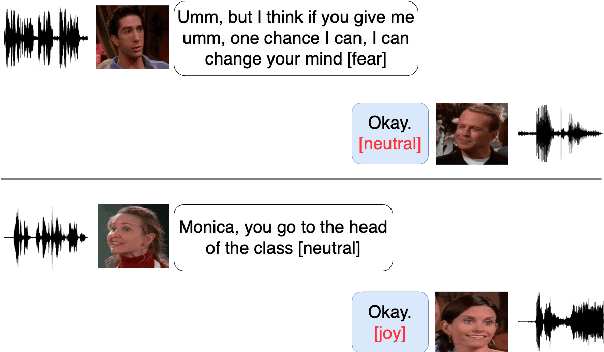
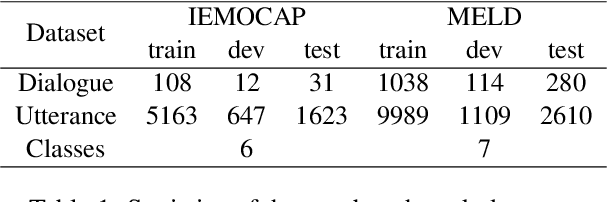
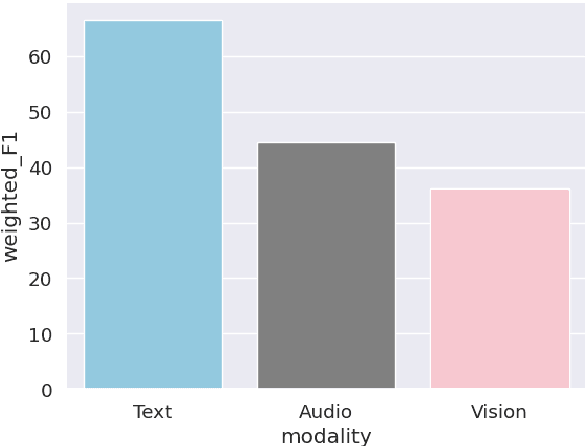
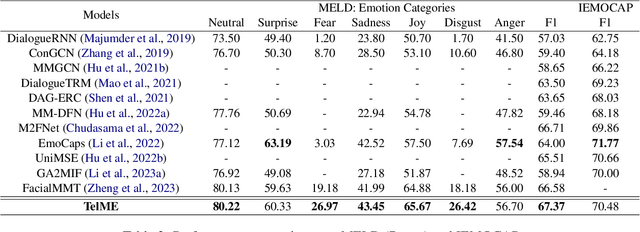
Emotion Recognition in Conversation (ERC) plays a crucial role in enabling dialogue systems to effectively respond to user requests. The emotions in a conversation can be identified by the representations from various modalities, such as audio, visual, and text. However, due to the weak contribution of non-verbal modalities to recognize emotions, multimodal ERC has always been considered a challenging task. In this paper, we propose Teacher-leading Multimodal fusion network for ERC (TelME). TelME incorporates cross-modal knowledge distillation to transfer information from a language model acting as the teacher to the non-verbal students, thereby optimizing the efficacy of the weak modalities. We then combine multimodal features using a shifting fusion approach in which student networks support the teacher. TelME achieves state-of-the-art performance in MELD, a multi-speaker conversation dataset for ERC. Finally, we demonstrate the effectiveness of our components through additional experiments.