 Add to Chrome
 Add to Firefox
 Add to Edge
Prototypicality Bias Reveals Blindspots in Multimodal Evaluation Metrics
Jan 08, 2026
Automatic metrics are now central to evaluating text-to-image models, often substituting for human judgment in benchmarking and large-scale filtering. However, it remains unclear whether these metrics truly prioritize semantic correctness or instead favor visually and socially prototypical images learned from biased data distributions. We identify and study \emph{prototypicality bias} as a systematic failure mode in multimodal evaluation. We introduce a controlled contrastive benchmark \textsc{\textbf{ProtoBias}} (\textit{\textbf{Proto}typical \textbf{Bias}}), spanning Animals, Objects, and Demography images, where semantically correct but non-prototypical images are paired with subtly incorrect yet prototypical adversarial counterparts. This setup enables a directional evaluation of whether metrics follow textual semantics or default to prototypes. Our results show that widely used metrics, including CLIPScore, PickScore, and VQA-based scores, frequently misrank these pairs, while even LLM-as-Judge systems exhibit uneven robustness in socially grounded cases. Human evaluations consistently favour semantic correctness with larger decision margins. Motivated by these findings, we propose \textbf{\textsc{ProtoScore}}, a robust 7B-parameter metric that substantially reduces failure rates and suppresses misranking, while running at orders of magnitude faster than the inference time of GPT-5, approaching the robustness of much larger closed-source judges.

Test Time Adaptation for Blind Image Quality Assessment
Jul 27, 2023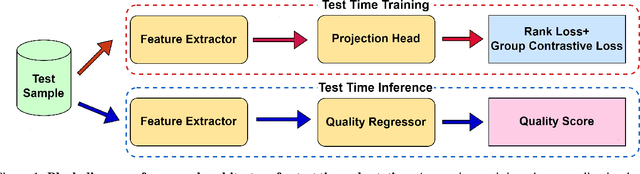
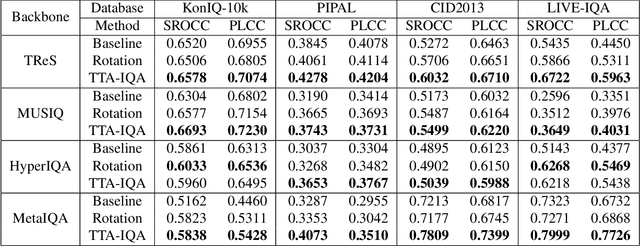
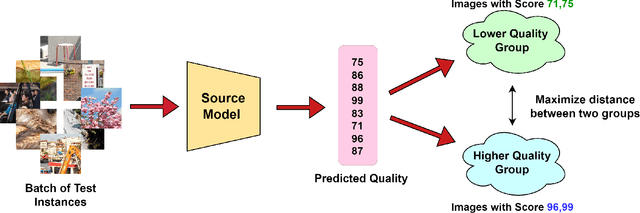
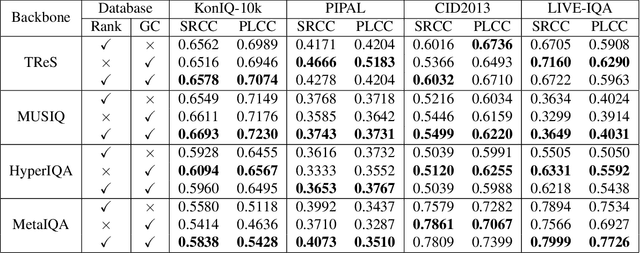
While the design of blind image quality assessment (IQA) algorithms has improved significantly, the distribution shift between the training and testing scenarios often leads to a poor performance of these methods at inference time. This motivates the study of test time adaptation (TTA) techniques to improve their performance at inference time. Existing auxiliary tasks and loss functions used for TTA may not be relevant for quality-aware adaptation of the pre-trained model. In this work, we introduce two novel quality-relevant auxiliary tasks at the batch and sample levels to enable TTA for blind IQA. In particular, we introduce a group contrastive loss at the batch level and a relative rank loss at the sample level to make the model quality aware and adapt to the target data. Our experiments reveal that even using a small batch of images from the test distribution helps achieve significant improvement in performance by updating the batch normalization statistics of the source model.