 Add to Chrome
 Add to Firefox
 Add to Edge
SpectraFormer: an Attention-Based Raman Unmixing Tool for Accessing the Graphene Buffer-Layer Signature on SiC
Jan 07, 2026
Raman spectroscopy is a key tool for graphene characterization, yet its application to graphene grown on silicon carbide (SiC) is strongly limited by the intense and variable second-order Raman response of the substrate. This limitation is critical for buffer layer graphene, a semiconducting interfacial phase, whose vibrational signatures are overlapped with the SiC background and challenging to be reliably accessed using conventional reference-based subtraction, due to strong spatial and experimental variability of the substrate signal. Here we present SpectraFormer, a transformer-based deep learning model that reconstructs the SiC Raman substrate contribution directly from post-growth partially masked spectroscopic data without relying on explicit reference measurements. By learning global correlations across the entire Raman shift range, the model captures the statistical structure of the SiC background and enables accurate reconstruction of its contribution in mixed spectra. Subtraction of the reconstructed substrate signal reveals weak vibrational features associated with ZLG that are inaccessible through conventional analysis methods. The extracted spectra are validated by ab initio vibrational calculations, allowing assignment of the resolved features to specific modes and confirming their physical consistency. By leveraging a state-of-the-art attention-based deep learning architecture, this approach establishes a robust, reference-free framework for Raman analysis of graphene on SiC and provides a foundation, compatible with real-time data acquisition, to its integration into automated, closed-loop AI-assisted growth optimization.

Adaptive AI-Driven Material Synthesis: Towards Autonomous 2D Materials Growth
Oct 10, 2024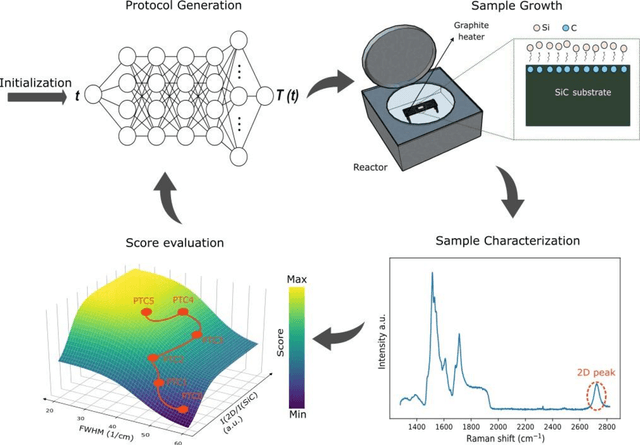
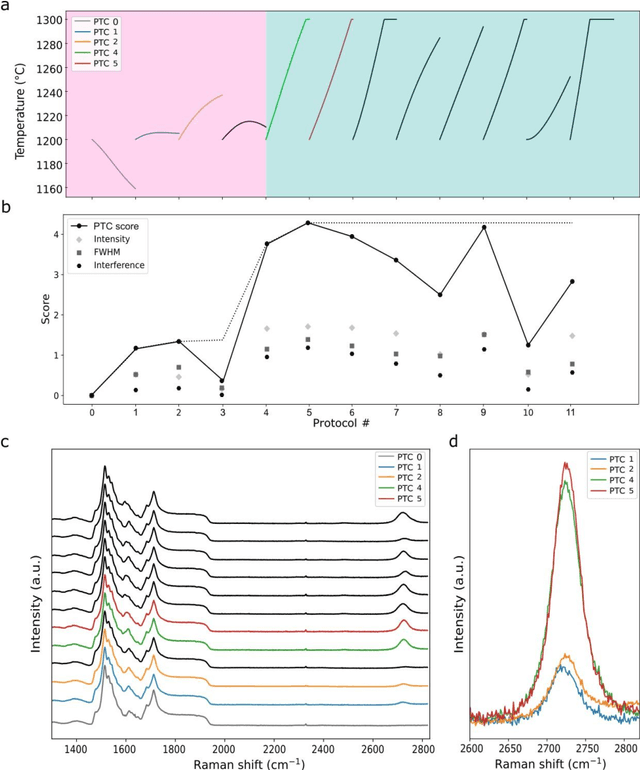
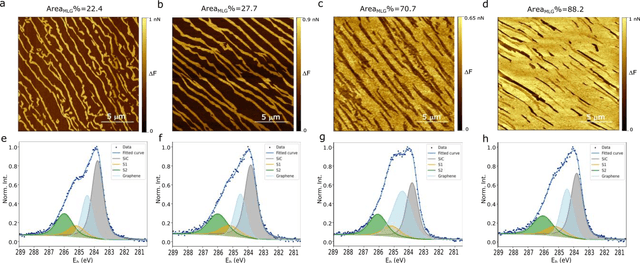
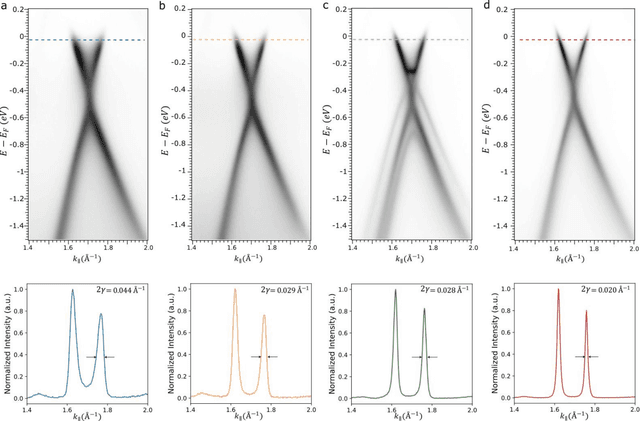
Two-dimensional (2D) materials are poised to revolutionize current solid-state technology with their extraordinary properties. Yet, the primary challenge remains their scalable production. While there have been significant advancements, much of the scientific progress has depended on the exfoliation of materials, a method that poses severe challenges for large-scale applications. With the advent of artificial intelligence (AI) in materials science, innovative synthesis methodologies are now on the horizon. This study explores the forefront of autonomous materials synthesis using an artificial neural network (ANN) trained by evolutionary methods, focusing on the efficient production of graphene. Our approach demonstrates that a neural network can iteratively and autonomously learn a time-dependent protocol for the efficient growth of graphene, without requiring pretraining on what constitutes an effective recipe. Evaluation criteria are based on the proximity of the Raman signature to that of monolayer graphene: higher scores are granted to outcomes whose spectrum more closely resembles that of an ideal continuous monolayer structure. This feedback mechanism allows for iterative refinement of the ANN's time-dependent synthesis protocols, progressively improving sample quality. Through the advancement and application of AI methodologies, this work makes a substantial contribution to the field of materials engineering, fostering a new era of innovation and efficiency in the synthesis process.