 Add to Chrome
 Add to Firefox
 Add to Edge
Learning Nonlinear Heterogeneity in Physical Kolmogorov-Arnold Networks
Jan 25, 2026
Physical neural networks typically train linear synaptic weights while treating device nonlinearities as fixed. We show the opposite - by training the synaptic nonlinearity itself, as in Kolmogorov-Arnold Network (KAN) architectures, we yield markedly higher task performance per physical resource and improved performance-parameter scaling than conventional linear weight-based networks, demonstrating ability of KAN topologies to exploit reconfigurable nonlinear physical dynamics. We experimentally realise physical KANs in silicon-on-insulator devices we term 'Synaptic Nonlinear Elements' (SYNEs), operating at room temperature, microampere currents, 2 MHz speeds and ~250 fJ per nonlinear operation, with no observed degradation over 10^13 measurements and months-long timescales. We demonstrate nonlinear function regression, classification, and prediction of Li-Ion battery dynamics from noisy real-world multi-sensor data. Physical KANs outperform equivalently-parameterised software multilayer perceptron networks across all tasks, with up to two orders of magnitude fewer parameters, and two orders of magnitude fewer devices than linear weight based physical networks. These results establish learned physical nonlinearity as a hardware-native computational primitive for compact and efficient learning systems, and SYNE devices as effective substrates for heterogenous nonlinear computing.

Synaptogen: A cross-domain generative device model for large-scale neuromorphic circuit design
Apr 09, 2024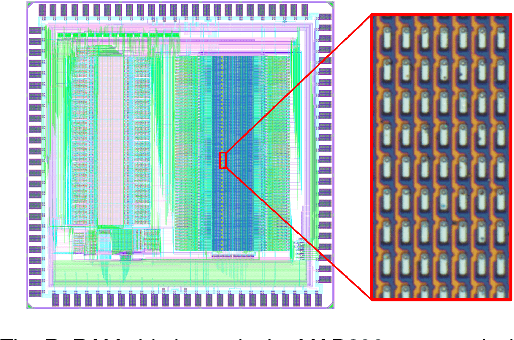
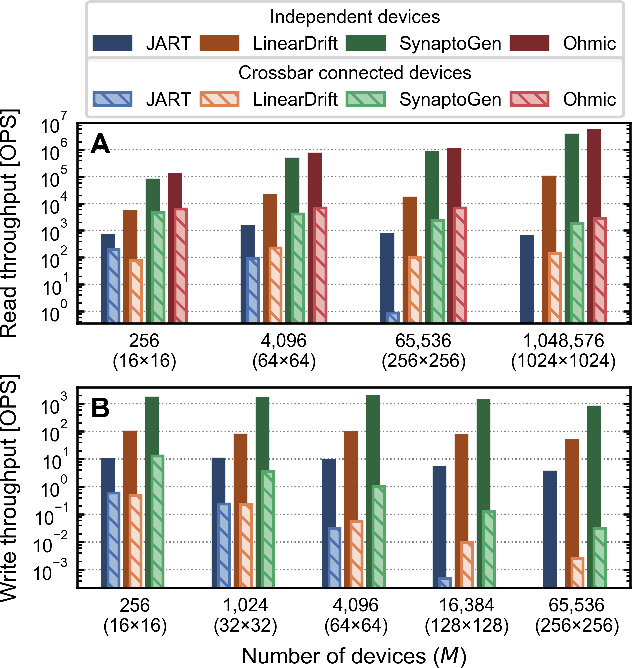
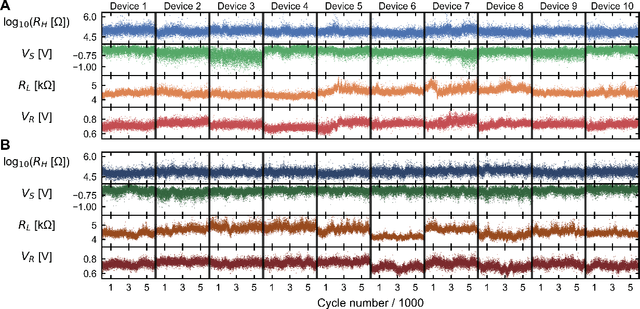
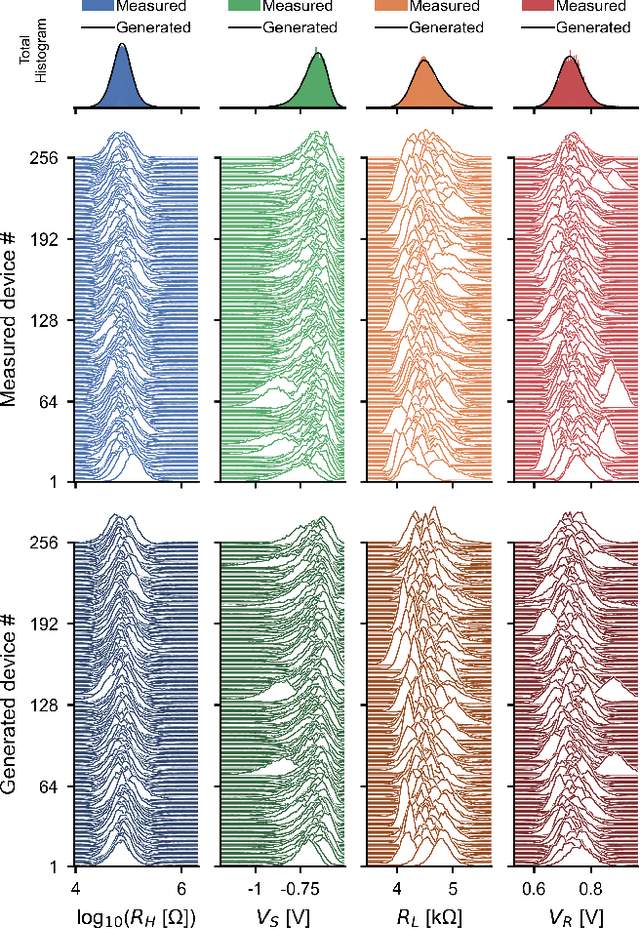
We present a fast generative modeling approach for resistive memories that reproduces the complex statistical properties of real-world devices. To enable efficient modeling of analog circuits, the model is implemented in Verilog-A. By training on extensive measurement data of integrated 1T1R arrays (6,000 cycles of 512 devices), an autoregressive stochastic process accurately accounts for the cross-correlations between the switching parameters, while non-linear transformations ensure agreement with both cycle-to-cycle (C2C) and device-to-device (D2D) variability. Benchmarks show that this statistically comprehensive model achieves read/write throughputs exceeding those of even highly simplified and deterministic compact models.