 Add to Chrome
 Add to Firefox
 Add to Edge
Continuous Angular Power Spectrum Recovery From Channel Covariance via Chebyshev Polynomials
Dec 30, 2025
This paper proposes a Chebyshev polynomial expansion framework for the recovery of a continuous angular power spectrum (APS) from channel covariance. By exploiting the orthogonality of Chebyshev polynomials in a transformed domain, we derive an exact series representation of the covariance and reformulate the inherently ill-posed APS inversion as a finite-dimensional linear regression problem via truncation. The associated approximation error is directly controlled by the tail of the APS's Chebyshev series and decays rapidly with increasing angular smoothness. Building on this representation, we derive an exact semidefinite characterization of nonnegative APS and introduce a derivative-based regularizer that promotes smoothly varying APS profiles while preserving transitions of clusters. Simulation results show that the proposed Chebyshev-based framework yields accurate APS reconstruction, and enables reliable downlink (DL) covariance prediction from uplink (UL) measurements in a frequency division duplex (FDD) setting. These findings indicate that jointly exploiting smoothness and nonnegativity in a Chebyshev domain provides an effective tool for covariance-domain processing in multi-antenna systems.

Affine-Projection Recovery of Continuous Angular Power Spectrum: Geometry and Resolution
Dec 29, 2025This paper considers recovering a continuous angular power spectrum (APS) from the channel covariance. Building on the projection-onto-linear-variety (PLV) algorithm, an affine-projection approach introduced by Miretti \emph{et. al.}, we analyze PLV in a well-defined \emph{weighted} Fourier-domain to emphasize its geometric interpretability. This yields an explicit fixed-dimensional trigonometric-polynomial representation and a closed-form solution via a positive-definite matrix, which directly implies uniqueness. We further establish an exact energy identity that yields the APS reconstruction error and leads to a sharp identifiability/resolution characterization: PLV achieves perfect recovery if and only if the ground-truth APS lies in the identified trigonometric-polynomial subspace; otherwise it returns the minimum-energy APS among all covariance-consistent spectra.
Precise Analysis of Covariance Identifiability for Activity Detection in Grant-Free Random Access
Jun 03, 2024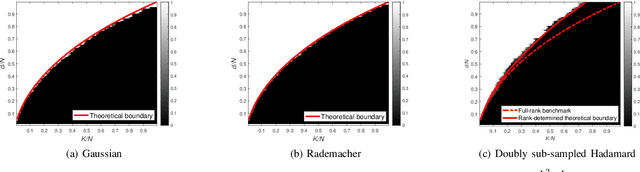
We consider the identifiability issue of maximum likelihood based activity detection in massive MIMO based grant-free random access. A prior work by Chen et al. indicates that the identifiability undergoes a phase transition for commonly-used random signatures. In this paper, we provide an analytical characterization of the boundary of the phase transition curve. Our theoretical results agree well with the numerical experiments.