 Add to Chrome
 Add to Firefox
 Add to Edge
Enhancing LUT-based Deep Neural Networks Inference through Architecture and Connectivity Optimization
Jan 14, 2026
Deploying deep neural networks (DNNs) on resource-constrained edge devices such as FPGAs requires a careful balance among latency, power, and hardware resource usage, while maintaining high accuracy. Existing Lookup Table (LUT)-based DNNs -- such as LogicNets, PolyLUT, and NeuraLUT -- face two critical challenges: the exponential growth of LUT size and inefficient random sparse connectivity. This paper presents SparseLUT, a comprehensive framework that addresses these challenges through two orthogonal optimizations. First, we propose an architectural enhancement that aggregates multiple PolyLUT sub-neurons via an adder, significantly reducing LUT consumption by 2.0x-13.9x and lowering inference latency by 1.2x-1.6x, all while maintaining comparable accuracy. Building upon this foundation, we further introduce a non-greedy training algorithm that optimizes neuron connectivity by selectively pruning less significant inputs and strategically regrowing more effective ones. This training optimization, which incurs no additional area and latency overhead, delivers consistent accuracy improvements across benchmarks -- achieving up to a 2.13% gain on MNIST and 0.94% on Jet Substructure Classification compared to existing LUT-DNN approaches.
* arXiv admin note: substantial text overlap with arXiv:2503.12829, arXiv:2406.04910

Continuous Angular Power Spectrum Recovery From Channel Covariance via Chebyshev Polynomials
Dec 30, 2025This paper proposes a Chebyshev polynomial expansion framework for the recovery of a continuous angular power spectrum (APS) from channel covariance. By exploiting the orthogonality of Chebyshev polynomials in a transformed domain, we derive an exact series representation of the covariance and reformulate the inherently ill-posed APS inversion as a finite-dimensional linear regression problem via truncation. The associated approximation error is directly controlled by the tail of the APS's Chebyshev series and decays rapidly with increasing angular smoothness. Building on this representation, we derive an exact semidefinite characterization of nonnegative APS and introduce a derivative-based regularizer that promotes smoothly varying APS profiles while preserving transitions of clusters. Simulation results show that the proposed Chebyshev-based framework yields accurate APS reconstruction, and enables reliable downlink (DL) covariance prediction from uplink (UL) measurements in a frequency division duplex (FDD) setting. These findings indicate that jointly exploiting smoothness and nonnegativity in a Chebyshev domain provides an effective tool for covariance-domain processing in multi-antenna systems.
Affine-Projection Recovery of Continuous Angular Power Spectrum: Geometry and Resolution
Dec 29, 2025This paper considers recovering a continuous angular power spectrum (APS) from the channel covariance. Building on the projection-onto-linear-variety (PLV) algorithm, an affine-projection approach introduced by Miretti \emph{et. al.}, we analyze PLV in a well-defined \emph{weighted} Fourier-domain to emphasize its geometric interpretability. This yields an explicit fixed-dimensional trigonometric-polynomial representation and a closed-form solution via a positive-definite matrix, which directly implies uniqueness. We further establish an exact energy identity that yields the APS reconstruction error and leads to a sharp identifiability/resolution characterization: PLV achieves perfect recovery if and only if the ground-truth APS lies in the identified trigonometric-polynomial subspace; otherwise it returns the minimum-energy APS among all covariance-consistent spectra.
SparseLUT: Sparse Connectivity Optimization for Lookup Table-based Deep Neural Networks
Mar 17, 2025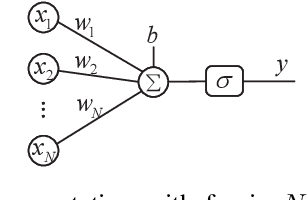
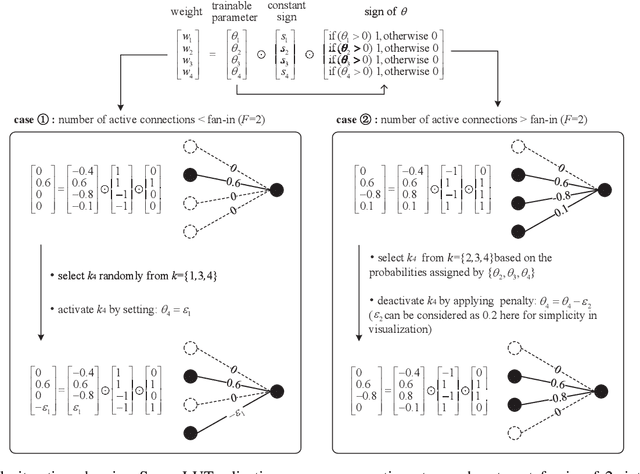


The deployment of deep neural networks (DNNs) on resource-constrained edge devices such as field-programmable gate arrays (FPGAs) requires a careful balance of latency, power, and resource usage while maintaining high accuracy. Existing Lookup Table (LUT)-based DNNs, including LogicNets, PolyLUT, PolyLUT-Add, and NeuraLUT, exploit native FPGA resources with random sparse connectivity. This paper introduces SparseLUT, a connectivity-centric training technique tailored for LUT-based DNNs. SparseLUT leverages a non-greedy training strategy that prioritizes the pruning of less significant connections and strategically regrows alternative ones, resulting in efficient convergence to the target sparsity. Experimental results show consistent accuracy improvements across benchmarks, including up to a 2.13\% increase on MNIST and a 0.94\% improvement for Jet Substructure Classification compared to random sparsity. This is done without any hardware overhead and achieves state-of-the-art results for LUT-based DNNs.