 Add to Chrome
 Add to Firefox
 Add to Edge
Perception Without Engagement: Dissecting the Causal Discovery Deficit in LMMs
May 10, 2026
Although Large Multimodal Models (LMMs) have achieved strong performance on general video understanding, their susceptibility to textual prior shortcuts during causal discovery has been recognized as a critical deficit. The underlying mechanisms of this phenomenon remain incompletely understood, as existing benchmarks only measure response accuracy without revealing the sources and extent of the deficit. We introduce ProCauEval, a perturbation-based evaluation protocol that shifts from outcome assessment to mechanism diagnosis, probing causal discovery through five controlled configurations that systematically manipulate visual and textual modalities to decompose their respective contributions to model behavior and dissect the failure modes. Evaluating 17 mainstream LMMs, we find that models faithfully perceive video content yet systematically underexploit it during causal reasoning. We further observe that stronger post-training amplifies rather than mitigates textual prior reliance, and that higher baseline performance correlates with greater fragility under perturbation. To address these, we propose Anti-Distillation Policy Optimization (ADPO), a reinforcement learning framework built on negative teacher alignment, which augments GRPO by explicitly pushing the policy away from a prior-only counterfactual teacher induced by visual corruption. Specifically, ADPO maximizes the divergence between the policy distributions conditioned on the original and visually corrupted inputs, thereby forcing the model to ground its reasoning in visual evidence rather than textual shortcuts. Extensive experiments show that ADPO improves visual engagement without sacrificing fundamental comprehension, thus offering a preliminary step toward reliable causal discovery.

Schema-Aware Planning and Hybrid Knowledge Toolset for Reliable Knowledge Graph Triple Verification
Apr 05, 2026Knowledge Graphs (KGs) serve as a critical foundation for AI systems, yet their automated construction inevitably introduces noise, compromising data trustworthiness. Existing triple verification methods, based on graph embeddings or language models, often suffer from single-source bias by relying on either internal structural constraints or external semantic evidence, and usually follow a static inference paradigm. As a result, they struggle with complex or long-tail facts and provide limited interpretability. To address these limitations, we propose SHARP (Schema-Hybrid Agent for Reliable Prediction), a training-free autonomous agent that reformulates triple verification as a dynamic process of strategic planning, active investigation, and evidential reasoning. Specifically, SHARP combines a Memory-Augmented Mechanism with Schema-Aware Strategic Planning to improve reasoning stability, and employs an enhanced ReAct loop with a Hybrid Knowledge Toolset to dynamically integrate internal KG structure and external textual evidence for cross-verification. Experiments on FB15K-237 and Wikidata5M-Ind show that SHARP significantly outperforms existing state-of-the-art baselines, achieving accuracy gains of 4.2% and 12.9%, respectively. Moreover, SHARP provides transparent, fact-based evidence chains for each judgment, demonstrating strong interpretability and robustness for complex verification tasks.
The Evolution of Tool Use in LLM Agents: From Single-Tool Call to Multi-Tool Orchestration
Mar 24, 2026Tool use enables large language models (LLMs) to access external information, invoke software systems, and act in digital environments beyond what can be solved from model parameters alone. Early research mainly studied whether a model could select and execute a correct single tool call. As agent systems evolve, however, the central problem has shifted from isolated invocation to multi-tool orchestration over long trajectories with intermediate state, execution feedback, changing environments, and practical constraints such as safety, cost, and verifiability. We comprehensively review recent progress in multi-tool LLM agents and analyzes the state of the art in this rapidly developing area. First, we unify task formulations and distinguish single-call tool use from long-horizon orchestration. Then, we organize the literature around six core dimensions: inference-time planning and execution, training and trajectory construction, safety and control, efficiency under resource constraints, capability completeness in open environments, and benchmark design and evaluation. We further summarize representative applications in software engineering, enterprise workflows, graphical user interfaces, and mobile systems. Finally, we discuss major challenges and outline future directions for building reliable, scalable, and verifiable multi-tool agents.
Graph Reasoning Paradigm: Structured and Symbolic Reasoning with Topology-Aware Reinforcement Learning for Large Language Models
Jan 19, 2026Long Chain-of-Thought (LCoT), achieved by Reinforcement Learning with Verifiable Rewards (RLVR), has proven effective in enhancing the reasoning capabilities of Large Language Models (LLMs). However, reasoning in current LLMs is primarily generated as plain text, where performing semantic evaluation on such unstructured data creates a computational bottleneck during training. Despite RLVR-based optimization, existing methods still suffer from coarse-grained supervision, reward hacking, high training costs, and poor generalization. To address these issues, we propose the Graph Reasoning Paradigm (GRP), which realizes structured and symbolic reasoning, implemented via graph-structured representations with step-level cognitive labels. Building upon GRP, we further design Process-Aware Stratified Clipping Group Relative Policy Optimization (PASC-GRPO), which leverages structured evaluation to replace semantic evaluation, achieves process-aware verification through graph-structured outcome rewards, and mitigates reward hacking via stratified clipping advantage estimation. Experiments demonstrate significant improvements across mathematical reasoning and code generation tasks. Data, models, and code will be released later.
AI Meets Brain: Memory Systems from Cognitive Neuroscience to Autonomous Agents
Dec 29, 2025Memory serves as the pivotal nexus bridging past and future, providing both humans and AI systems with invaluable concepts and experience to navigate complex tasks. Recent research on autonomous agents has increasingly focused on designing efficient memory workflows by drawing on cognitive neuroscience. However, constrained by interdisciplinary barriers, existing works struggle to assimilate the essence of human memory mechanisms. To bridge this gap, we systematically synthesizes interdisciplinary knowledge of memory, connecting insights from cognitive neuroscience with LLM-driven agents. Specifically, we first elucidate the definition and function of memory along a progressive trajectory from cognitive neuroscience through LLMs to agents. We then provide a comparative analysis of memory taxonomy, storage mechanisms, and the complete management lifecycle from both biological and artificial perspectives. Subsequently, we review the mainstream benchmarks for evaluating agent memory. Additionally, we explore memory security from dual perspectives of attack and defense. Finally, we envision future research directions, with a focus on multimodal memory systems and skill acquisition.
Ontology-Guided Reverse Thinking Makes Large Language Models Stronger on Knowledge Graph Question Answering
Feb 17, 2025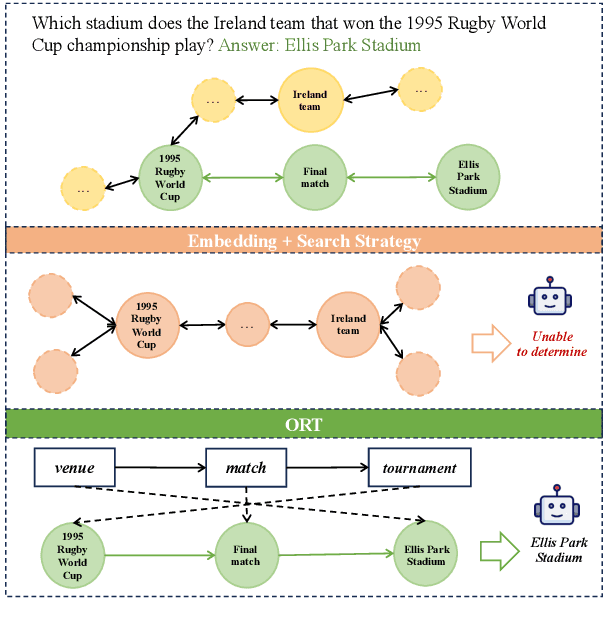
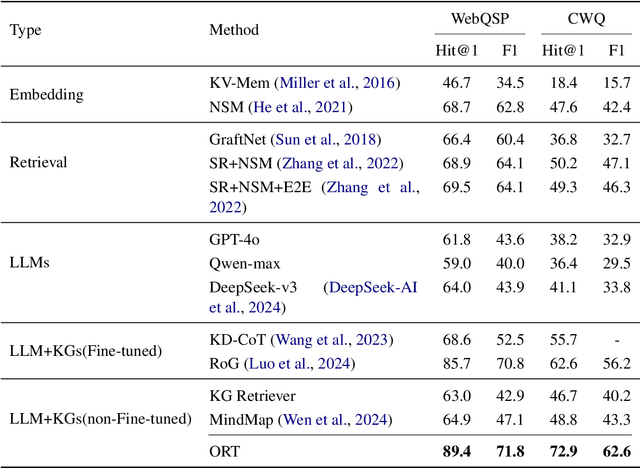
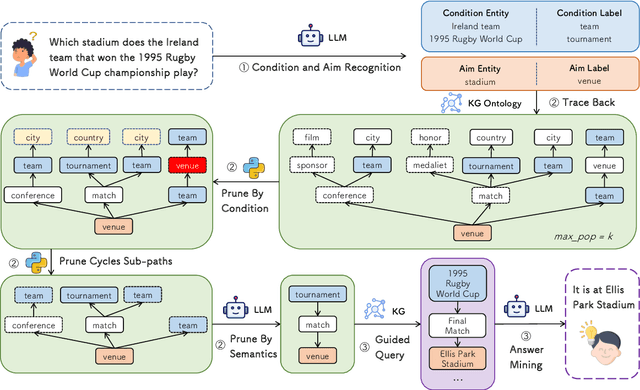
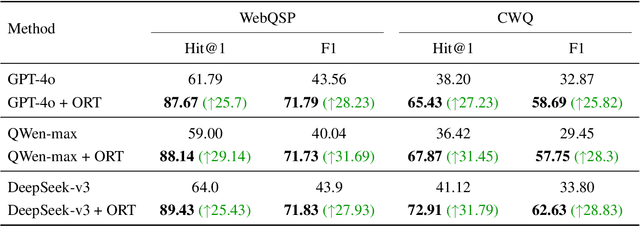
Large language models (LLMs) have shown remarkable capabilities in natural language processing. However, in knowledge graph question answering tasks (KGQA), there remains the issue of answering questions that require multi-hop reasoning. Existing methods rely on entity vector matching, but the purpose of the question is abstract and difficult to match with specific entities. As a result, it is difficult to establish reasoning paths to the purpose, which leads to information loss and redundancy. To address this issue, inspired by human reverse thinking, we propose Ontology-Guided Reverse Thinking (ORT), a novel framework that constructs reasoning paths from purposes back to conditions. ORT operates in three key phases: (1) using LLM to extract purpose labels and condition labels, (2) constructing label reasoning paths based on the KG ontology, and (3) using the label reasoning paths to guide knowledge retrieval. Experiments on the WebQSP and CWQ datasets show that ORT achieves state-of-the-art performance and significantly enhances the capability of LLMs for KGQA.