 Add to Chrome
 Add to Firefox
 Add to Edge
Learning Physics-Grounded 4D Dynamics with Neural Gaussian Force Fields
Jan 29, 2026
Predicting physical dynamics from raw visual data remains a major challenge in AI. While recent video generation models have achieved impressive visual quality, they still cannot consistently generate physically plausible videos due to a lack of modeling of physical laws. Recent approaches combining 3D Gaussian splatting and physics engines can produce physically plausible videos, but are hindered by high computational costs in both reconstruction and simulation, and often lack robustness in complex real-world scenarios. To address these issues, we introduce Neural Gaussian Force Field (NGFF), an end-to-end neural framework that integrates 3D Gaussian perception with physics-based dynamic modeling to generate interactive, physically realistic 4D videos from multi-view RGB inputs, achieving two orders of magnitude faster than prior Gaussian simulators. To support training, we also present GSCollision, a 4D Gaussian dataset featuring diverse materials, multi-object interactions, and complex scenes, totaling over 640k rendered physical videos (~4 TB). Evaluations on synthetic and real 3D scenarios show NGFF's strong generalization and robustness in physical reasoning, advancing video prediction towards physics-grounded world models.

Neural Force Field: Learning Generalized Physical Representation from a Few Examples
Feb 13, 2025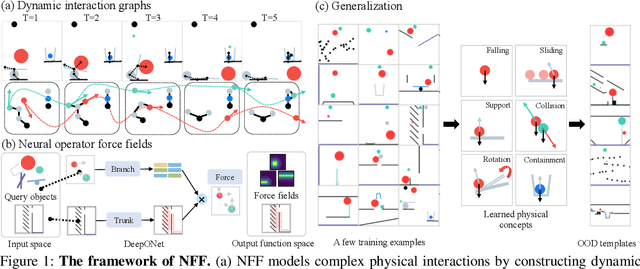
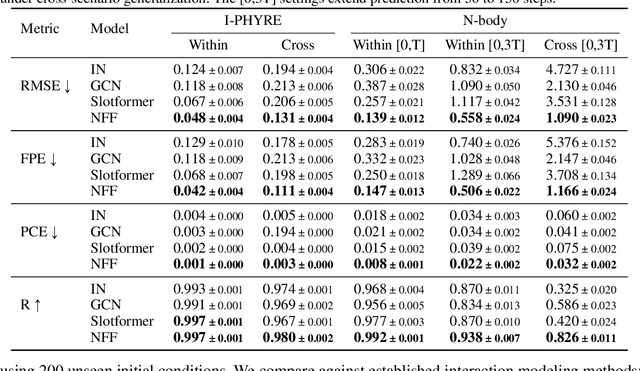
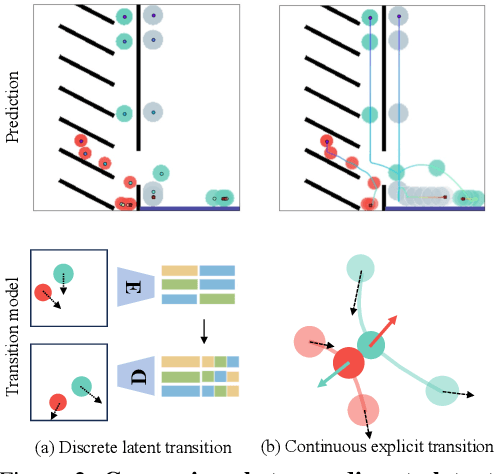

Physical reasoning is a remarkable human ability that enables rapid learning and generalization from limited experience. Current AI models, despite extensive training, still struggle to achieve similar generalization, especially in Out-of-distribution (OOD) settings. This limitation stems from their inability to abstract core physical principles from observations. A key challenge is developing representations that can efficiently learn and generalize physical dynamics from minimal data. Here we present Neural Force Field (NFF) a modeling framework built on Neural Ordinary Differential Equation (NODE) that learns interpretable force field representations which can be efficiently integrated through an Ordinary Differential Equation ( ODE) solver to predict object trajectories. Unlike existing approaches that rely on high-dimensional latent spaces, NFF captures fundamental physical concepts such as gravity, support, and collision in an interpretable manner. Experiments on two challenging physical reasoning tasks demonstrate that NFF, trained with only a few examples, achieves strong generalization to unseen scenarios. This physics-grounded representation enables efficient forward-backward planning and rapid adaptation through interactive refinement. Our work suggests that incorporating physics-inspired representations into learning systems can help bridge the gap between artificial and human physical reasoning capabilities.