 Add to Chrome
 Add to Firefox
 Add to Edge
CoG: Controllable Graph Reasoning via Relational Blueprints and Failure-Aware Refinement over Knowledge Graphs
Jan 16, 2026
Large Language Models (LLMs) have demonstrated remarkable reasoning capabilities but often grapple with reliability challenges like hallucinations. While Knowledge Graphs (KGs) offer explicit grounding, existing paradigms of KG-augmented LLMs typically exhibit cognitive rigidity--applying homogeneous search strategies that render them vulnerable to instability under neighborhood noise and structural misalignment leading to reasoning stagnation. To address these challenges, we propose CoG, a training-free framework inspired by Dual-Process Theory that mimics the interplay between intuition and deliberation. First, functioning as the fast, intuitive process, the Relational Blueprint Guidance module leverages relational blueprints as interpretable soft structural constraints to rapidly stabilize the search direction against noise. Second, functioning as the prudent, analytical process, the Failure-Aware Refinement module intervenes upon encountering reasoning impasses. It triggers evidence-conditioned reflection and executes controlled backtracking to overcome reasoning stagnation. Experimental results on three benchmarks demonstrate that CoG significantly outperforms state-of-the-art approaches in both accuracy and efficiency.

TAP: Parameter-efficient Task-Aware Prompting for Adverse Weather Removal
Aug 11, 2025Image restoration under adverse weather conditions has been extensively explored, leading to numerous high-performance methods. In particular, recent advances in All-in-One approaches have shown impressive results by training on multi-task image restoration datasets. However, most of these methods rely on dedicated network modules or parameters for each specific degradation type, resulting in a significant parameter overhead. Moreover, the relatedness across different restoration tasks is often overlooked. In light of these issues, we propose a parameter-efficient All-in-One image restoration framework that leverages task-aware enhanced prompts to tackle various adverse weather degradations.Specifically, we adopt a two-stage training paradigm consisting of a pretraining phase and a prompt-tuning phase to mitigate parameter conflicts across tasks. We first employ supervised learning to acquire general restoration knowledge, and then adapt the model to handle specific degradation via trainable soft prompts. Crucially, we enhance these task-specific prompts in a task-aware manner. We apply low-rank decomposition to these prompts to capture both task-general and task-specific characteristics, and impose contrastive constraints to better align them with the actual inter-task relatedness. These enhanced prompts not only improve the parameter efficiency of the restoration model but also enable more accurate task modeling, as evidenced by t-SNE analysis. Experimental results on different restoration tasks demonstrate that the proposed method achieves superior performance with only 2.75M parameters.
Fire and Smoke Detection with Burning Intensity Representation
Oct 22, 2024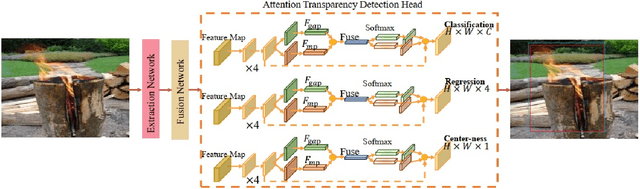
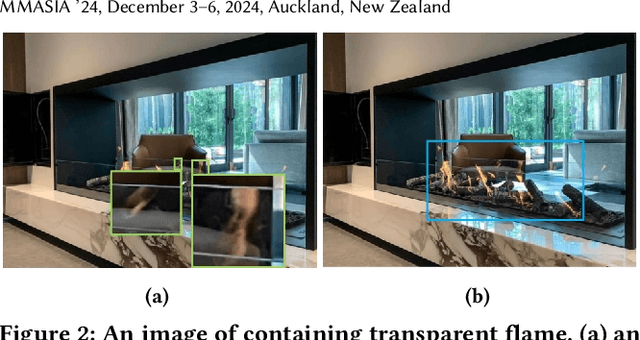
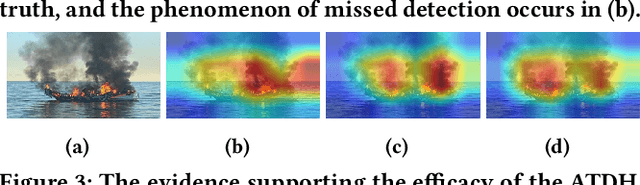
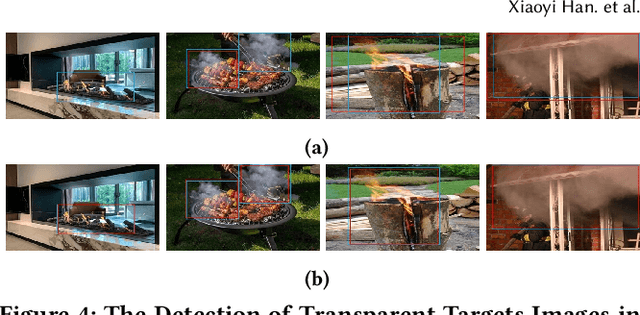
An effective Fire and Smoke Detection (FSD) and analysis system is of paramount importance due to the destructive potential of fire disasters. However, many existing FSD methods directly employ generic object detection techniques without considering the transparency of fire and smoke, which leads to imprecise localization and reduces detection performance. To address this issue, a new Attentive Fire and Smoke Detection Model (a-FSDM) is proposed. This model not only retains the robust feature extraction and fusion capabilities of conventional detection algorithms but also redesigns the detection head specifically for transparent targets in FSD, termed the Attentive Transparency Detection Head (ATDH). In addition, Burning Intensity (BI) is introduced as a pivotal feature for fire-related downstream risk assessments in traditional FSD methodologies. Extensive experiments on multiple FSD datasets showcase the effectiveness and versatility of the proposed FSD model. The project is available at \href{https://xiaoyihan6.github.io/FSD/}{https://xiaoyihan6.github.io/FSD/}.
Benchmarking Multi-Scene Fire and Smoke Detection
Oct 22, 2024The current irregularities in existing public Fire and Smoke Detection (FSD) datasets have become a bottleneck in the advancement of FSD technology. Upon in-depth analysis, we identify the core issue as the lack of standardized dataset construction, uniform evaluation systems, and clear performance benchmarks. To address this issue and drive innovation in FSD technology, we systematically gather diverse resources from public sources to create a more comprehensive and refined FSD benchmark. Additionally, recognizing the inadequate coverage of existing dataset scenes, we strategically expand scenes, relabel, and standardize existing public FSD datasets to ensure accuracy and consistency. We aim to establish a standardized, realistic, unified, and efficient FSD research platform that mirrors real-life scenes closely. Through our efforts, we aim to provide robust support for the breakthrough and development of FSD technology. The project is available at \href{https://xiaoyihan6.github.io/FSD/}{https://xiaoyihan6.github.io/FSD/}.