 Add to Chrome
 Add to Firefox
 Add to Edge
Redefining Machine Simultaneous Interpretation: From Incremental Translation to Human-Like Strategies
Jan 16, 2026
Simultaneous Machine Translation (SiMT) requires high-quality translations under strict real-time constraints, which traditional policies with only READ/WRITE actions cannot fully address. We extend the action space of SiMT with four adaptive actions: Sentence_Cut, Drop, Partial_Summarization and Pronominalization, which enable real-time restructuring, omission, and simplification while preserving semantic fidelity. We adapt these actions in a large language model (LLM) framework and construct training references through action-aware prompting. To evaluate both quality and word-level monotonicity, we further develop a latency-aware TTS pipeline that maps textual outputs to speech with realistic timing. Experiments on the ACL60/60 English-Chinese, English-German and English-Japanese benchmarks show that our framework consistently improves semantic metrics and achieves lower delay compared to reference translations and salami-based baselines. Notably, combining Drop and Sentence_Cut leads to consistent improvements in the balance between fluency and latency. These results demonstrate that enriching the action space of LLM-based SiMT provides a promising direction for bridging the gap between human and machine interpretation.

DPO-Shift: Shifting the Distribution of Direct Preference Optimization
Feb 11, 2025
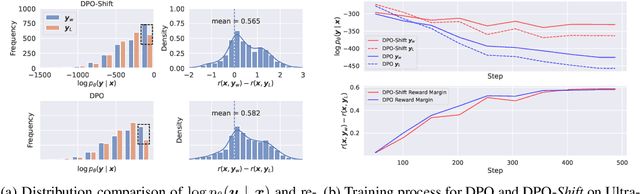
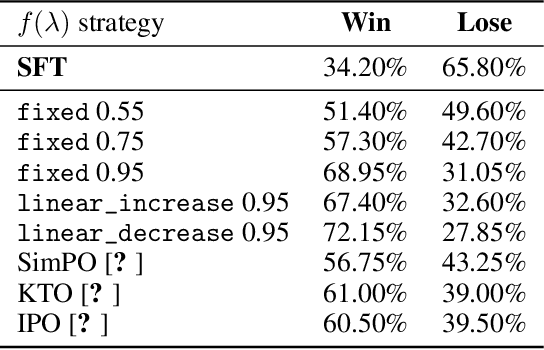
Direct Preference Optimization (DPO) and its variants have become increasingly popular for aligning language models with human preferences. These methods aim to teach models to better distinguish between chosen (or preferred) and rejected (or dispreferred) responses. However, prior research has identified that the probability of chosen responses often decreases during training, and this phenomenon is known as likelihood displacement. To tackle this challenge, in this work we introduce \method to controllably shift the distribution of the chosen probability. Then, we show that \method exhibits a fundamental trade-off between improving the chosen probability and sacrificing the reward margin, as supported by both theoretical analysis and experimental validation. Furthermore, we demonstrate the superiority of \method over DPO on downstream tasks such as MT-Bench and a designed win rate experiment. We believe this study shows that the likelihood displacement issue of DPO can be effectively mitigated with a simple, theoretically grounded solution. Our code is available at https://github.com/Meaquadddd/DPO-Shift.