 Add to Chrome
 Add to Firefox
 Add to Edge
Med-MMFL: A Multimodal Federated Learning Benchmark in Healthcare
Feb 04, 2026
Federated learning (FL) enables collaborative model training across decentralized medical institutions while preserving data privacy. However, medical FL benchmarks remain scarce, with existing efforts focusing mainly on unimodal or bimodal modalities and a limited range of medical tasks. This gap underscores the need for standardized evaluation to advance systematic understanding in medical MultiModal FL (MMFL). To this end, we introduce Med-MMFL, the first comprehensive MMFL benchmark for the medical domain, encompassing diverse modalities, tasks, and federation scenarios. Our benchmark evaluates six representative state-of-the-art FL algorithms, covering different aggregation strategies, loss formulations, and regularization techniques. It spans datasets with 2 to 4 modalities, comprising a total of 10 unique medical modalities, including text, pathology images, ECG, X-ray, radiology reports, and multiple MRI sequences. Experiments are conducted across naturally federated, synthetic IID, and synthetic non-IID settings to simulate real-world heterogeneity. We assess segmentation, classification, modality alignment (retrieval), and VQA tasks. To support reproducibility and fair comparison of future multimodal federated learning (MMFL) methods under realistic medical settings, we release the complete benchmark implementation, including data processing and partitioning pipelines, at https://github.com/bhattarailab/Med-MMFL-Benchmark .

Deep Representation Learning for Electronic Design Automation
May 04, 2025Representation learning has become an effective technique utilized by electronic design automation (EDA) algorithms, which leverage the natural representation of workflow elements as images, grids, and graphs. By addressing challenges related to the increasing complexity of circuits and stringent power, performance, and area (PPA) requirements, representation learning facilitates the automatic extraction of meaningful features from complex data formats, including images, grids, and graphs. This paper examines the application of representation learning in EDA, covering foundational concepts and analyzing prior work and case studies on tasks that include timing prediction, routability analysis, and automated placement. Key techniques, including image-based methods, graph-based approaches, and hybrid multimodal solutions, are presented to illustrate the improvements provided in routing, timing, and parasitic prediction. The provided advancements demonstrate the potential of representation learning to enhance efficiency, accuracy, and scalability in current integrated circuit design flows.
3D Reconstruction of Shoes for Augmented Reality
Jan 29, 2025
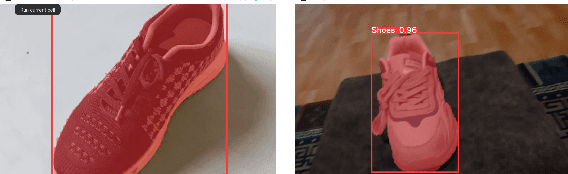


This paper introduces a mobile-based solution that enhances online shoe shopping through 3D modeling and Augmented Reality (AR), leveraging the efficiency of 3D Gaussian Splatting. Addressing the limitations of static 2D images, the framework generates realistic 3D shoe models from 2D images, achieving an average Peak Signal-to-Noise Ratio (PSNR) of 0.32, and enables immersive AR interactions via smartphones. A custom shoe segmentation dataset of 3120 images was created, with the best-performing segmentation model achieving an Intersection over Union (IoU) score of 0.95. This paper demonstrates the potential of 3D modeling and AR to revolutionize online shopping by offering realistic virtual interactions, with applicability across broader fashion categories.