 Add to Chrome
 Add to Firefox
 Add to Edge
Context-specific Credibility-aware Multimodal Fusion with Conditional Probabilistic Circuits
Mar 27, 2026
Multimodal fusion requires integrating information from multiple sources that may conflict depending on context. Existing fusion approaches typically rely on static assumptions about source reliability, limiting their ability to resolve conflicts when a modality becomes unreliable due to situational factors such as sensor degradation or class-specific corruption. We introduce C$^2$MF, a context-specfic credibility-aware multimodal fusion framework that models per-instance source reliability using a Conditional Probabilistic Circuit (CPC). We formalize instance-level reliability through Context-Specific Information Credibility (CSIC), a KL-divergence-based measure computed exactly from the CPC. CSIC generalizes conventional static credibility estimates as a special case, enabling principled and adaptive reliability assessment. To evaluate robustness under cross-modal conflicts, we propose the Conflict benchmark, in which class-specific corruptions deliberately induce discrepancies between different modalities. Experimental results show that C$^2$MF improves predictive accuracy by up to 29% over static-reliability baselines in high-noise settings, while preserving the interpretability advantages of probabilistic circuit-based fusion.

Credibility-Aware Multi-Modal Fusion Using Probabilistic Circuits
Mar 05, 2024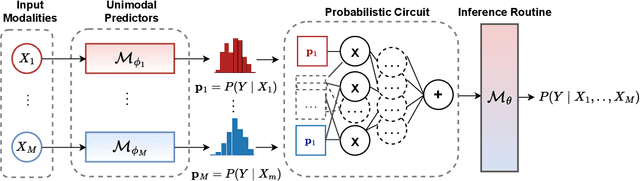
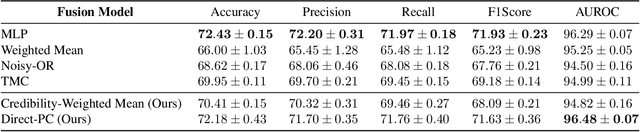
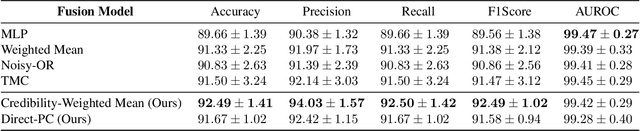
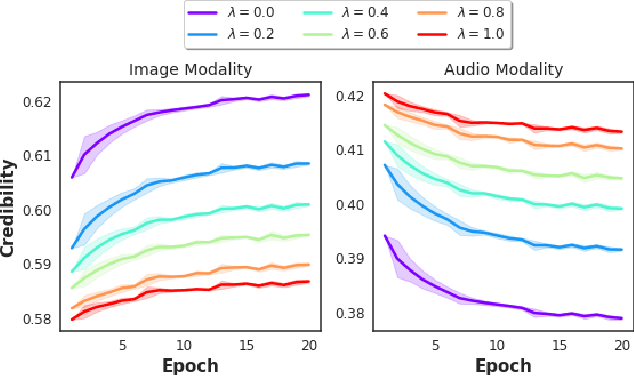
We consider the problem of late multi-modal fusion for discriminative learning. Motivated by noisy, multi-source domains that require understanding the reliability of each data source, we explore the notion of credibility in the context of multi-modal fusion. We propose a combination function that uses probabilistic circuits (PCs) to combine predictive distributions over individual modalities. We also define a probabilistic measure to evaluate the credibility of each modality via inference queries over the PC. Our experimental evaluation demonstrates that our fusion method can reliably infer credibility while maintaining competitive performance with the state-of-the-art.