 Add to Chrome
 Add to Firefox
 Add to Edge
ItinBench: Benchmarking Planning Across Multiple Cognitive Dimensions with Large Language Models
Mar 19, 2026
Large language models (LLMs) with advanced cognitive capabilities are emerging as agents for various reasoning and planning tasks. Traditional evaluations often focus on specific reasoning or planning questions within controlled environments. Recent studies have explored travel planning as a medium to integrate various verbal reasoning tasks into real-world contexts. However, reasoning tasks extend beyond verbal reasoning alone, and a comprehensive evaluation of LLMs requires a testbed that incorporates tasks from multiple cognitive domains. To address this gap, we introduce ItinBench, a benchmark that features one task of spatial reasoning, i.e., route optimization, into trip itinerary planning while keeping the traditional verbal reasoning tasks. ItinBench evaluates various LLMs across diverse tasks simultaneously, including Llama 3.1 8B, Mistral Large, Gemini 1.5 Pro, and GPT family. Our findings reveal that LLMs struggle to maintain high and consistent performance when concurrently handling multiple cognitive dimensions. By incorporating tasks from distinct human-level cognitive domains, ItinBench provides new insights into building more comprehensive reasoning testbeds that better reflect real-world challenges. The code and dataset: https://ethanwtl.github.io/IBweb/

Multi-Agent Debate: A Unified Agentic Framework for Tabular Anomaly Detection
Feb 15, 2026Tabular anomaly detection is often handled by single detectors or static ensembles, even though strong performance on tabular data typically comes from heterogeneous model families (e.g., tree ensembles, deep tabular networks, and tabular foundation models) that frequently disagree under distribution shift, missingness, and rare-anomaly regimes. We propose MAD, a Multi-Agent Debating framework that treats this disagreement as a first-class signal and resolves it through a mathematically grounded coordination layer. Each agent is a machine learning (ML)-based detector that produces a normalized anomaly score, confidence, and structured evidence, augmented by a large language model (LLM)-based critic. A coordinator converts these messages into bounded per-agent losses and updates agent influence via an exponentiated-gradient rule, yielding both a final debated anomaly score and an auditable debate trace. MAD is a unified agentic framework that can recover existing approaches, such as mixture-of-experts gating and learning-with-expert-advice aggregation, by restricting the message space and synthesis operator. We establish regret guarantees for the synthesized losses and show how conformal calibration can wrap the debated score to control false positives under exchangeability. Experiments on diverse tabular anomaly benchmarks show improved robustness over baselines and clearer traces of model disagreement
FinRobot: AI Agent for Equity Research and Valuation with Large Language Models
Nov 13, 2024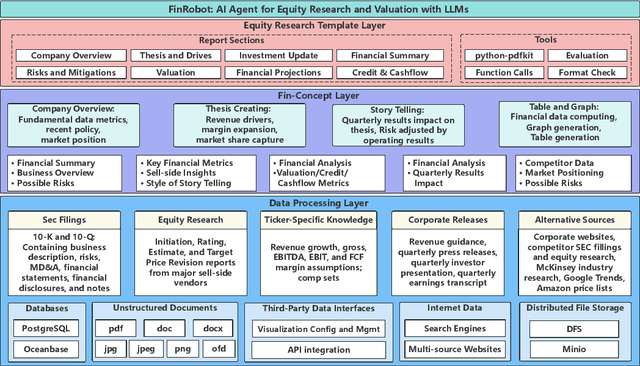
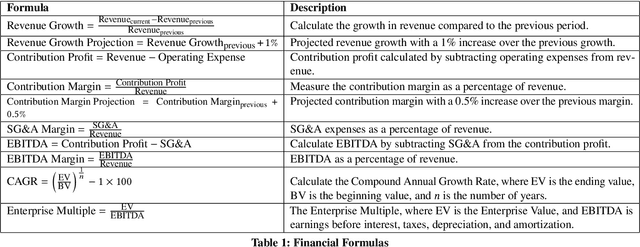
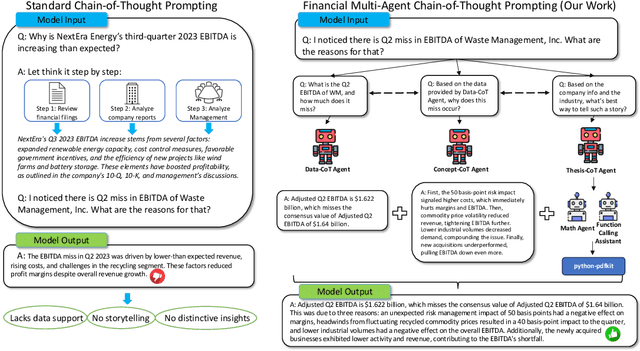
As financial markets grow increasingly complex, there is a rising need for automated tools that can effectively assist human analysts in equity research, particularly within sell-side research. While Generative AI (GenAI) has attracted significant attention in this field, existing AI solutions often fall short due to their narrow focus on technical factors and limited capacity for discretionary judgment. These limitations hinder their ability to adapt to new data in real-time and accurately assess risks, which diminishes their practical value for investors. This paper presents FinRobot, the first AI agent framework specifically designed for equity research. FinRobot employs a multi-agent Chain of Thought (CoT) system, integrating both quantitative and qualitative analyses to emulate the comprehensive reasoning of a human analyst. The system is structured around three specialized agents: the Data-CoT Agent, which aggregates diverse data sources for robust financial integration; the Concept-CoT Agent, which mimics an analysts reasoning to generate actionable insights; and the Thesis-CoT Agent, which synthesizes these insights into a coherent investment thesis and report. FinRobot provides thorough company analysis supported by precise numerical data, industry-appropriate valuation metrics, and realistic risk assessments. Its dynamically updatable data pipeline ensures that research remains timely and relevant, adapting seamlessly to new financial information. Unlike existing automated research tools, such as CapitalCube and Wright Reports, FinRobot delivers insights comparable to those produced by major brokerage firms and fundamental research vendors. We open-source FinRobot at \url{https://github. com/AI4Finance-Foundation/FinRobot}.