 Add to Chrome
 Add to Firefox
 Add to Edge
R-HTN: Rebellious Online HTN Planning for Safety and Game AI
Feb 01, 2026
We introduce online Hierarchical Task Network (HTN) agents whose behaviors are governed by a set of built-in directives \D. Like other agents that are capable of rebellion (i.e., {\it intelligent disobedience}), our agents will, under some conditions, not perform a user-assigned task and instead act in ways that do not meet a user's expectations. Our work combines three concepts: HTN planning, online planning, and the directives \D, which must be considered when performing user-assigned tasks. We investigate two agent variants: (1) a Nonadaptive agent that stops execution if it finds itself in violation of \D~ and (2) an Adaptive agent that, in the same situation, instead modifies its HTN plan to search for alternative ways to achieve its given task. We present R-HTN (for: Rebellious-HTN), a general algorithm for online HTN planning under directives \D. We evaluate R-HTN in two task domains where the agent must not violate some directives for safety reasons or as dictated by their personality traits. We found that R-HTN agents never violate directives, and aim to achieve the user-given goals if feasible though not necessarily as the user expected.

ChatHTN: Interleaving Approximate (LLM) and Symbolic HTN Planning
May 17, 2025We introduce ChatHTN, a Hierarchical Task Network (HTN) planner that combines symbolic HTN planning techniques with queries to ChatGPT to approximate solutions in the form of task decompositions. The resulting hierarchies interleave task decompositions generated by symbolic HTN planning with those generated by ChatGPT. Despite the approximate nature of the results generates by ChatGPT, ChatHTN is provably sound; any plan it generates correctly achieves the input tasks. We demonstrate this property with an open-source implementation of our system.
Advancing Methodology for Social Science Research Using Alternate Reality Games: Proof-of-Concept Through Measuring Individual Differences and Adaptability and their impact on Team Performance
Jun 25, 2021

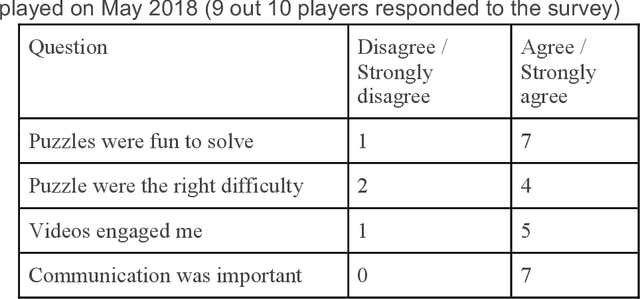
While work in fields of CSCW (Computer Supported Collaborative Work), Psychology and Social Sciences have progressed our understanding of team processes and their effect performance and effectiveness, current methods rely on observations or self-report, with little work directed towards studying team processes with quantifiable measures based on behavioral data. In this report we discuss work tackling this open problem with a focus on understanding individual differences and its effect on team adaptation, and further explore the effect of these factors on team performance as both an outcome and a process. We specifically discuss our contribution in terms of methods that augment survey data and behavioral data that allow us to gain more insight on team performance as well as develop a method to evaluate adaptation and performance across and within a group. To make this problem more tractable we chose to focus on specific types of environments, Alternate Reality Games (ARGs), and for several reasons. First, these types of games involve setups that are similar to a real-world setup, e.g., communication through slack or email. Second, they are more controllable than real environments allowing us to embed stimuli if needed. Lastly, they allow us to collect data needed to understand decisions and communications made through the entire duration of the experience, which makes team processes more transparent than otherwise possible. In this report we discuss the work we did so far and demonstrate the efficacy of the approach.
Interpreting social cues to generate credible affective reactions of virtual job interviewers
Feb 25, 2014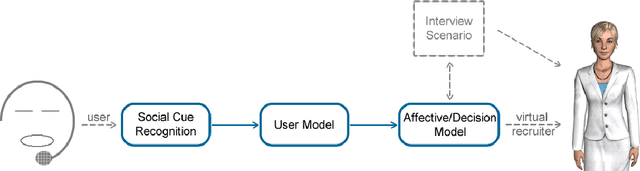
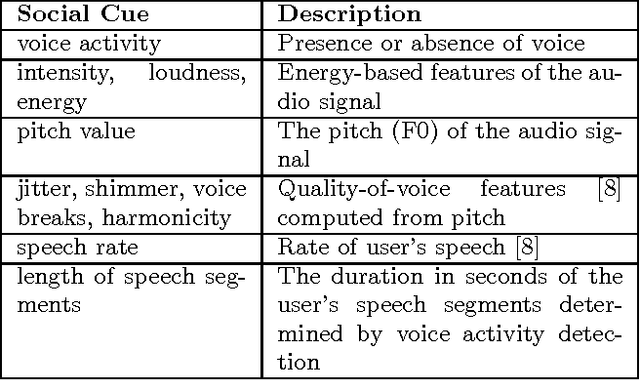
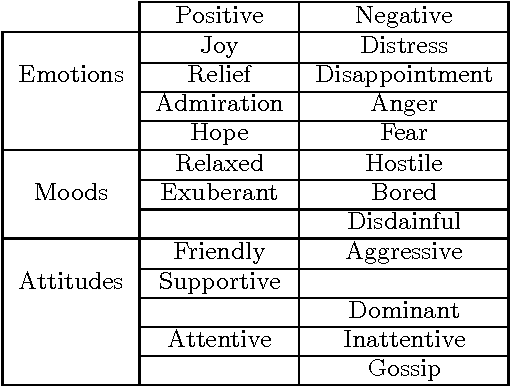
In this paper we describe a mechanism of generating credible affective reactions in a virtual recruiter during an interaction with a user. This is done using communicative performance computation based on the behaviours of the user as detected by a recognition module. The proposed software pipeline is part of the TARDIS system which aims to aid young job seekers in acquiring job interview related social skills. In this context, our system enables the virtual recruiter to realistically adapt and react to the user in real-time.