 Add to Chrome
 Add to Firefox
 Add to Edge
OS-Marathon: Benchmarking Computer-Use Agents on Long-Horizon Repetitive Tasks
Jan 28, 2026
Long-horizon, repetitive workflows are common in professional settings, such as processing expense reports from receipts and entering student grades from exam papers. These tasks are often tedious for humans since they can extend to extreme lengths proportional to the size of the data to process. However, they are ideal for Computer-Use Agents (CUAs) due to their structured, recurring sub-workflows with logic that can be systematically learned. Identifying the absence of an evaluation benchmark as a primary bottleneck, we establish OS-Marathon, comprising 242 long-horizon, repetitive tasks across 2 domains to evaluate state-of-the-art (SOTA) agents. We then introduce a cost-effective method to construct a condensed demonstration using only few-shot examples to teach agents the underlying workflow logic, enabling them to execute similar workflows effectively on larger, unseen data collections. Extensive experiments demonstrate both the inherent challenges of these tasks and the effectiveness of our proposed method. Project website: https://os-marathon.github.io/.

A Schema-Guided Reason-while-Retrieve framework for Reasoning on Scene Graphs with Large-Language-Models (LLMs)
Feb 05, 2025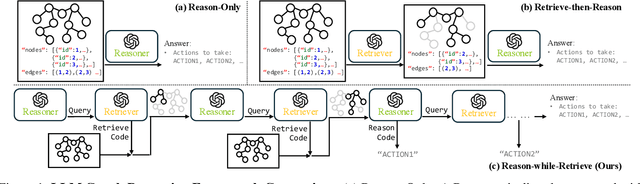

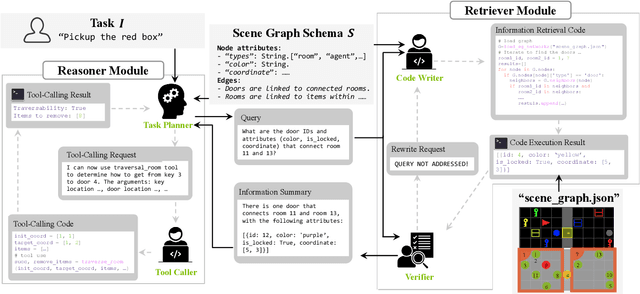
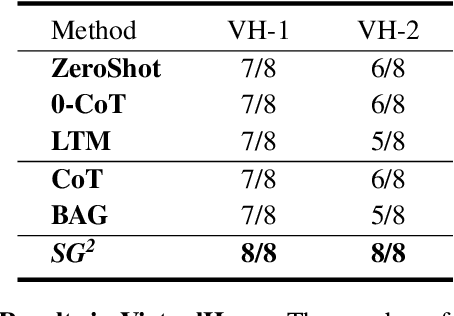
Scene graphs have emerged as a structured and serializable environment representation for grounded spatial reasoning with Large Language Models (LLMs). In this work, we propose SG-RwR, a Schema-Guided Retrieve-while-Reason framework for reasoning and planning with scene graphs. Our approach employs two cooperative, code-writing LLM agents: a (1) Reasoner for task planning and information queries generation, and a (2) Retriever for extracting corresponding graph information following the queries. Two agents collaborate iteratively, enabling sequential reasoning and adaptive attention to graph information. Unlike prior works, both agents are prompted only with the scene graph schema rather than the full graph data, which reduces the hallucination by limiting input tokens, and drives the Reasoner to generate reasoning trace abstractly.Following the trace, the Retriever programmatically query the scene graph data based on the schema understanding, allowing dynamic and global attention on the graph that enhances alignment between reasoning and retrieval. Through experiments in multiple simulation environments, we show that our framework surpasses existing LLM-based approaches in numerical Q\&A and planning tasks, and can benefit from task-level few-shot examples, even in the absence of agent-level demonstrations. Project code will be released.