 Add to Chrome
 Add to Firefox
 Add to Edge
Calibrated Multivariate Distributional Regression with Pre-Rank Regularization
Jan 30, 2026
The goal of probabilistic prediction is to issue predictive distributions that are as informative as possible, subject to being calibrated. Despite substantial progress in the univariate setting, achieving multivariate calibration remains challenging. Recent work has introduced pre-rank functions, scalar projections of multivariate forecasts and observations, as flexible diagnostics for assessing specific aspects of multivariate calibration, but their use has largely been limited to post-hoc evaluation. We propose a regularization-based calibration method that enforces multivariate calibration during training of multivariate distributional regression models using pre-rank functions. We further introduce a novel PCA-based pre-rank that projects predictions onto principal directions of the predictive distribution. Through simulation studies and experiments on 18 real-world multi-output regression datasets, we show that the proposed approach substantially improves multivariate pre-rank calibration without compromising predictive accuracy, and that the PCA pre-rank reveals dependence-structure misspecifications that are not detected by existing pre-ranks.

Multi-Output Conformal Regression: A Unified Comparative Study with New Conformity Scores
Jan 17, 2025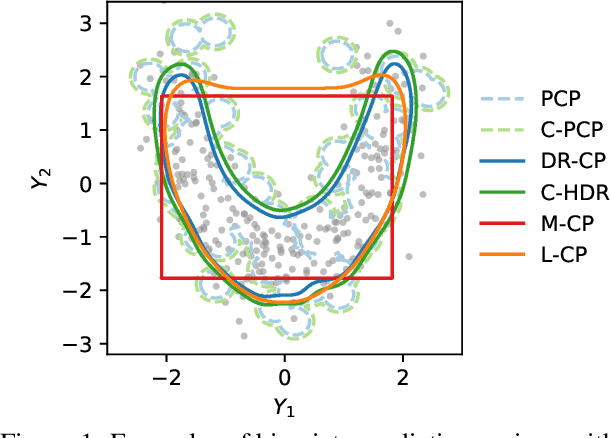
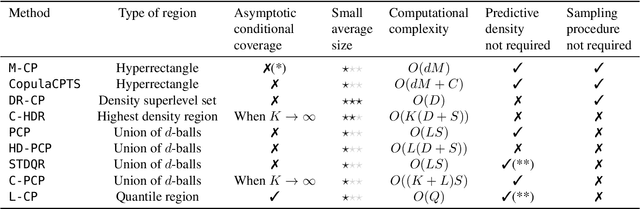
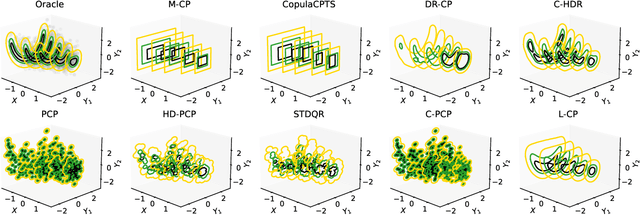
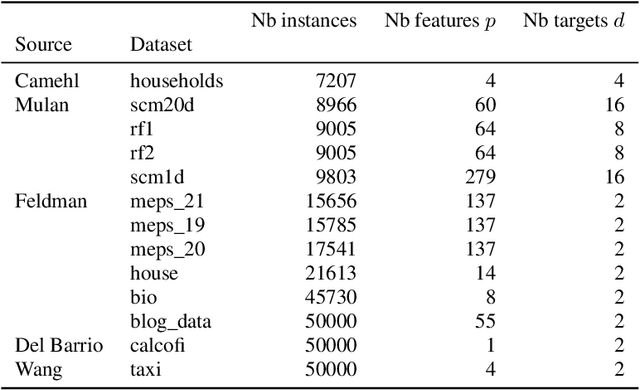
Quantifying uncertainty in multivariate regression is essential in many real-world applications, yet existing methods for constructing prediction regions often face limitations such as the inability to capture complex dependencies, lack of coverage guarantees, or high computational cost. Conformal prediction provides a robust framework for producing distribution-free prediction regions with finite-sample coverage guarantees. In this work, we present a unified comparative study of multi-output conformal methods, exploring their properties and interconnections. Based on our findings, we introduce two classes of conformity scores that achieve asymptotic conditional coverage: one is compatible with any generative model, and the other offers low computational cost by leveraging invertible generative models. Finally, we conduct a comprehensive empirical study across 32 tabular datasets to compare all the multi-output conformal methods considered in this work. All methods are implemented within a unified code base to ensure a fair and consistent comparison.