 Add to Chrome
 Add to Firefox
 Add to Edge
Off-Policy Actor-Critic with Sigmoid-Bounded Entropy for Real-World Robot Learning
Jan 22, 2026
Deploying reinforcement learning in the real world remains challenging due to sample inefficiency, sparse rewards, and noisy visual observations. Prior work leverages demonstrations and human feedback to improve learning efficiency and robustness. However, offline-to-online methods need large datasets and can be unstable, while VLA-assisted RL relies on large-scale pretraining and fine-tuning. As a result, a low-cost real-world RL method with minimal data requirements has yet to emerge. We introduce \textbf{SigEnt-SAC}, an off-policy actor-critic method that learns from scratch using a single expert trajectory. Our key design is a sigmoid-bounded entropy term that prevents negative-entropy-driven optimization toward out-of-distribution actions and reduces Q-function oscillations. We benchmark SigEnt-SAC on D4RL tasks against representative baselines. Experiments show that SigEnt-SAC substantially alleviates Q-function oscillations and reaches a 100\% success rate faster than prior methods. Finally, we validate SigEnt-SAC on four real-world robotic tasks across multiple embodiments, where agents learn from raw images and sparse rewards; results demonstrate that SigEnt-SAC can learn successful policies with only a small number of real-world interactions, suggesting a low-cost and practical pathway for real-world RL deployment.

Fluid Dynamic DNNs for Reliable and Adaptive Distributed Inference on Edge Devices
Jan 17, 2024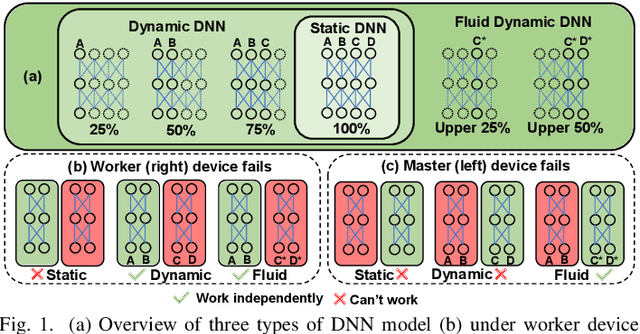
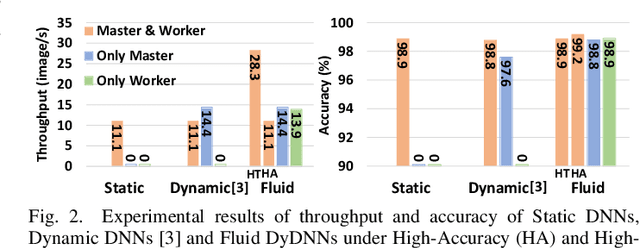
Distributed inference is a popular approach for efficient DNN inference at the edge. However, traditional Static and Dynamic DNNs are not distribution-friendly, causing system reliability and adaptability issues. In this paper, we introduce Fluid Dynamic DNNs (Fluid DyDNNs), tailored for distributed inference. Distinct from Static and Dynamic DNNs, Fluid DyDNNs utilize a novel nested incremental training algorithm to enable independent and combined operation of its sub-networks, enhancing system reliability and adaptability. Evaluation on embedded Arm CPUs with a DNN model and the MNIST dataset, shows that in scenarios of single device failure, Fluid DyDNNs ensure continued inference, whereas Static and Dynamic DNNs fail. When devices are fully operational, Fluid DyDNNs can operate in either a High-Accuracy mode and achieve comparable accuracy with Static DNNs, or in a High-Throughput mode and achieve 2.5x and 2x throughput compared with Static and Dynamic DNNs, respectively.