 Add to Chrome
 Add to Firefox
 Add to Edge
Automated electrostatic characterization of quantum dot devices in single- and bilayer heterostructures
Dec 31, 2025
As quantum dot (QD)-based spin qubits advance toward larger, more complex device architectures, rapid, automated device characterization and data analysis tools become critical. The orientation and spacing of transition lines in a charge stability diagram (CSD) contain a fingerprint of a QD device's capacitive environment, making these measurements useful tools for device characterization. However, manually interpreting these features is time-consuming, error-prone, and impractical at scale. Here, we present an automated protocol for extracting underlying capacitive properties from CSDs. Our method integrates machine learning, image processing, and object detection to identify and track charge transitions across large datasets without manual labeling. We demonstrate this method using experimentally measured data from a strained-germanium single-quantum-well (planar) and a strained-germanium double-quantum-well (bilayer) QD device. Unlike for planar QD devices, CSDs in bilayer germanium heterostructure exhibit a larger set of transitions, including interlayer tunneling and distinct loading lines for the vertically stacked QDs, making them a powerful testbed for automation methods. By analyzing the properties of many CSDs, we can statistically estimate physically relevant quantities, like relative lever arms and capacitive couplings. Thus, our protocol enables rapid extraction of useful, nontrivial information about QD devices.

Deep Neural Encoder-Decoder Model to Relate fMRI Brain Activity with Naturalistic Stimuli
Jul 16, 2025We propose an end-to-end deep neural encoder-decoder model to encode and decode brain activity in response to naturalistic stimuli using functional magnetic resonance imaging (fMRI) data. Leveraging temporally correlated input from consecutive film frames, we employ temporal convolutional layers in our architecture, which effectively allows to bridge the temporal resolution gap between natural movie stimuli and fMRI acquisitions. Our model predicts activity of voxels in and around the visual cortex and performs reconstruction of corresponding visual inputs from neural activity. Finally, we investigate brain regions contributing to visual decoding through saliency maps. We find that the most contributing regions are the middle occipital area, the fusiform area, and the calcarine, respectively employed in shape perception, complex recognition (in particular face perception), and basic visual features such as edges and contrasts. These functions being strongly solicited are in line with the decoder's capability to reconstruct edges, faces, and contrasts. All in all, this suggests the possibility to probe our understanding of visual processing in films using as a proxy the behaviour of deep learning models such as the one proposed in this paper.
Domain-adaptive Fall Detection Using Deep Adversarial Training
Dec 20, 2020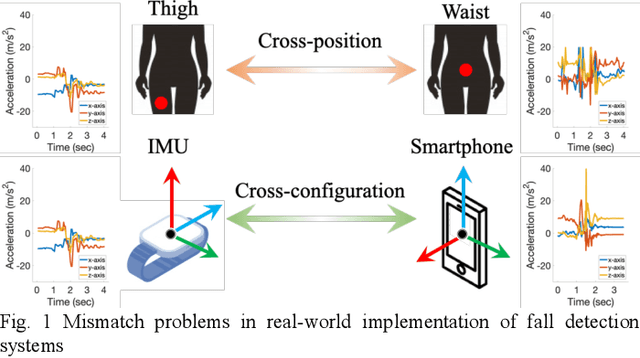

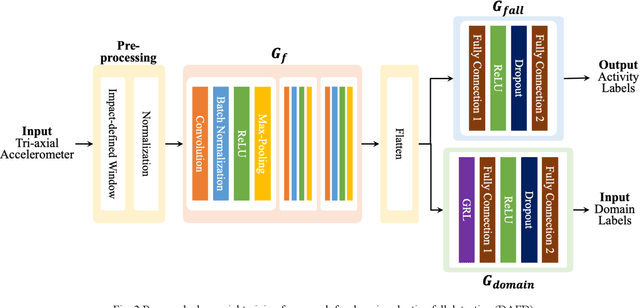
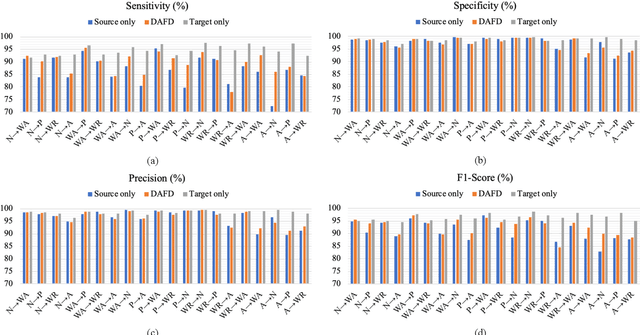
Fall detection (FD) systems are important assistive technologies for healthcare that can detect emergency fall events and alert caregivers. However, it is not easy to obtain large-scale annotated fall events with various specifications of sensors or sensor positions, during the implementation of accurate FD systems. Moreover, the knowledge obtained through machine learning has been restricted to tasks in the same domain. The mismatch between different domains might hinder the performance of FD systems. Cross-domain knowledge transfer is very beneficial for machine-learning based FD systems to train a reliable FD model with well-labeled data in new environments. In this study, we propose domain-adaptive fall detection (DAFD) using deep adversarial training (DAT) to tackle cross-domain problems, such as cross-position and cross-configuration. The proposed DAFD can transfer knowledge from the source domain to the target domain by minimizing the domain discrepancy to avoid mismatch problems. The experimental results show that the average F1score improvement when using DAFD ranges from 1.5% to 7% in the cross-position scenario, and from 3.5% to 12% in the cross-configuration scenario, compared to using the conventional FD model without domain adaptation training. The results demonstrate that the proposed DAFD successfully helps to deal with cross-domain problems and to achieve better detection performance.