 Add to Chrome
 Add to Firefox
 Add to Edge
WIND: Weather Inverse Diffusion for Zero-Shot Atmospheric Modeling
Feb 03, 2026
Deep learning has revolutionized weather and climate modeling, yet the current landscape remains fragmented: highly specialized models are typically trained individually for distinct tasks. To unify this landscape, we introduce WIND, a single pre-trained foundation model capable of replacing specialized baselines across a vast array of tasks. Crucially, in contrast to previous atmospheric foundation models, we achieve this without any task-specific fine-tuning. To learn a robust, task-agnostic prior of the atmosphere, we pre-train WIND with a self-supervised video reconstruction objective, utilizing an unconditional video diffusion model to iteratively reconstruct atmospheric dynamics from a noisy state. At inference, we frame diverse domain-specific problems strictly as inverse problems and solve them via posterior sampling. This unified approach allows us to tackle highly relevant weather and climate problems, including probabilistic forecasting, spatial and temporal downscaling, sparse reconstruction and enforcing conservation laws purely with our pre-trained model. We further demonstrate the model's capacity to generate physically consistent counterfactual storylines of extreme weather events under global warming scenarios. By combining generative video modeling with inverse problem solving, WIND offers a computationally efficient paradigm shift in AI-based atmospheric modeling.

Generating time-consistent dynamics with discriminator-guided image diffusion models
May 15, 2025Realistic temporal dynamics are crucial for many video generation, processing and modelling applications, e.g. in computational fluid dynamics, weather prediction, or long-term climate simulations. Video diffusion models (VDMs) are the current state-of-the-art method for generating highly realistic dynamics. However, training VDMs from scratch can be challenging and requires large computational resources, limiting their wider application. Here, we propose a time-consistency discriminator that enables pretrained image diffusion models to generate realistic spatiotemporal dynamics. The discriminator guides the sampling inference process and does not require extensions or finetuning of the image diffusion model. We compare our approach against a VDM trained from scratch on an idealized turbulence simulation and a real-world global precipitation dataset. Our approach performs equally well in terms of temporal consistency, shows improved uncertainty calibration and lower biases compared to the VDM, and achieves stable centennial-scale climate simulations at daily time steps.
Fast, Scale-Adaptive, and Uncertainty-Aware Downscaling of Earth System Model Fields with Generative Foundation Models
Mar 05, 2024

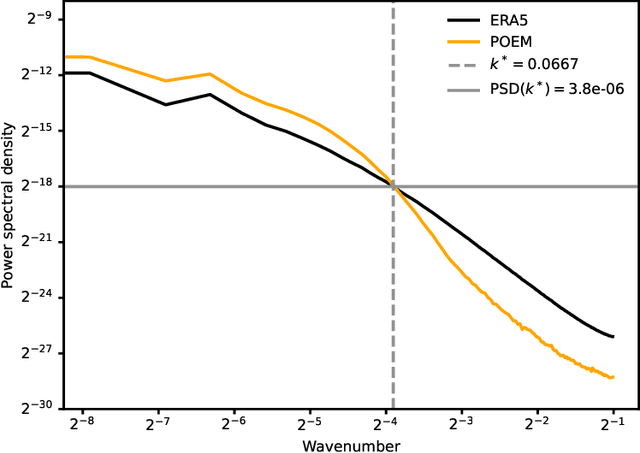

Accurate and high-resolution Earth system model (ESM) simulations are essential to assess the ecological and socio-economic impacts of anthropogenic climate change, but are computationally too expensive. Recent machine learning approaches have shown promising results in downscaling ESM simulations, outperforming state-of-the-art statistical approaches. However, existing methods require computationally costly retraining for each ESM and extrapolate poorly to climates unseen during training. We address these shortcomings by learning a consistency model (CM) that efficiently and accurately downscales arbitrary ESM simulations without retraining in a zero-shot manner. Our foundation model approach yields probabilistic downscaled fields at resolution only limited by the observational reference data. We show that the CM outperforms state-of-the-art diffusion models at a fraction of computational cost while maintaining high controllability on the downscaling task. Further, our method generalizes to climate states unseen during training without explicitly formulated physical constraints.