 Add to Chrome
 Add to Firefox
 Add to Edge
Autofocus Method for Human-Body Imaging under Respiratory Motion Using Synthetic Aperture Radar
Jan 11, 2026
This study presents an effective autofocusing approach for synthetic aperture radar imaging of the human body under conditions of respiratory motion. The proposed method suppresses respiratory-motion-induced phase errors by separating radar echoes in the spatial- and time-frequency domains and estimating phase errors individually for each separated echo. By compensating for the estimated phase errors, synthetic aperture radar images focused on all scattering points are generated, even when multiple body parts exhibit different motions due to respiration. The performance of the proposed method is evaluated through experiments with four participants in the supine position. Compared with a conventional method, the proposed approach improves image quality by a factor of 5.1 in terms of Muller-Buffington sharpness, and reduces the root-mean-square error with respect to a reference point cloud from 34 mm to 20 mm.

Self-localization on a 3D map by fusing global and local features from a monocular camera
Oct 30, 2025Self-localization on a 3D map by using an inexpensive monocular camera is required to realize autonomous driving. Self-localization based on a camera often uses a convolutional neural network (CNN) that can extract local features that are calculated by nearby pixels. However, when dynamic obstacles, such as people, are present, CNN does not work well. This study proposes a new method combining CNN with Vision Transformer, which excels at extracting global features that show the relationship of patches on whole image. Experimental results showed that, compared to the state-of-the-art method (SOTA), the accuracy improvement rate in a CG dataset with dynamic obstacles is 1.5 times higher than that without dynamic obstacles. Moreover, the self-localization error of our method is 20.1% smaller than that of SOTA on public datasets. Additionally, our robot using our method can localize itself with 7.51cm error on average, which is more accurate than SOTA.
Radar-based Measurement of the Body Movements of Multiple Students in Classroom Environments
Dec 03, 2024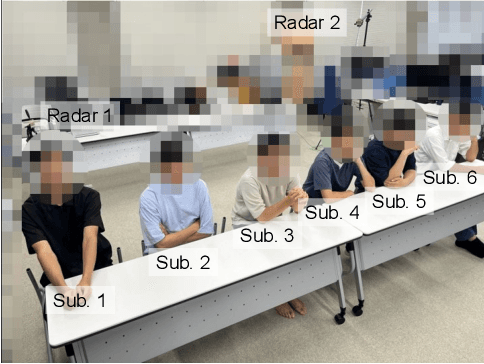
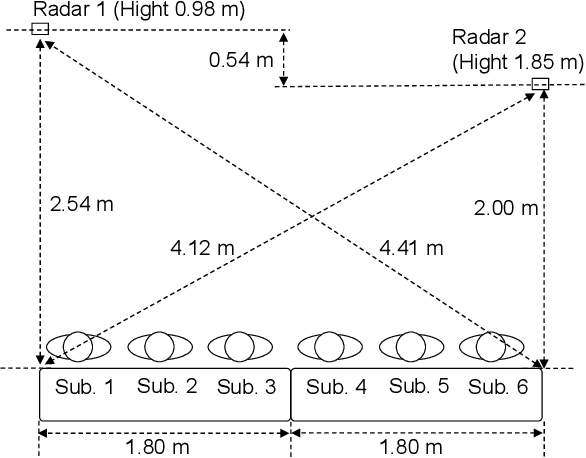
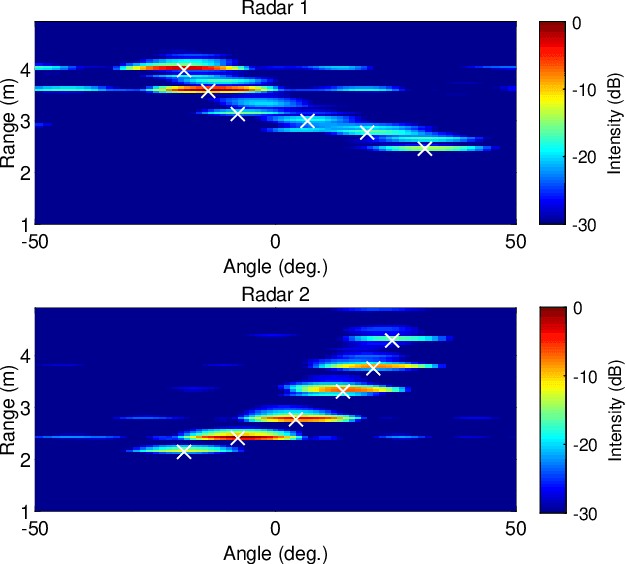
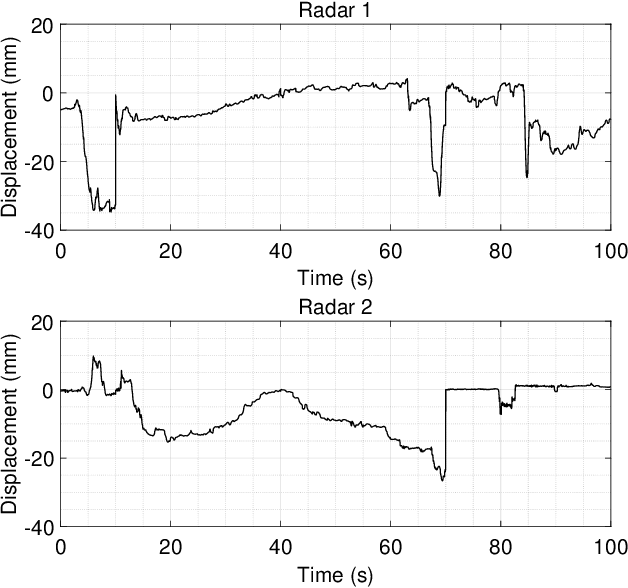
We demonstrate the feasibility of the radar-based measurement of body movements in scenarios involving multiple students using a pair of 79-GHz millimeter-wave radar systems with array antennas. We quantify the body motion using the Doppler frequency calculated from radar echoes. The measurement accuracy is evaluated for two experimental scenarios, namely university students in an office and elementary school students in a classroom. The body movements measured using the two radar systems are compared to evaluate the repeatability and angle dependency of the measurement. Moreover, in the first scenario, we compare the radar-estimated body movement with subjective evaluation scores provided by two evaluators. In the first scenario, the coefficient of correlation between the radar-estimated body movement and the subjective evaluation score is 0.73 on average, with a maximum value of 0.97; in the second scenario, the average correlation coefficient of body movements measured using two radar systems is as high as 0.78. These results indicate that the proposed approach can be used to monitor the body movements of multiple students in realistic scenarios.