 Add to Chrome
 Add to Firefox
 Add to Edge
Variational Feature Compression for Model-Specific Representations
Apr 08, 2026
As deep learning inference is increasingly deployed in shared and cloud-based settings, a growing concern is input repurposing, in which data submitted for one task is reused by unauthorized models for another. Existing privacy defenses largely focus on restricting data access, but provide limited control over what downstream uses a released representation can still support. We propose a feature extraction framework that suppresses cross-model transfer while preserving accuracy for a designated classifier. The framework employs a variational latent bottleneck, trained with a task-driven cross-entropy objective and KL regularization, but without any pixel-level reconstruction loss, to encode inputs into a compact latent space. A dynamic binary mask, computed from per-dimension KL divergence and gradient-based saliency with respect to the frozen target model, suppresses latent dimensions that are uninformative for the intended task. Because saliency computation requires gradient access, the encoder is trained in a white-box setting, whereas inference requires only a forward pass through the frozen target model. On CIFAR-100, the processed representations retain strong utility for the designated classifier while reducing the accuracy of all unintended classifiers to below 2%, yielding a suppression ratio exceeding 45 times relative to unintended models. Preliminary experiments on CIFAR-10, Tiny ImageNet, and Pascal VOC provide exploratory evidence that the approach extends across task settings, although further evaluation is needed to assess robustness against adaptive adversaries.

PAODING: A High-fidelity Data-free Pruning Toolkit for Debloating Pre-trained Neural Networks
Apr 30, 2024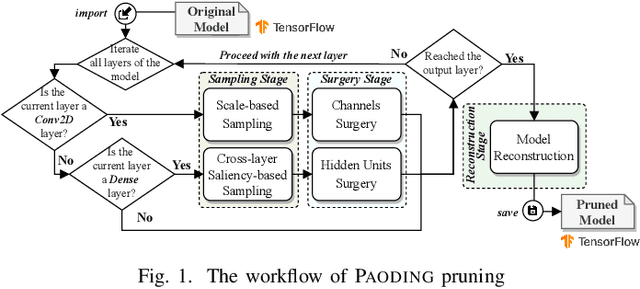
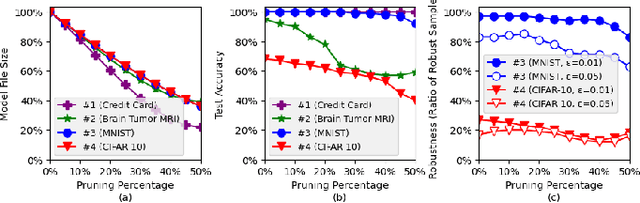
We present PAODING, a toolkit to debloat pretrained neural network models through the lens of data-free pruning. To preserve the model fidelity, PAODING adopts an iterative process, which dynamically measures the effect of deleting a neuron to identify candidates that have the least impact to the output layer. Our evaluation shows that PAODING can significantly reduce the model size, generalize on different datasets and models, and meanwhile preserve the model fidelity in terms of test accuracy and adversarial robustness. PAODING is publicly available on PyPI via https://pypi.org/project/paoding-dl.