 Add to Chrome
 Add to Firefox
 Add to Edge
World of Workflows: a Benchmark for Bringing World Models to Enterprise Systems
Jan 29, 2026
Frontier large language models (LLMs) excel as autonomous agents in many domains, yet they remain untested in complex enterprise systems where hidden workflows create cascading effects across interconnected databases. Existing enterprise benchmarks evaluate surface-level agentic task completion similar to general consumer benchmarks, ignoring true challenges in enterprises, such as limited observability, large database state, and hidden workflows with cascading side effects. We introduce World of Workflows (WoW), a realistic ServiceNow-based environment incorporating 4,000+ business rules and 55 active workflows embedded in the system, alongside WoW-bench, a benchmark of 234 tasks evaluating constrained agentic task completion and enterprise dynamics modeling capabilities. We reveal two major takeaways: (1) Frontier LLMs suffer from dynamics blindness, consistently failing to predict the invisible, cascading side effects of their actions, which leads to silent constraint violations, and (2) reliability in opaque systems requires grounded world modeling, where agents must mentally simulate hidden state transitions to bridge the observability gap when high-fidelity feedback is unavailable. For reliable and useful enterprise agents, WoW motivates a new paradigm to explicitly learn system dynamics. We release our GitHub for setting up and evaluating WoW.

Dynamic Neural Control Flow Execution: An Agent-Based Deep Equilibrium Approach for Binary Vulnerability Detection
Apr 03, 2024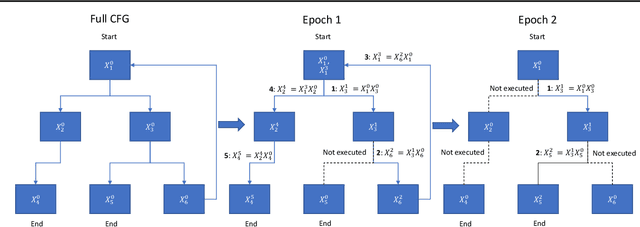
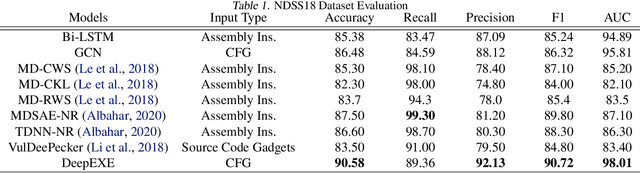
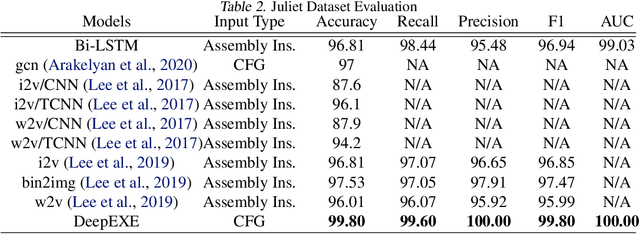
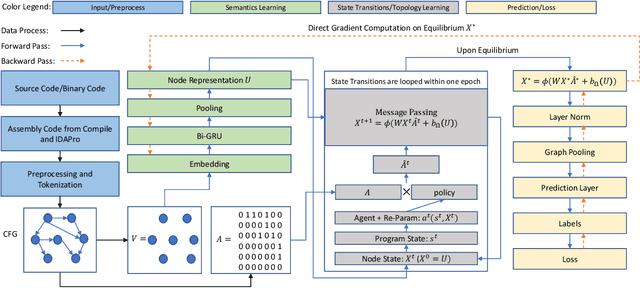
Software vulnerabilities are a challenge in cybersecurity. Manual security patches are often difficult and slow to be deployed, while new vulnerabilities are created. Binary code vulnerability detection is less studied and more complex compared to source code, and this has important practical implications. Deep learning has become an efficient and powerful tool in the security domain, where it provides end-to-end and accurate prediction. Modern deep learning approaches learn the program semantics through sequence and graph neural networks, using various intermediate representation of programs, such as abstract syntax trees (AST) or control flow graphs (CFG). Due to the complex nature of program execution, the output of an execution depends on the many program states and inputs. Also, a CFG generated from static analysis can be an overestimation of the true program flow. Moreover, the size of programs often does not allow a graph neural network with fixed layers to aggregate global information. To address these issues, we propose DeepEXE, an agent-based implicit neural network that mimics the execution path of a program. We use reinforcement learning to enhance the branching decision at every program state transition and create a dynamic environment to learn the dependency between a vulnerability and certain program states. An implicitly defined neural network enables nearly infinite state transitions until convergence, which captures the structural information at a higher level. The experiments are conducted on two semi-synthetic and two real-world datasets. We show that DeepEXE is an accurate and efficient method and outperforms the state-of-the-art vulnerability detection methods.