 Add to Chrome
 Add to Firefox
 Add to Edge
A Two-Stage Globally-Diverse Adversarial Attack for Vision-Language Pre-training Models
Jan 18, 2026
Vision-language pre-training (VLP) models are vulnerable to adversarial examples, particularly in black-box scenarios. Existing multimodal attacks often suffer from limited perturbation diversity and unstable multi-stage pipelines. To address these challenges, we propose 2S-GDA, a two-stage globally-diverse attack framework. The proposed method first introduces textual perturbations through a globally-diverse strategy by combining candidate text expansion with globally-aware replacement. To enhance visual diversity, image-level perturbations are generated using multi-scale resizing and block-shuffle rotation. Extensive experiments on VLP models demonstrate that 2S-GDA consistently improves attack success rates over state-of-the-art methods, with gains of up to 11.17\% in black-box settings. Our framework is modular and can be easily combined with existing methods to further enhance adversarial transferability.

UPC: Learning Universal Physical Camouflage Attacks on Object Detectors
Sep 10, 2019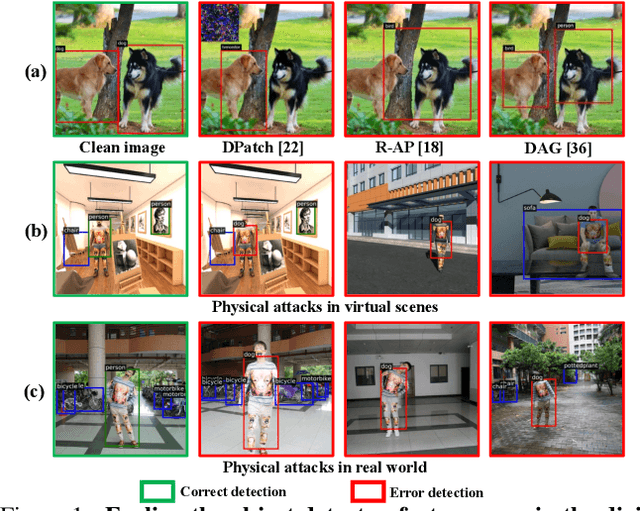
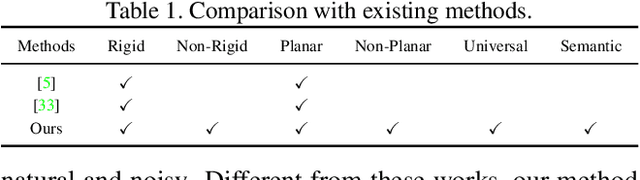
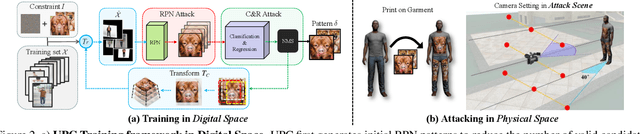
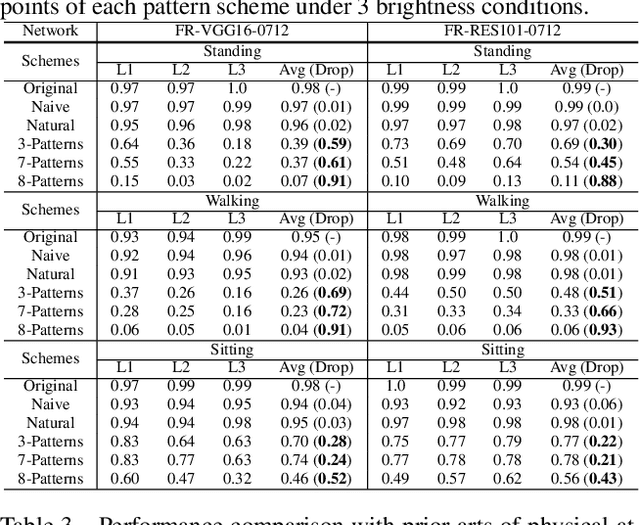
In this paper, we study physical adversarial attacks on object detectors in the wild. Prior arts on this matter mostly craft instance-dependent perturbations only for rigid and planar objects. To this end, we propose to learn an adversarial pattern to effectively attack all instances belonging to the same object category (e.g., person, car), referred to as Universal Physical Camouflage Attack (UPC). Concretely, UPC crafts camouflage by jointly fooling the region proposal network, as well as misleading the classifier and the regressor to output errors. In order to make UPC effective for articulated non-rigid or non-planar objects, we introduce a set of transformations for the generated camouflage patterns to mimic their deformable properties. We additionally impose optimization constraint to make generated patterns look natural for human observers. To fairly evaluate the effectiveness of different physical-world attacks on object detectors, we present the first standardized virtual database, AttackScenes, which simulates the real 3D world in a controllable and reproducible environment. Extensive experiments suggest the superiority of our proposed UPC compared with existing physical adversarial attackers not only in virtual environments (AttackScenes), but also in real-world physical environments. Codes, models, and demos are publicly available at https://mesunhlf.github.io/index_physical.html.