 Add to Chrome
 Add to Firefox
 Add to Edge
Spurious Rewards Paradox: Mechanistically Understanding How RLVR Activates Memorization Shortcuts in LLMs
Jan 16, 2026
Reinforcement Learning with Verifiable Rewards (RLVR) is highly effective for enhancing LLM reasoning, yet recent evidence shows models like Qwen 2.5 achieve significant gains even with spurious or incorrect rewards. We investigate this phenomenon and identify a "Perplexity Paradox": spurious RLVR triggers a divergence where answer-token perplexity drops while prompt-side coherence degrades, suggesting the model is bypassing reasoning in favor of memorization. Using Path Patching, Logit Lens, JSD analysis, and Neural Differential Equations, we uncover a hidden Anchor-Adapter circuit that facilitates this shortcut. We localize a Functional Anchor in the middle layers (L18-20) that triggers the retrieval of memorized solutions, followed by Structural Adapters in later layers (L21+) that transform representations to accommodate the shortcut signal. Finally, we demonstrate that scaling specific MLP keys within this circuit allows for bidirectional causal steering-artificially amplifying or suppressing contamination-driven performance. Our results provide a mechanistic roadmap for identifying and mitigating data contamination in RLVR-tuned models. Code is available at https://github.com/idwts/How-RLVR-Activates-Memorization-Shortcuts.

Large Language Models as Code Executors: An Exploratory Study
Oct 10, 2024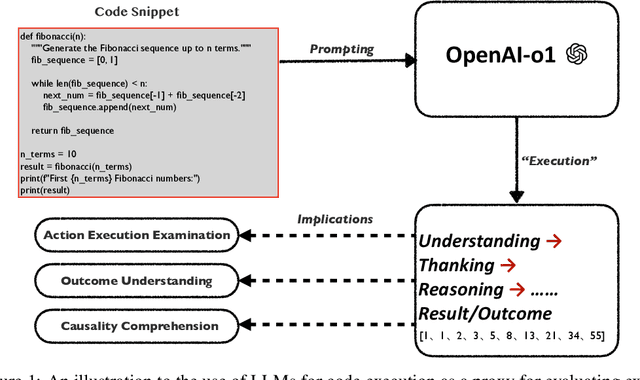

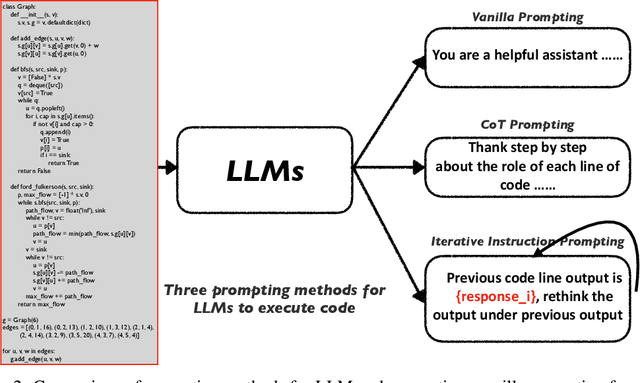

The capabilities of Large Language Models (LLMs) have significantly evolved, extending from natural language processing to complex tasks like code understanding and generation. We expand the scope of LLMs' capabilities to a broader context, using LLMs to execute code snippets to obtain the output. This paper pioneers the exploration of LLMs as code executors, where code snippets are directly fed to the models for execution, and outputs are returned. We are the first to comprehensively examine this feasibility across various LLMs, including OpenAI's o1, GPT-4o, GPT-3.5, DeepSeek, and Qwen-Coder. Notably, the o1 model achieved over 90% accuracy in code execution, while others demonstrated lower accuracy levels. Furthermore, we introduce an Iterative Instruction Prompting (IIP) technique that processes code snippets line by line, enhancing the accuracy of weaker models by an average of 7.22% (with the highest improvement of 18.96%) and an absolute average improvement of 3.86% against CoT prompting (with the highest improvement of 19.46%). Our study not only highlights the transformative potential of LLMs in coding but also lays the groundwork for future advancements in automated programming and the completion of complex tasks.