 Add to Chrome
 Add to Firefox
 Add to Edge
Layer-Aware Early Fusion of Acoustic and Linguistic Embeddings for Cognitive Status Classification
Jan 30, 2026
Speech contains both acoustic and linguistic patterns that reflect cognitive decline, and therefore models describing only one domain cannot fully capture such complexity. This study investigates how early fusion (EF) of speech and its corresponding transcription text embeddings, with attention to encoder layer depth, can improve cognitive status classification. Using a DementiaBank-derived collection of recordings (1,629 speakers; cognitively normal controls$\unicode{x2013}$CN, Mild Cognitive Impairment$\unicode{x2013}$MCI, and Alzheimer's Disease and Related Dementias$\unicode{x2013}$ADRD), we extracted frame-aligned embeddings from different internal layers of wav2vec 2.0 or Whisper combined with DistilBERT or RoBERTa. Unimodal, EF and late fusion (LF) models were trained with a transformer classifier, optimized, and then evaluated across 10 seeds. Performance consistently peaked in mid encoder layers ($\sim$8$\unicode{x2013}$10), with the single best F1 at Whisper + RoBERTa layer 9 and the best log loss at Whisper + DistilBERT layer 10. Acoustic-only models consistently outperformed text-only variants. EF boosts discrimination for genuinely acoustic embeddings, whereas LF improves probability calibration. Layer choice critically shapes clinical multimodal synergy.

Deep Learning for In-Orbit Cloud Segmentation and Classification in Hyperspectral Satellite Data
Mar 13, 2024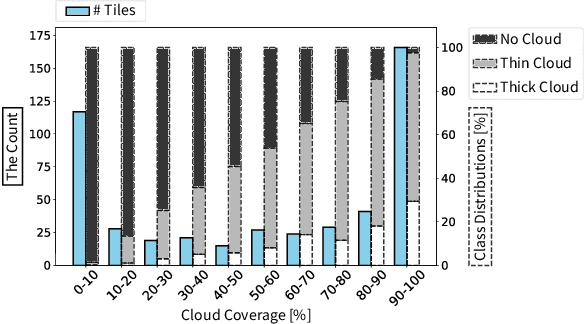
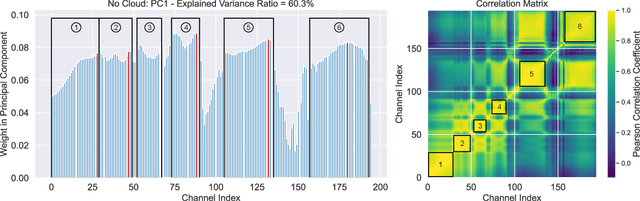
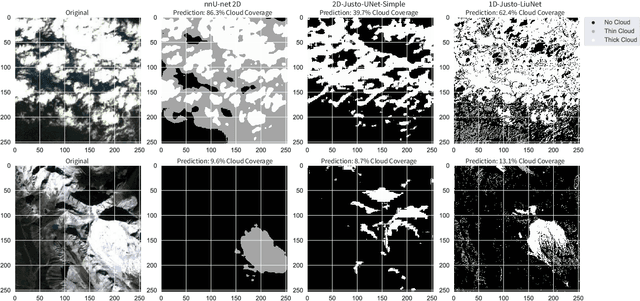
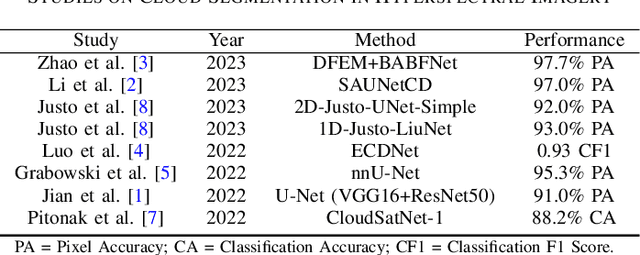
This article explores the latest Convolutional Neural Networks (CNNs) for cloud detection aboard hyperspectral satellites. The performance of the latest 1D CNN (1D-Justo-LiuNet) and two recent 2D CNNs (nnU-net and 2D-Justo-UNet-Simple) for cloud segmentation and classification is assessed. Evaluation criteria include precision and computational efficiency for in-orbit deployment. Experiments utilize NASA's EO-1 Hyperion data, with varying spectral channel numbers after Principal Component Analysis. Results indicate that 1D-Justo-LiuNet achieves the highest accuracy, outperforming 2D CNNs, while maintaining compactness with larger spectral channel sets, albeit with increased inference times. However, the performance of 1D CNN degrades with significant channel reduction. In this context, the 2D-Justo-UNet-Simple offers the best balance for in-orbit deployment, considering precision, memory, and time costs. While nnU-net is suitable for on-ground processing, deployment of lightweight 1D-Justo-LiuNet is recommended for high-precision applications. Alternatively, lightweight 2D-Justo-UNet-Simple is recommended for balanced costs between timing and precision in orbit.