 Add to Chrome
 Add to Firefox
 Add to Edge
Prompt and Circumstances: Evaluating the Efficacy of Human Prompt Inference in AI-Generated Art
Jan 24, 2026
The emerging field of AI-generated art has witnessed the rise of prompt marketplaces, where creators can purchase, sell, or share prompts to generate unique artworks. These marketplaces often assert ownership over prompts, claiming them as intellectual property. This paper investigates whether concealed prompts sold on prompt marketplaces can be considered bona fide intellectual property, given that humans and AI tools may be able to infer the prompts based on publicly advertised sample images accompanying each prompt on sale. Specifically, our study aims to assess (i) how accurately humans can infer the original prompt solely by examining an AI-generated image, with the goal of generating images similar to the original image, and (ii) the possibility of improving upon individual human and AI prompt inferences by crafting combined human and AI prompts with the help of a large language model. Although previous research has explored AI-driven prompt inference and protection strategies, our work is the first to incorporate a human subject study and examine collaborative human-AI prompt inference in depth. Our findings indicate that while prompts inferred by humans and prompts inferred through a combined human and AI effort can generate images with a moderate level of similarity, they are not as successful as using the original prompt. Moreover, combining human- and AI-inferred prompts using our suggested merging techniques did not improve performance over purely human-inferred prompts.

A Picture is Worth a Thousand Prompts? Efficacy of Iterative Human-Driven Prompt Refinement in Image Regeneration Tasks
Apr 29, 2025
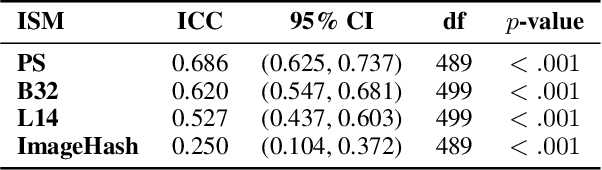
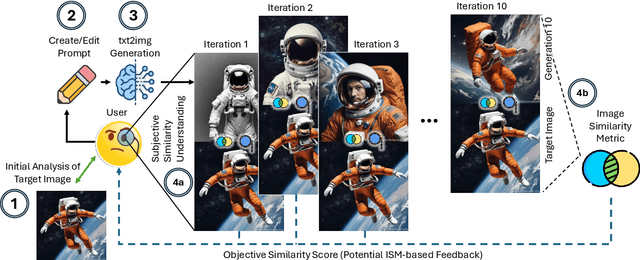
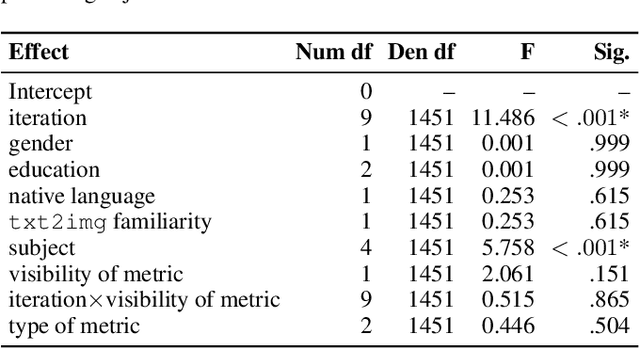
With AI-generated content becoming ubiquitous across the web, social media, and other digital platforms, it is vital to examine how such content are inspired and generated. The creation of AI-generated images often involves refining the input prompt iteratively to achieve desired visual outcomes. This study focuses on the relatively underexplored concept of image regeneration using AI, in which a human operator attempts to closely recreate a specific target image by iteratively refining their prompt. Image regeneration is distinct from normal image generation, which lacks any predefined visual reference. A separate challenge lies in determining whether existing image similarity metrics (ISMs) can provide reliable, objective feedback in iterative workflows, given that we do not fully understand if subjective human judgments of similarity align with these metrics. Consequently, we must first validate their alignment with human perception before assessing their potential as a feedback mechanism in the iterative prompt refinement process. To address these research gaps, we present a structured user study evaluating how iterative prompt refinement affects the similarity of regenerated images relative to their targets, while also examining whether ISMs capture the same improvements perceived by human observers. Our findings suggest that incremental prompt adjustments substantially improve alignment, verified through both subjective evaluations and quantitative measures, underscoring the broader potential of iterative workflows to enhance generative AI content creation across various application domains.
Promptly Yours? A Human Subject Study on Prompt Inference in AI-Generated Art
Oct 10, 2024
The emerging field of AI-generated art has witnessed the rise of prompt marketplaces, where creators can purchase, sell, or share prompts for generating unique artworks. These marketplaces often assert ownership over prompts, claiming them as intellectual property. This paper investigates whether concealed prompts sold on prompt marketplaces can be considered as secure intellectual property, given that humans and AI tools may be able to approximately infer the prompts based on publicly advertised sample images accompanying each prompt on sale. Specifically, our survey aims to assess (i) how accurately can humans infer the original prompt solely by examining an AI-generated image, with the goal of generating images similar to the original image, and (ii) the possibility of improving upon individual human and AI prompt inferences by crafting human-AI combined prompts with the help of a large language model. Although previous research has explored the use of AI and machine learning to infer (and also protect against) prompt inference, we are the first to include humans in the loop. Our findings indicate that while humans and human-AI collaborations can infer prompts and generate similar images with high accuracy, they are not as successful as using the original prompt.