 Add to Chrome
 Add to Firefox
 Add to Edge
BiTDiff: Fine-Grained 3D Conducting Motion Generation via BiMamba-Transformer Diffusion
Apr 06, 2026
3D conducting motion generation aims to synthesize fine-grained conductor motions from music, with broad potential in music education, virtual performance, digital human animation, and human-AI co-creation. However, this task remains underexplored due to two major challenges: (1) the lack of large-scale fine-grained 3D conducting datasets and (2) the absence of effective methods that can jointly support long-sequence generation with high quality and efficiency. To address the data limitation, we develop a quality-oriented 3D conducting motion collection pipeline and construct CM-Data, a fine-grained SMPL-X dataset with about 10 hours of conducting motion data. To the best of our knowledge, CM-Data is the first and largest public dataset for 3D conducting motion generation. To address the methodological limitation, we propose BiTDiff, a novel framework for 3D conducting motion generation, built upon a BiMamba-Transformer hybrid model architecture for efficient long-sequence modeling and a Diffusion-based generative strategy with human-kinematic decomposition for high-quality motion synthesis. Specifically, BiTDiff introduces auxiliary physical-consistency losses and a hand-/body-specific forward-kinematics design for better fine-grained motion modeling, while leveraging BiMamba for memory-efficient long-sequence temporal modeling and Transformer for cross-modal semantic alignment. In addition, BiTDiff supports training-free joint-level motion editing, enabling downstream human-AI interaction design. Extensive quantitative and qualitative experiments demonstrate that BiTDiff achieves state-of-the-art (SOTA) performance for 3D conducting motion generation on the CM-Data dataset. Code will be available upon acceptance.

An Efficient Multi-solution Solver for the Inverse Kinematics of 3-Section Constant-Curvature Robots
May 02, 2023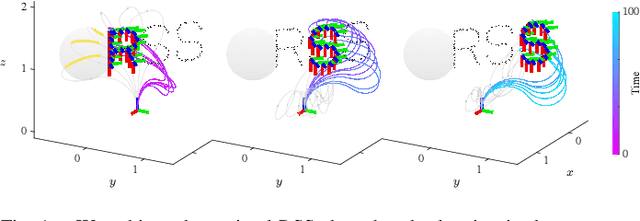

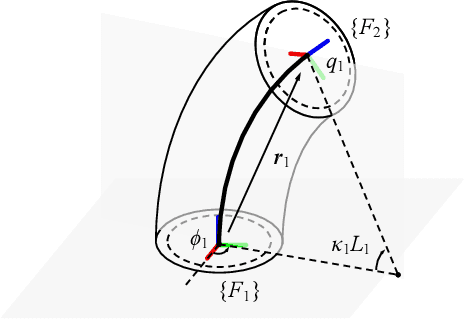
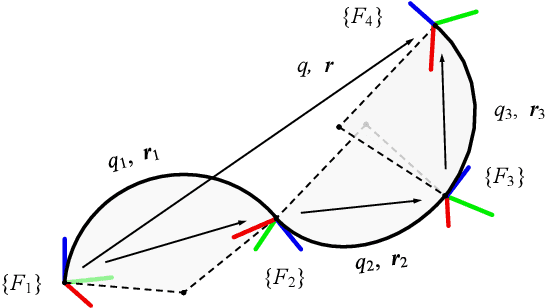
Piecewise constant curvature is a popular kinematics framework for continuum robots. Computing the model parameters from the desired end pose, known as the inverse kinematics problem, is fundamental in manipulation, tracking and planning tasks. In this paper, we propose an efficient multi-solution solver to address the inverse kinematics problem of 3-section constant-curvature robots by bridging both the theoretical reduction and numerical correction. We derive analytical conditions to simplify the original problem into a one-dimensional problem. Further, the equivalence of the two problems is formalised. In addition, we introduce an approximation with bounded error so that the one dimension becomes traversable while the remaining parameters analytically solvable. With the theoretical results, the global search and numerical correction are employed to implement the solver. The experiments validate the better efficiency and higher success rate of our solver than the numerical methods when one solution is required, and demonstrate the ability of obtaining multiple solutions with optimal path planning in a space with obstacles.