 Add to Chrome
 Add to Firefox
 Add to Edge
DementiaBank-Emotion: A Multi-Rater Emotion Annotation Corpus for Alzheimer's Disease Speech (Version 1.0)
Feb 04, 2026
We present DementiaBank-Emotion, the first multi-rater emotion annotation corpus for Alzheimer's disease (AD) speech. Annotating 1,492 utterances from 108 speakers for Ekman's six basic emotions and neutral, we find that AD patients express significantly more non-neutral emotions (16.9%) than healthy controls (5.7%; p < .001). Exploratory acoustic analysis suggests a possible dissociation: control speakers showed substantial F0 modulation for sadness (Delta = -3.45 semitones from baseline), whereas AD speakers showed minimal change (Delta = +0.11 semitones; interaction p = .023), though this finding is based on limited samples (sadness: n=5 control, n=15 AD) and requires replication. Within AD speech, loudness differentiates emotion categories, indicating partially preserved emotion-prosody mappings. We release the corpus, annotation guidelines, and calibration workshop materials to support research on emotion recognition in clinical populations.

Individualized Dynamic Model for Multi-resolutional Data
Nov 22, 2023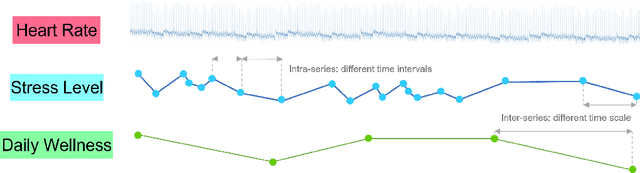

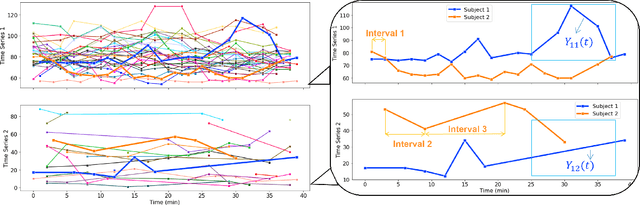
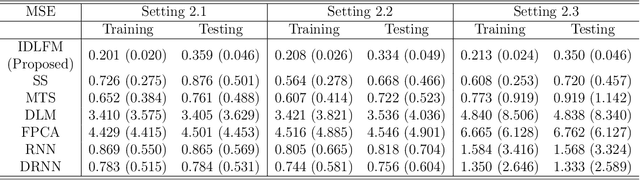
Mobile health has emerged as a major success in tracking individual health status, due to the popularity and power of smartphones and wearable devices. This has also brought great challenges in handling heterogeneous, multi-resolution data which arise ubiquitously in mobile health due to irregular multivariate measurements collected from individuals. In this paper, we propose an individualized dynamic latent factor model for irregular multi-resolution time series data to interpolate unsampled measurements of time series with low resolution. One major advantage of the proposed method is the capability to integrate multiple irregular time series and multiple subjects by mapping the multi-resolution data to the latent space. In addition, the proposed individualized dynamic latent factor model is applicable to capturing heterogeneous longitudinal information through individualized dynamic latent factors. In theory, we provide the integrated interpolation error bound of the proposed estimator and derive the convergence rate with B-spline approximation methods. Both the simulation studies and the application to smartwatch data demonstrate the superior performance of the proposed method compared to existing methods.