 Add to Chrome
 Add to Firefox
 Add to Edge
Global Plane Waves From Local Gaussians: Periodic Charge Densities in a Blink
Jan 27, 2026
We introduce ELECTRAFI, a fast, end-to-end differentiable model for predicting periodic charge densities in crystalline materials. ELECTRAFI constructs anisotropic Gaussians in real space and exploits their closed-form Fourier transforms to analytically evaluate plane-wave coefficients via the Poisson summation formula. This formulation delegates non-local and periodic behavior to analytic transforms, enabling reconstruction of the full periodic charge density with a single inverse FFT. By avoiding explicit real-space grid probing, periodic image summation, and spherical harmonic expansions, ELECTRAFI matches or exceeds state-of-the-art accuracy across periodic benchmarks while being up to $633 \times$ faster than the strongest competing method, reconstructing crystal charge densities in a fraction of a second. When used to initialize DFT calculations, ELECTRAFI reduces total DFT compute cost by up to ~20%, whereas slower charge density models negate savings due to high inference times. Our results show that accuracy and inference cost jointly determine end-to-end DFT speedups, and motivate our focus on efficiency.

Reinforcement Learning for Chemical Ordering in Alloy Nanoparticles
Nov 15, 2025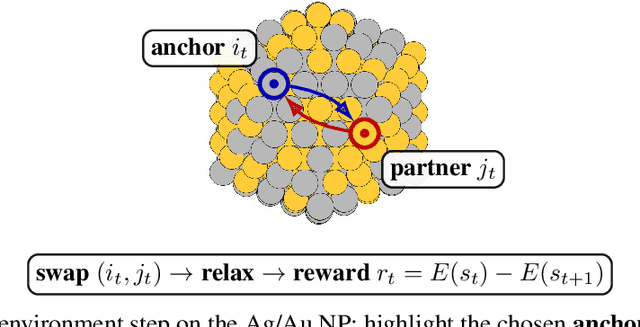

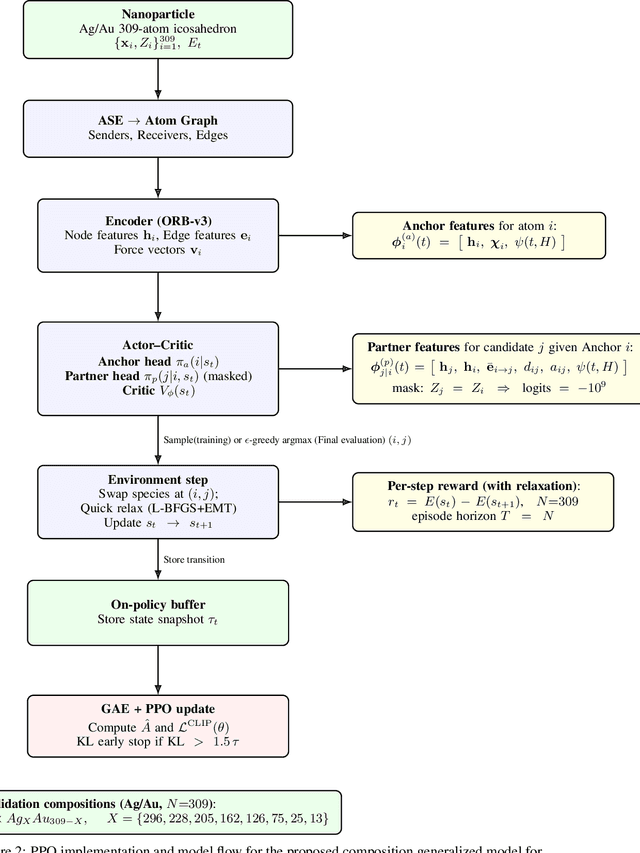
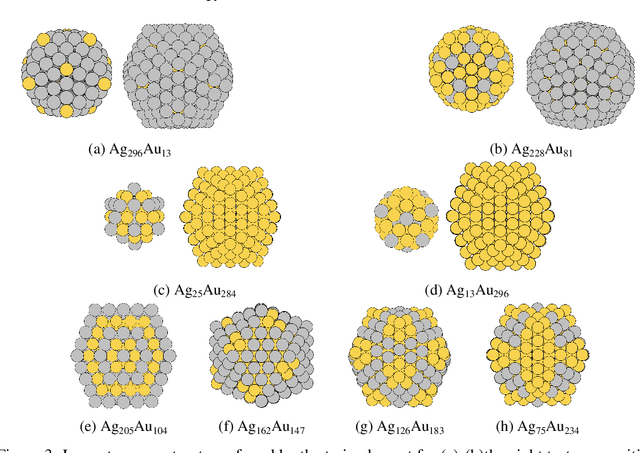
We approach the search for optimal element ordering in bimetallic alloy nanoparticles (NPs) as a reinforcement learning (RL) problem, and have built an RL agent that learns to perform such global optimisation using the geometric graph representation of the NPs. To demonstrate the effectiveness, we train an RL agent to perform composition-conserving atomic swap actions on the icosahedral nanoparticle structure. Trained once on randomised $Ag_{X}Au_{309-X}$ compositions and orderings, the agent discovers previously established ground state structure. We show that this optimization is robust to differently ordered initialisations of the same NP compositions. We also demonstrate that a trained policy can extrapolate effectively to NPs of unseen size. However, the efficacy is limited when multiple alloying elements are involved. Our results demonstrate that RL with pre-trained equivariant graph encodings can navigate combinatorial ordering spaces at the nanoparticle scale, and offer a transferable optimisation strategy with the potential to generalise across composition and reduce repeated individual search cost.
Acoustic Classification of Maritime Vessels using Learnable Filterbanks
May 29, 2025Reliably monitoring and recognizing maritime vessels based on acoustic signatures is complicated by the variability of different recording scenarios. A robust classification framework must be able to generalize across diverse acoustic environments and variable source-sensor distances. To this end, we present a deep learning model with robust performance across different recording scenarios. Using a trainable spectral front-end and temporal feature encoder to learn a Gabor filterbank, the model can dynamically emphasize different frequency components. Trained on the VTUAD hydrophone recordings from the Strait of Georgia, our model, CATFISH, achieves a state-of-the-art 96.63 % percent test accuracy across varying source-sensor distances, surpassing the previous benchmark by over 12 percentage points. We present the model, justify our architectural choices, analyze the learned Gabor filters, and perform ablation studies on sensor data fusion and attention-based pooling.
ELECTRA: A Symmetry-breaking Cartesian Network for Charge Density Prediction with Floating Orbitals
Mar 11, 2025We present the Electronic Tensor Reconstruction Algorithm (ELECTRA) - an equivariant model for predicting electronic charge densities using "floating" orbitals. Floating orbitals are a long-standing idea in the quantum chemistry community that promises more compact and accurate representations by placing orbitals freely in space, as opposed to centering all orbitals at the position of atoms. Finding ideal placements of these orbitals requires extensive domain knowledge though, which thus far has prevented widespread adoption. We solve this in a data-driven manner by training a Cartesian tensor network to predict orbital positions along with orbital coefficients. This is made possible through a symmetry-breaking mechanism that is used to learn position displacements with lower symmetry than the input molecule while preserving the rotation equivariance of the charge density itself. Inspired by recent successes of Gaussian Splatting in representing densities in space, we are using Gaussians as our orbitals and predict their weights and covariance matrices. Our method achieves a state-of-the-art balance between computational efficiency and predictive accuracy on established benchmarks.