 Add to Chrome
 Add to Firefox
 Add to Edge
TransportAgents: a multi-agents LLM framework for traffic accident severity prediction
Jan 21, 2026
Accurate prediction of traffic crash severity is critical for improving emergency response and public safety planning. Although recent large language models (LLMs) exhibit strong reasoning capabilities, their single-agent architectures often struggle with heterogeneous, domain-specific crash data and tend to generate biased or unstable predictions. To address these limitations, this paper proposes TransportAgents, a hybrid multi-agent framework that integrates category-specific LLM reasoning with a multilayer perceptron (MLP) integration module. Each specialized agent focuses on a particular subset of traffic information, such as demographics, environmental context, or incident details, to produce intermediate severity assessments that are subsequently fused into a unified prediction. Extensive experiments on two complementary U.S. datasets, the Consumer Product Safety Risk Management System (CPSRMS) and the National Electronic Injury Surveillance System (NEISS), demonstrate that TransportAgents consistently outperforms both traditional machine learning and advanced LLM-based baselines. Across three representative backbones, including closed-source models such as GPT-3.5 and GPT-4o, as well as open-source models such as LLaMA-3.3, the framework exhibits strong robustness, scalability, and cross-dataset generalizability. A supplementary distributional analysis further shows that TransportAgents produces more balanced and well-calibrated severity predictions than standard single-agent LLM approaches, highlighting its interpretability and reliability for safety-critical decision support applications.

Self-GIVE: Associative Thinking from Limited Structured Knowledge for Enhanced Large Language Model Reasoning
May 21, 2025When addressing complex questions that require new information, people often associate the question with existing knowledge to derive a sensible answer. For instance, when evaluating whether melatonin aids insomnia, one might associate "hormones helping mental disorders" with "melatonin being a hormone and insomnia a mental disorder" to complete the reasoning. Large Language Models (LLMs) also require such associative thinking, particularly in resolving scientific inquiries when retrieved knowledge is insufficient and does not directly answer the question. Graph Inspired Veracity Extrapolation (GIVE) addresses this by using a knowledge graph (KG) to extrapolate structured knowledge. However, it involves the construction and pruning of many hypothetical triplets, which limits efficiency and generalizability. We propose Self-GIVE, a retrieve-RL framework that enhances LLMs with automatic associative thinking through reinforcement learning. Self-GIVE extracts structured information and entity sets to assist the model in linking to the queried concepts. We address GIVE's key limitations: (1) extensive LLM calls and token overhead for knowledge extrapolation, (2) difficulty in deploying on smaller LLMs (3B or 7B) due to complex instructions, and (3) inaccurate knowledge from LLM pruning. Specifically, after fine-tuning using self-GIVE with a 135 node UMLS KG, it improves the performance of the Qwen2.5 3B and 7B models by up to $\textbf{28.5%$\rightarrow$71.4%}$ and $\textbf{78.6$\rightarrow$90.5%}$ in samples $\textbf{unseen}$ in challenging biomedical QA tasks. In particular, Self-GIVE allows the 7B model to match or outperform GPT3.5 turbo with GIVE, while cutting token usage by over 90\%. Self-GIVE enhances the scalable integration of structured retrieval and reasoning with associative thinking.
GIVE: Structured Reasoning with Knowledge Graph Inspired Veracity Extrapolation
Oct 11, 2024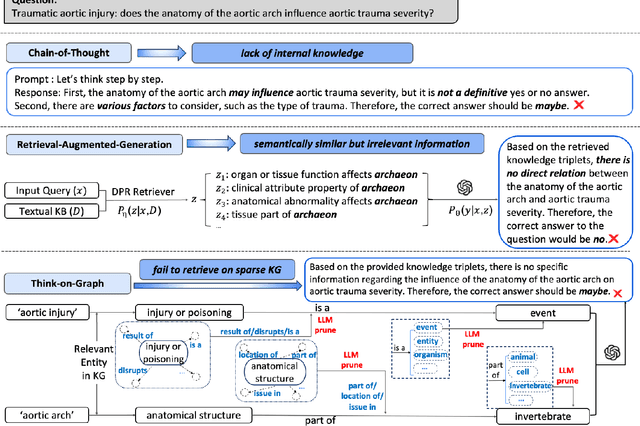
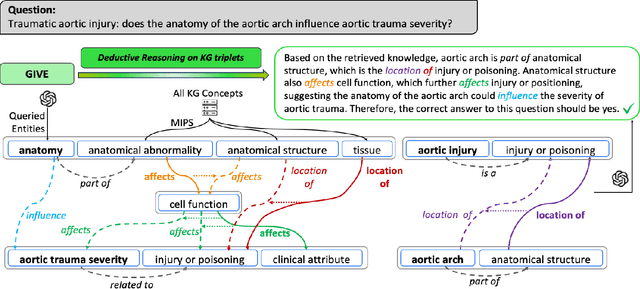
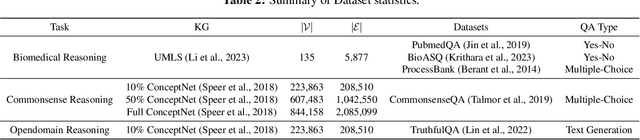
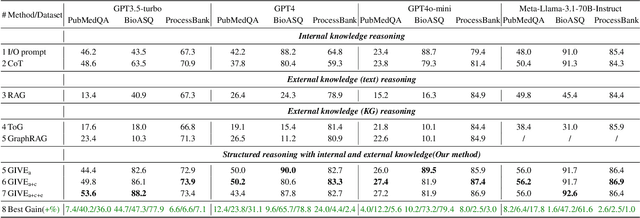
Existing retrieval-based reasoning approaches for large language models (LLMs) heavily rely on the density and quality of the non-parametric knowledge source to provide domain knowledge and explicit reasoning chain. However, inclusive knowledge sources are expensive and sometimes infeasible to build for scientific or corner domains. To tackle the challenges, we introduce Graph Inspired Veracity Extrapolation (GIVE), a novel reasoning framework that integrates the parametric and non-parametric memories to enhance both knowledge retrieval and faithful reasoning processes on very sparse knowledge graphs. By leveraging the external structured knowledge to inspire LLM to model the interconnections among relevant concepts, our method facilitates a more logical and step-wise reasoning approach akin to experts' problem-solving, rather than gold answer retrieval. Specifically, the framework prompts LLMs to decompose the query into crucial concepts and attributes, construct entity groups with relevant entities, and build an augmented reasoning chain by probing potential relationships among node pairs across these entity groups. Our method incorporates both factual and extrapolated linkages to enable comprehensive understanding and response generation. Extensive experiments on reasoning-intense benchmarks on biomedical and commonsense QA demonstrate the effectiveness of our proposed method. Specifically, GIVE enables GPT3.5-turbo to outperform advanced models like GPT4 without any additional training cost, thereby underscoring the efficacy of integrating structured information and internal reasoning ability of LLMs for tackling specialized tasks with limited external resources.