 Add to Chrome
 Add to Firefox
 Add to Edge
BrainDistill: Implantable Motor Decoding with Task-Specific Knowledge Distillation
Jan 24, 2026
Transformer-based neural decoders with large parameter counts, pre-trained on large-scale datasets, have recently outperformed classical machine learning models and small neural networks on brain-computer interface (BCI) tasks. However, their large parameter counts and high computational demands hinder deployment in power-constrained implantable systems. To address this challenge, we introduce BrainDistill, a novel implantable motor decoding pipeline that integrates an implantable neural decoder (IND) with a task-specific knowledge distillation (TSKD) framework. Unlike standard feature distillation methods that attempt to preserve teacher representations in full, TSKD explicitly prioritizes features critical for decoding through supervised projection. Across multiple neural datasets, IND consistently outperforms prior neural decoders on motor decoding tasks, while its TSKD-distilled variant further surpasses alternative distillation methods in few-shot calibration settings. Finally, we present a quantization-aware training scheme that enables integer-only inference with activation clipping ranges learned during training. The quantized IND enables deployment under the strict power constraints of implantable BCIs with minimal performance loss.

PDR: A Plug-and-Play Positional Decay Framework for LLM Pre-training Data Detection
Jan 11, 2026Detecting pre-training data in Large Language Models (LLMs) is crucial for auditing data privacy and copyright compliance, yet it remains challenging in black-box, zero-shot settings where computational resources and training data are scarce. While existing likelihood-based methods have shown promise, they typically aggregate token-level scores using uniform weights, thereby neglecting the inherent information-theoretic dynamics of autoregressive generation. In this paper, we hypothesize and empirically validate that memorization signals are heavily skewed towards the high-entropy initial tokens, where model uncertainty is highest, and decay as context accumulates. To leverage this linguistic property, we introduce Positional Decay Reweighting (PDR), a training-free and plug-and-play framework. PDR explicitly reweights token-level scores to amplify distinct signals from early positions while suppressing noise from later ones. Extensive experiments show that PDR acts as a robust prior and can usually enhance a wide range of advanced methods across multiple benchmarks.
Machine-Learning-Powered Neural Interfaces for Smart Prosthetics and Diagnostics
May 05, 2025Advanced neural interfaces are transforming applications ranging from neuroscience research to diagnostic tools (for mental state recognition, tremor and seizure detection) as well as prosthetic devices (for motor and communication recovery). By integrating complex functions into miniaturized neural devices, these systems unlock significant opportunities for personalized assistive technologies and adaptive therapeutic interventions. Leveraging high-density neural recordings, on-site signal processing, and machine learning (ML), these interfaces extract critical features, identify disease neuro-markers, and enable accurate, low-latency neural decoding. This integration facilitates real-time interpretation of neural signals, adaptive modulation of brain activity, and efficient control of assistive devices. Moreover, the synergy between neural interfaces and ML has paved the way for self-sufficient, ubiquitous platforms capable of operating in diverse environments with minimal hardware costs and external dependencies. In this work, we review recent advancements in AI-driven decoding algorithms and energy-efficient System-on-Chip (SoC) platforms for next-generation miniaturized neural devices. These innovations highlight the potential for developing intelligent neural interfaces, addressing critical challenges in scalability, reliability, interpretability, and user adaptability.
A Unified Search and Recommendation Framework Based on Multi-Scenario Learning for Ranking in E-commerce
May 17, 2024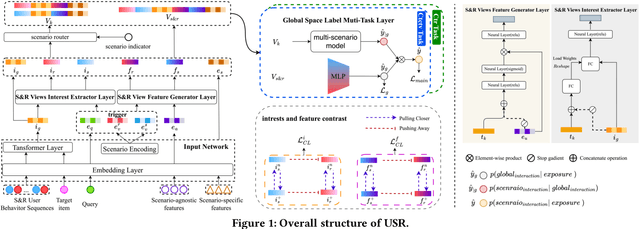

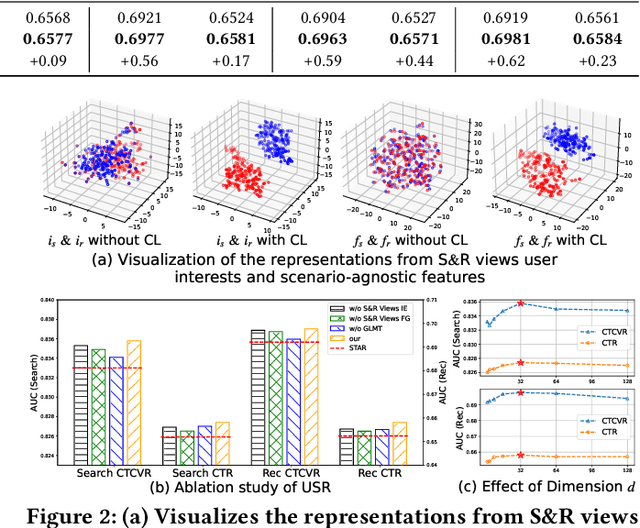
Search and recommendation (S&R) are the two most important scenarios in e-commerce. The majority of users typically interact with products in S&R scenarios, indicating the need and potential for joint modeling. Traditional multi-scenario models use shared parameters to learn the similarity of multiple tasks, and task-specific parameters to learn the divergence of individual tasks. This coarse-grained modeling approach does not effectively capture the differences between S&R scenarios. Furthermore, this approach does not sufficiently exploit the information across the global label space. These issues can result in the suboptimal performance of multi-scenario models in handling both S&R scenarios. To address these issues, we propose an effective and universal framework for Unified Search and Recommendation (USR), designed with S&R Views User Interest Extractor Layer (IE) and S&R Views Feature Generator Layer (FG) to separately generate user interests and scenario-agnostic feature representations for S&R. Next, we introduce a Global Label Space Multi-Task Layer (GLMT) that uses global labels as supervised signals of auxiliary tasks and jointly models the main task and auxiliary tasks using conditional probability. Extensive experimental evaluations on real-world industrial datasets show that USR can be applied to various multi-scenario models and significantly improve their performance. Online A/B testing also indicates substantial performance gains across multiple metrics. Currently, USR has been successfully deployed in the 7Fresh App.