 Add to Chrome
 Add to Firefox
 Add to Edge
Cross-Modal Memory Compression for Efficient Multi-Agent Debate
Jan 31, 2026
Multi-agent debate can improve reasoning quality and reduce hallucinations, but it incurs rapidly growing context as debate rounds and agent count increase. Retaining full textual histories leads to token usage that can exceed context limits and often requires repeated summarization, adding overhead and compounding information loss. We introduce DebateOCR, a cross-modal compression framework that replaces long textual debate traces with compact image representations, which are then consumed through a dedicated vision encoder to condition subsequent rounds. This design compresses histories that commonly span tens to hundreds of thousands of tokens, cutting input tokens by more than 92% and yielding substantially lower compute cost and faster inference across multiple benchmarks. We further provide a theoretical perspective showing that diversity across agents supports recovery of omitted information: although any single compressed history may discard details, aggregating multiple agents' compressed views allows the collective representation to approach the information bottleneck with exponentially high probability.

Towards a Robust Retrieval-Based Summarization System
Mar 29, 2024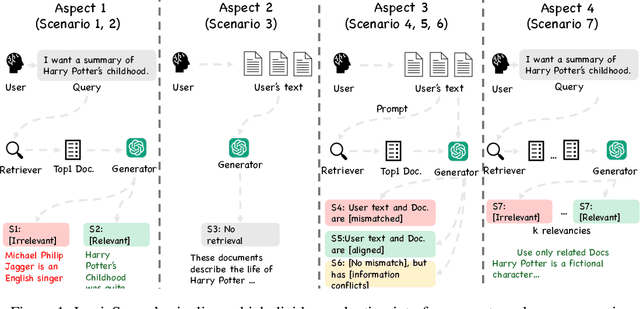
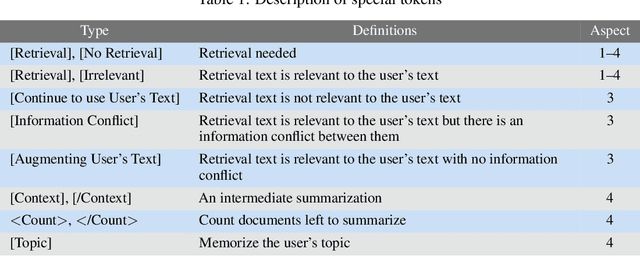
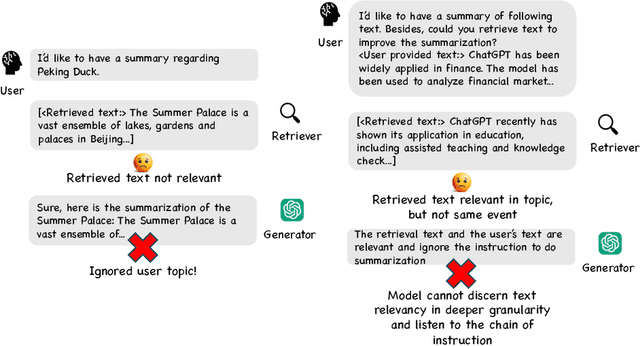
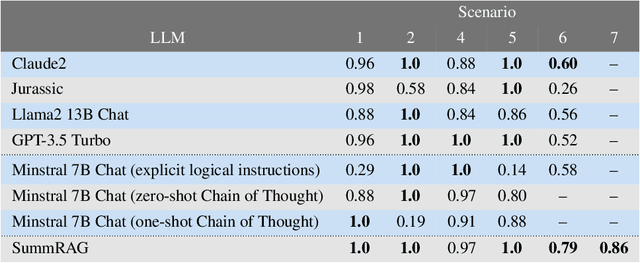
This paper describes an investigation of the robustness of large language models (LLMs) for retrieval augmented generation (RAG)-based summarization tasks. While LLMs provide summarization capabilities, their performance in complex, real-world scenarios remains under-explored. Our first contribution is LogicSumm, an innovative evaluation framework incorporating realistic scenarios to assess LLM robustness during RAG-based summarization. Based on limitations identified by LogiSumm, we then developed SummRAG, a comprehensive system to create training dialogues and fine-tune a model to enhance robustness within LogicSumm's scenarios. SummRAG is an example of our goal of defining structured methods to test the capabilities of an LLM, rather than addressing issues in a one-off fashion. Experimental results confirm the power of SummRAG, showcasing improved logical coherence and summarization quality. Data, corresponding model weights, and Python code are available online.