 Add to Chrome
 Add to Firefox
 Add to Edge
Plug-and-Adapt: Multimodal Coreference Resolution at First Sight with a Pretrained Alignment Model
Jun 16, 2026
Visual information helps resolve ambiguity in coreference resolution, leading to notable performance gains. However, existing Multi-modal Coreference Resolution (MCR) methods require training with (partially) annotated data from the target dataset before they can be applied, preventing their direct usability and raising concerns about generalization. While Vision-Language Large Models (VLLMs) with billions of parameters offer promising zero-shot capabilities, they remain largely inaccessible. Their massive size limits deployability, and many are only accessible through paid APIs. In this paper, we propose a plug-and-adapt method that strategically adapts a carefully pre-trained \emph{alignment model} for immediate use in MCR tasks, designed to eliminate the need for training on scarce benchmark datasets or relying on resource-intensive VLLMs. Specifically, we first pre-train a fine-grained alignment model between textual and visual contextual information using vision-language alignment datasets. We then repurpose the alignment model to MCR through similarity aggregation by fusing visual and categorical cues with evidence theory, thereby enhancing effectiveness. Experiments on the Coreference Image Narratives (CIN) benchmark dataset demonstrate the effectiveness of our method, achieving a 5.31\% and 2.12\% improvement in CoNLL F1 over SOTA dedicated methods and popular VLLMs, respectively. We further evaluate our method on a masked CIN dataset for robustness testing and on a specially constructed VCR-MCR dataset for generalization assessment, with results confirming both capabilities.

SCOUT-RAG: Scalable and Cost-Efficient Unifying Traversal for Agentic Graph-RAG over Distributed Domains
Feb 09, 2026Graph-RAG improves LLM reasoning using structured knowledge, yet conventional designs rely on a centralized knowledge graph. In distributed and access-restricted settings (e.g., hospitals or multinational organizations), retrieval must select relevant domains and appropriate traversal depth without global graph visibility or exhaustive querying. To address this challenge, we introduce \textbf{SCOUT-RAG} (\textit{\underline{S}calable and \underline{CO}st-efficient \underline{U}nifying \underline{T}raversal}), a distributed agentic Graph-RAG framework that performs progressive cross-domain retrieval guided by incremental utility goals. SCOUT-RAG employs four cooperative agents that: (i) estimate domain relevance, (ii) decide when to expand retrieval to additional domains, (iii) adapt traversal depth to avoid unnecessary graph exploration, and (iv) synthesize the high-quality answers. The framework is designed to minimize retrieval regret, defined as missing useful domain information, while controlling latency and API cost. Across multi-domain knowledge settings, SCOUT-RAG achieves performance comparable to centralized baselines, including DRIFT and exhaustive domain traversal, while substantially reducing cross-domain calls, total tokens processed, and latency.
AVE Speech Dataset: A Comprehensive Benchmark for Multi-Modal Speech Recognition Integrating Audio, Visual, and Electromyographic Signals
Jan 28, 2025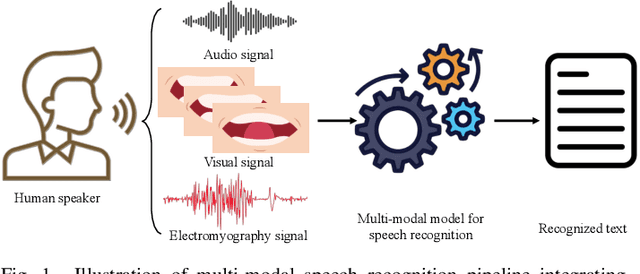
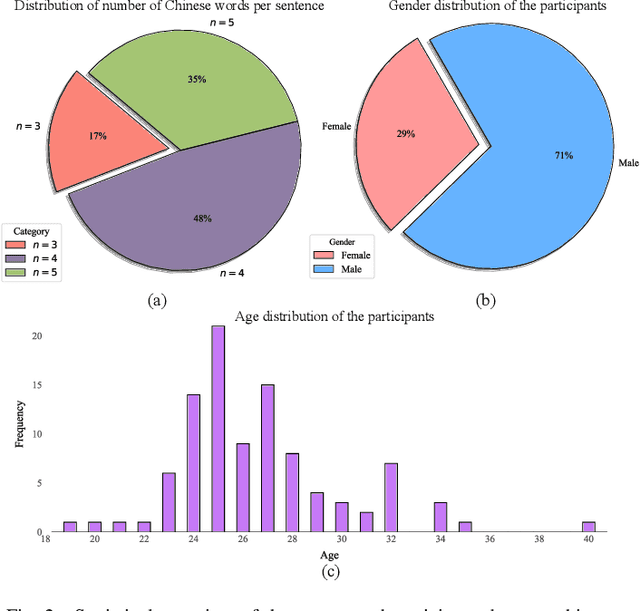
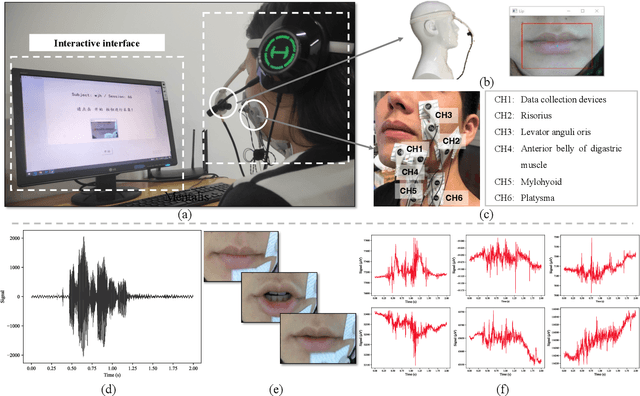
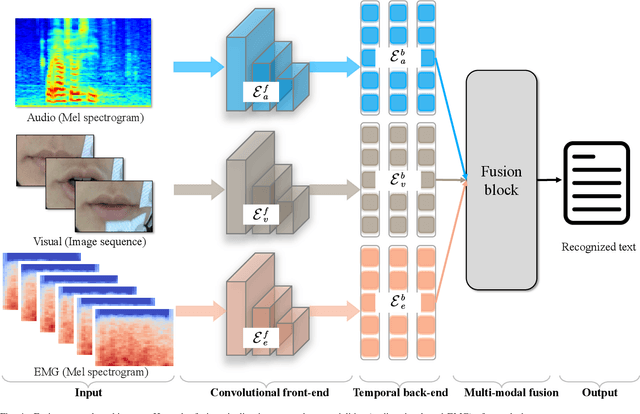
The global aging population faces considerable challenges, particularly in communication, due to the prevalence of hearing and speech impairments. To address these, we introduce the AVE speech dataset, a comprehensive multi-modal benchmark for speech recognition tasks. The dataset includes a 100-sentence Mandarin Chinese corpus with audio signals, lip-region video recordings, and six-channel electromyography (EMG) data, collected from 100 participants. Each subject read the entire corpus ten times, with each sentence averaging approximately two seconds in duration, resulting in over 55 hours of multi-modal speech data per modality. Experiments demonstrate that combining these modalities significantly improves recognition performance, particularly in cross-subject and high-noise environments. To our knowledge, this is the first publicly available sentence-level dataset integrating these three modalities for large-scale Mandarin speech recognition. We expect this dataset to drive advancements in both acoustic and non-acoustic speech recognition research, enhancing cross-modal learning and human-machine interaction.