 Add to Chrome
 Add to Firefox
 Add to Edge
RubRIX: Rubric-Driven Risk Mitigation in Caregiver-AI Interactions
Jan 19, 2026
Caregivers seeking AI-mediated support express complex needs -- information-seeking, emotional validation, and distress cues -- that warrant careful evaluation of response safety and appropriateness. Existing AI evaluation frameworks, primarily focused on general risks (toxicity, hallucinations, policy violations, etc), may not adequately capture the nuanced risks of LLM-responses in caregiving-contexts. We introduce RubRIX (Rubric-based Risk Index), a theory-driven, clinician-validated framework for evaluating risks in LLM caregiving responses. Grounded in the Elements of an Ethic of Care, RubRIX operationalizes five empirically-derived risk dimensions: Inattention, Bias & Stigma, Information Inaccuracy, Uncritical Affirmation, and Epistemic Arrogance. We evaluate six state-of-the-art LLMs on over 20,000 caregiver queries from Reddit and ALZConnected. Rubric-guided refinement consistently reduced risk-components by 45-98% after one iteration across models. This work contributes a methodological approach for developing domain-sensitive, user-centered evaluation frameworks for high-burden contexts. Our findings highlight the importance of domain-sensitive, interactional risk evaluation for the responsible deployment of LLMs in caregiving support contexts. We release benchmark datasets to enable future research on contextual risk evaluation in AI-mediated support.

From Text to Visuals: Using LLMs to Generate Math Diagrams with Vector Graphics
Mar 10, 2025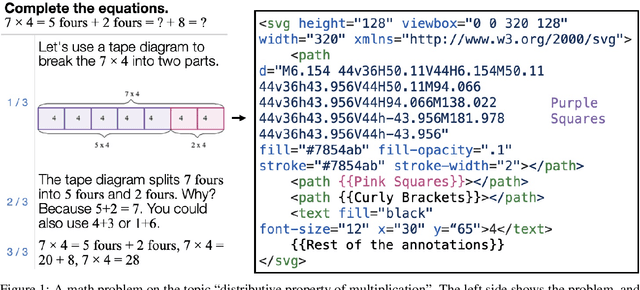
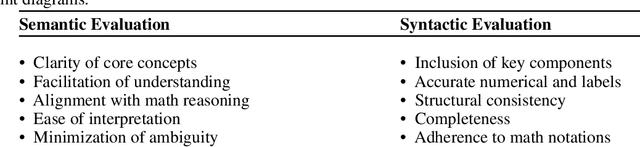
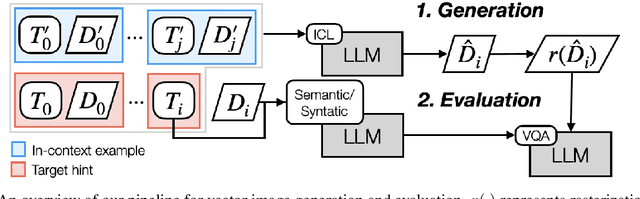
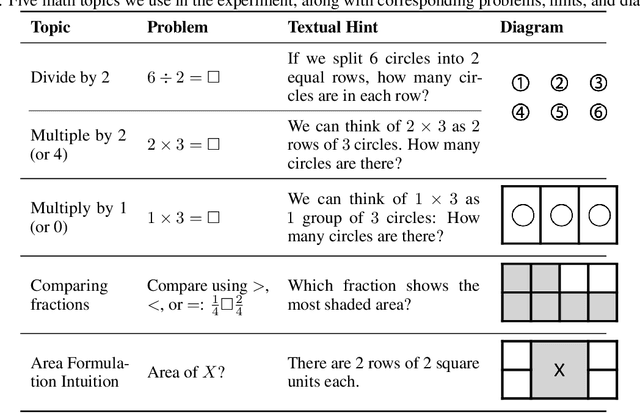
Advances in large language models (LLMs) offer new possibilities for enhancing math education by automating support for both teachers and students. While prior work has focused on generating math problems and high-quality distractors, the role of visualization in math learning remains under-explored. Diagrams are essential for mathematical thinking and problem-solving, yet manually creating them is time-consuming and requires domain-specific expertise, limiting scalability. Recent research on using LLMs to generate Scalable Vector Graphics (SVG) presents a promising approach to automating diagram creation. Unlike pixel-based images, SVGs represent geometric figures using XML, allowing seamless scaling and adaptability. Educational platforms such as Khan Academy and IXL already use SVGs to display math problems and hints. In this paper, we explore the use of LLMs to generate math-related diagrams that accompany textual hints via intermediate SVG representations. We address three research questions: (1) how to automatically generate math diagrams in problem-solving hints and evaluate their quality, (2) whether SVG is an effective intermediate representation for math diagrams, and (3) what prompting strategies and formats are required for LLMs to generate accurate SVG-based diagrams. Our contributions include defining the task of automatically generating SVG-based diagrams for math hints, developing an LLM prompting-based pipeline, and identifying key strategies for improving diagram generation. Additionally, we introduce a Visual Question Answering-based evaluation setup and conduct ablation studies to assess different pipeline variations. By automating the math diagram creation, we aim to provide students and teachers with accurate, conceptually relevant visual aids that enhance problem-solving and learning experiences.